
Marketing teams work hard to keep their messaging consistent, because customer trust depends on it.
In higher education, that consistency carries even more weight. A single inaccurate message about pricing, partnerships, or program eligibility isn’t just a brand issue; it can trigger regulatory scrutiny.
Here’s a real life example: in 2019, the University of Phoenix agreed to a record $191 million FTC settlement after allegations that it misled students about career opportunities and tuition costs.
That cautionary tale reinforces Southern New Hampshire University (SNHU)’s commitment to OMB Uniform Guidance: Single Audit, NECHE & National Council for State Authorization Reciprocity Agreements, and Title IV compliance. Every student-facing email, campaign, and message tied to pricing, program offerings, military, and other partnerships must be accurate and provable, even when achieving that level of rigor at one point demanded 40 hours of manual audits annually.
Let’s take a look at how SNHU’s marketing operations team transformed their critical compliance process into a trusted, automated email engine.
A painful, manual compliance process
When Rachel Cusumano joined SNHU’s marketing ops team, compliance was still a manual process. Educational pricing updates were made by hand. Salesforce sync issues periodically broke email sequences. And every six months, the team had to essentially shut down to complete mandatory audits.
The results affected a ton of other teams, including academic programs, partnerships, and military education teams, who operated on separate timelines, with different requirements and questions.
What they all wanted was the same thing: confidence. Confidence that the data was correct, that their messaging was compliant, and that the university could prove it to their third-party stakeholders when asked.
“Data is the gold mine of an organization,” Cusumano says.
But at SNHU, that gold was buried under manual processes, undocumented dependencies, and workflows that were completely opaque to other teams, not to mention stakeholders.
To illustrate how entrenched the problem was, the team would give it to every new hire as a challenge.
No one ever solved it—and they weren’t expected to. But the exercise brought new hires deep into the inner workings of SNHU’s marketing ops. Weeks later, they would emerge with a hard-earned understanding of the university’s marketing stack and the complexity of its compliance workflows.
When lightweight automation stops being enough
Before Cusumano introduced Workato, and foundationally reshaped how the marketing team approached integration and automation, SNHU was operating with an email marketing stack that may look familiar:
- Airtable
- Salesforce
- Salesforce Marketing Cloud (notoriously difficult to automate)
- FormAssembly
Because the team relied on manual SQL, only highly technical people could access data. But when non-technical people needed answers to questions like “Where does pricing appear?” “Which emails reference payment?” and “What data flows into Marketing Cloud?,” they couldn’t get them.
There was just no way to answer complex questions without pulling the team into one-off work.
How Workato adds visibility to compliance
Faced with this system-wide, cross-functional challenge, Cusumano knew the only way forward was to bring structure and visibility to her team’s process. Because every member on her team had faced down the complexity of the compliance workflows during onboarding, they were able to document:
- Every email segment by student type and program
- The messages sent to each segment
- Automated sequences vs. one-off sends
- Each handoff between Salesforce and Marketing Cloud
- The points where compliance needed to be verified to proceed
Cusumano mapped everything in SFMC data extensions, and then visualized them in Airtable, creating a shared view of how data moved across the marketing stack. At that point, she knew she could automate 100% of the compliance process.
It was a high stakes approach.
“If it’s wrong, there are legal ramifications,” Cusumano explains.
To pull this off, Cusumano needed an automation platform she could trust. She replaced brittle native automations and manual scripts with Workato—a much more structured, governed approach to integration and automation. It provided the features necessary to orchestrate compliance at a high level.
Workato allowed her team to:
- Tap into Marketing Cloud’s difficult-to-access APIs
- Centralize logic instead of scattering it across scripts
- Create processes that could be explained to auditors and legal
- Build trust that data updates were happening correctly, every time
Instead of constantly reacting to broken syncs or the next audit, the team could finally step back and visualize how data moved end to end. This view made it possible to build workflows intentionally.
The results: How Workato built trust
The most obvious win was time saved.
The burden of each audit dropped dramatically. A process that used to shut down Cusumano’s team every six months was now easy to maintain without pausing other projects, because it was automated.
But the bigger win was confidence.
For the first time, the marketing ops team could verify email compliance on the spot, and answer whatever questions came up with to-the-minute data. For cross-functional teams:
- Compliance audits were no longer blockers.
- Broken sequences were no longer a recurring crisis.
- And non-technical employees could find data.
News traveled fast.
“Teams I didn’t even know existed started pinging me,” admits Cusumano.
Employees who had never been part of the conversation before were now able to pull data for their stakeholders. The automation increased the entire university’s trust in its compliance methods.
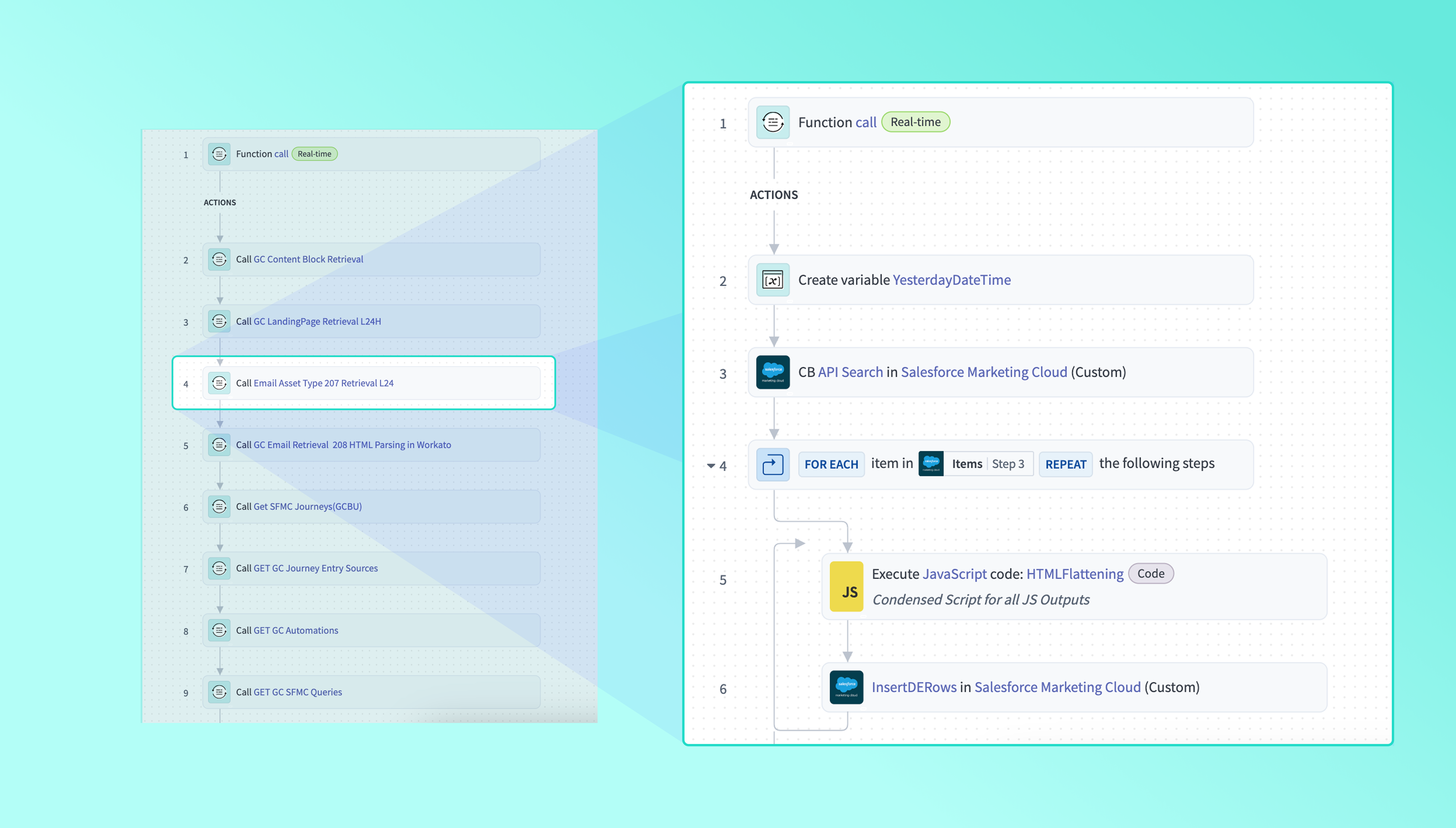
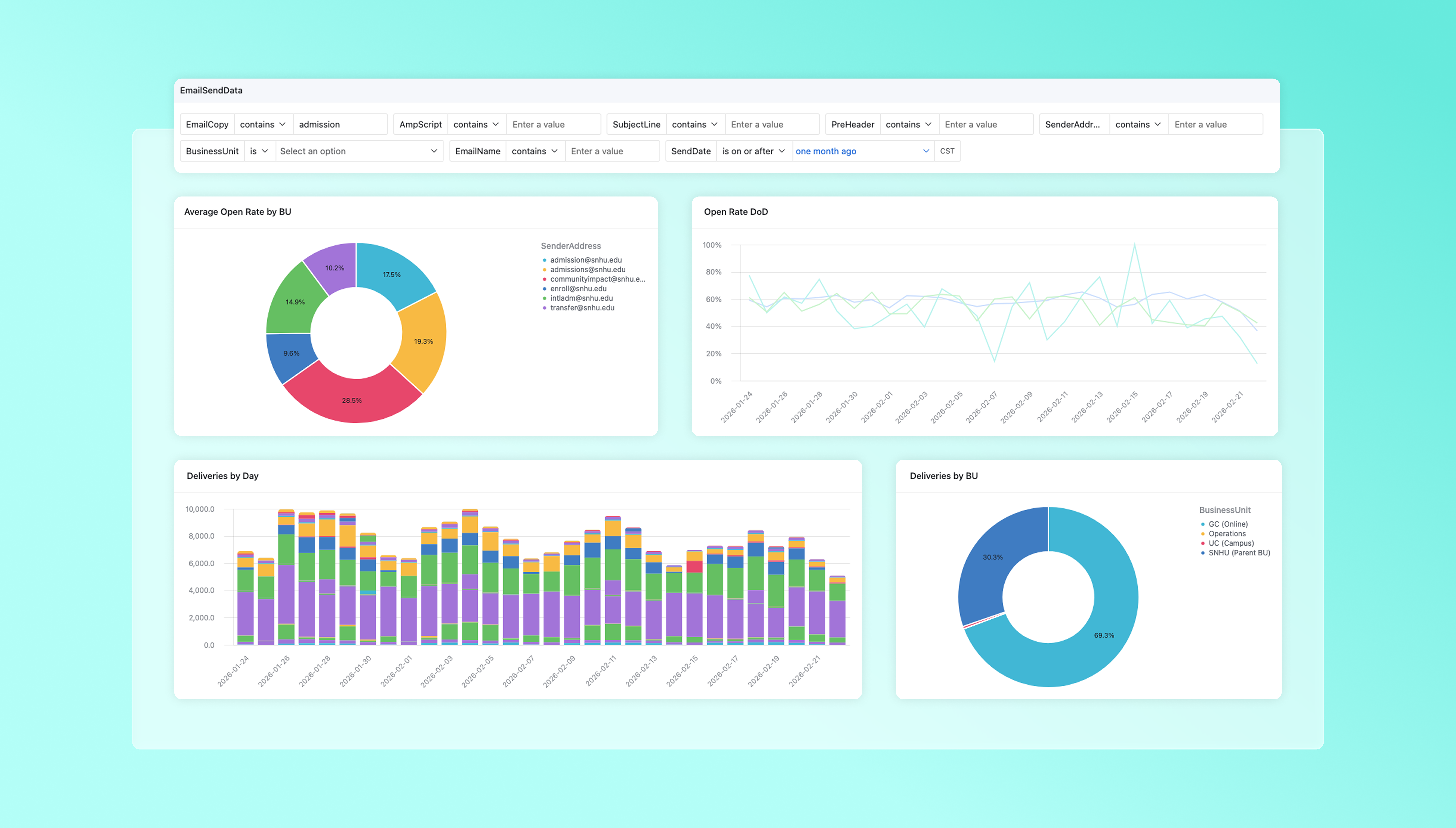
Here’s what the new audit on demand process looks like, just a simple text-based search:
A new model for marketing ops
Rachel’s story highlights a shift many ops teams are starting to make. Marketing ops isn’t just about keeping systems running. It’s about building a data foundation the entire organization can rest on.
That means:
- Treating documentation as a strategic asset
- Building automations with compliance in mind
- Choosing platforms that scale beyond one-off use cases
- Thinking holistically about data, not just individual problems
At SNHU, that mindset turned a process that was painful for everyone into a durable, trusted email engine.
Where AI fits (and where it doesn’t)
Rachel is thoughtful about how AI fits into this ecosystem.
Her team makes deliberate choices:
- Use standard scripting for deterministic, compliance-sensitive logic
- Use AI for higher-level reasoning, pattern recognition, and ideation
- Only give AI access to data when it’s explicitly required
The goal is not faster automation at any cost, but better decisions supported by reliable data. At the same time, there is a dual imperative between needing quality data to train AI and needing AI to interpret data.
The next step, says Rachel, will be adopting AI to monitor and improve key compliance steps.
The takeaway
If your team spends more time proving data is correct than using it…
If completing an audit feels like a caving expedition…
If what you have now keeps breaking…
The issue probably isn’t effort or talent. It’s structure.
Rachel Cusumano’s work at SNHU shows what happens when ops teams step back, document what they have, and rebuild with intention.
If data is the gold mine of your organization, automation is the process that brings it to the surface.