Prince Retail Group (PRG) has spent over three decades building a retail network across the Philippine archipelago that most competitors would never attempt. With 70-plus stores reaching into the suburbs, mountain provinces, and island communities of Luzon, Visayas and Mindanao, PRG serves the base of the Philippine socio-economic pyramid: lower-income households that comprise more than 85% of the population. Its “One Town, One Prince” expansion strategy targets places where no other retail presence exists, and where families would otherwise travel hours to access basic necessities.
When Christopher Calalang joined as Associate Director of IT and Data Services, PRG was already investing across demand forecasting, pricing optimisation, cloud infrastructure, and e-commerce. The ambition was clear: push PRG from a traditional retailer into a retail tech company. The challenge was that the integration infrastructure connecting that growing ecosystem of platforms had not kept pace with the business.
“In my first week, I was already waking up at 3AM, 4AM because there were issues with the integration,” Chris recalls. “By eight o’clock when the users come in, data is not there. We can’t actually place an order for our procure-to-pay process.” In plain terms: the system that tells PRG what to buy, from whom, and for which stores was breaking down before anyone arrived at work.
For a retailer whose mission is delivering affordable goods to communities across 7,000 islands, many without proper roads or reliable internet, the stakes of reliable data go far beyond a performance dashboard. Leaving shelves empty is “a mortal sin”, explains Chris.
When Ambition Outpaces Infrastructure
PRG’s integration architecture still relied on an on-premise data warehouse platform that was never designed to operate as a real-time integration layer. Data moved between systems through scheduled file transfers that could time out without warning. The underlying servers, shared across multiple workloads, regularly hit capacity limits overnight. The team had no visibility into whether critical data had actually been delivered.
As PRG pushes toward 100-plus stores by 2030, their integration layer needed to evolve as fast as the business it supported.
Chris’s mandate from PRG’s young generation of founders was unambiguous: make IT the engine that propels the company toward becoming the most digital brick-and-mortar retailer in the Philippines.
Connecting the Supply Chain, Starting with Procurement
The first Workato implementation targeted the most critical fracture point in PRG’s supply chain: the data pipeline between its Relex planning and forecasting platform and its merchandising system.
Each night, Relex generates purchase recommendations across 75-plus stores and 40,000 individual products, signalling which items to reorder based on historical sales, inventory levels, and demand patterns. That data must reach merchandisers before the working day begins. Under the legacy system, scheduled file transfers timed out silently, leaving 15% of critical procurement data undelivered on any given day.
Chris framed the business case for the board in terms they understood immediately. Fifteen percent data unavailability translated directly to sales opportunity lost and profit forgone. The board presentation lasted fifteen minutes.
“When you have that number, showing that we’re losing sales because data was not available, versus the investment in Workato, the rest was just history,” Chris says.
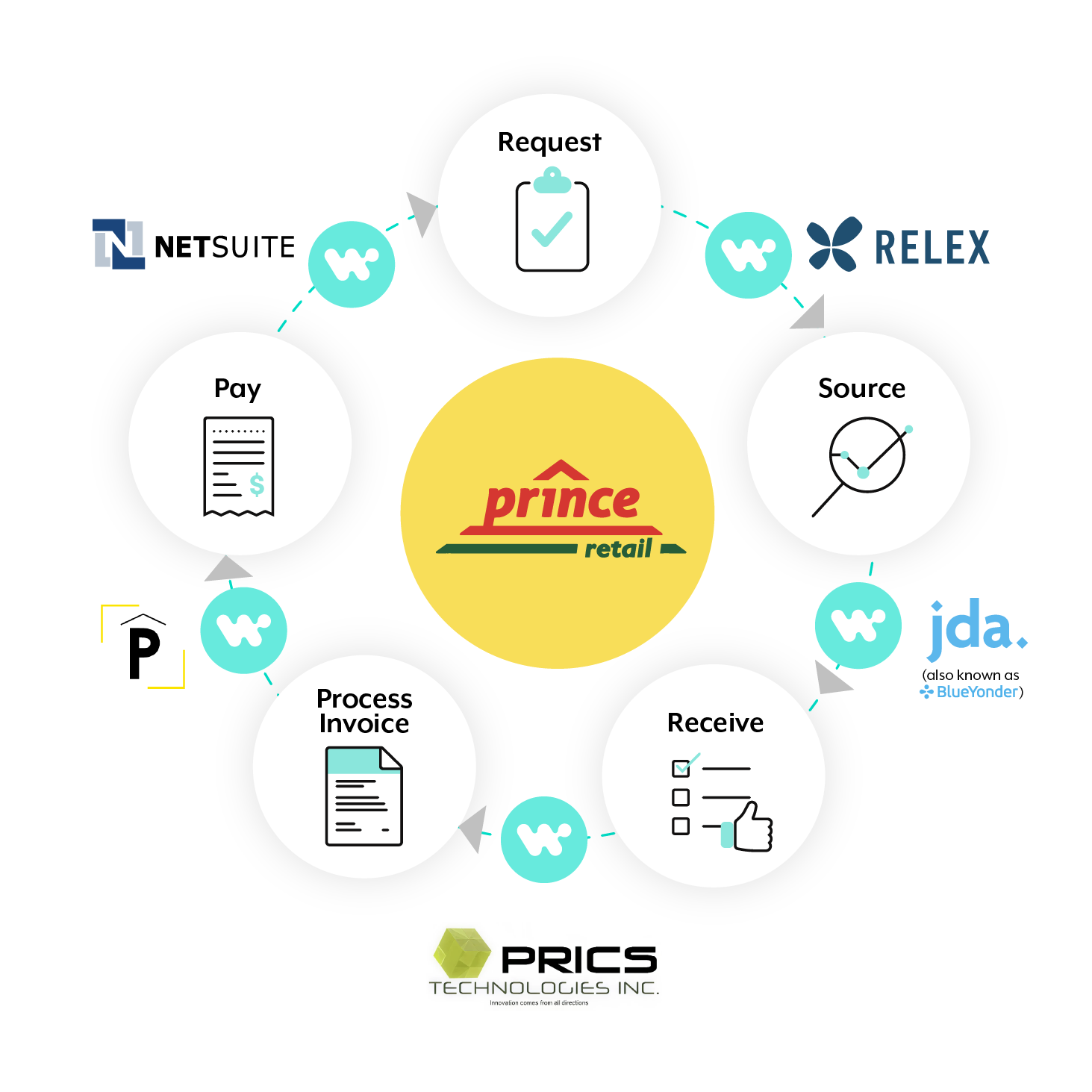
Here’s a snapshot of the envisioned solution:

A Workato implementation partner built the initial integration in roughly two months. The results arrived fast.
A Retail Tech Company Takes Shape
PRG experienced a huge shift. Data availability leapt from 85% to 97-98% within one month of deployment. But the organisational transformation runs deeper.
Six certified integration builders quickly emerged within PRG’s 104-person IT and Data Services team. Chris drove platform adoption through a gamified certification challenge over the 2025 Christmas holidays, offering prizes for the most Workato Academy completions. The winner earned 15 certifications.
“Nobody wants to study, right?” Chris laughs. “So we gamified it so that they want to attend school to level up.”
The team no longer depends on external partners for every integration build. Internal capability means faster iteration, broader coverage, and a foundation that can absorb the complexity of PRG’s growth trajectory.
From Procurement to Full Procure-to-Pay and Beyond
Chris has mapped a three-year roadmap that extends Workato’s reach across PRG’s entire purchasing lifecycle, from the moment a product is ordered to the moment the supplier is paid. Year one addresses procurement. Year two involves connecting distribution centre and warehouse systems for logistics orchestration, and year three brings payment partners and NetSuite ERP into the integrated fabric, completing the end-to-end cycle.
Beyond operational integration, PRG is building toward an AI-ready architecture. The team is constructing a private LLM in the cloud, fed with clean, governed data, and laying the groundwork for agentic capabilities that could automate decision-making across the supply chain.
“We’re building the foundation first,” Chris says. “The right data, without hallucination. Once we have that, we can move into agentic territory.”
For a retailer serving communities that most technology narratives never reach, PRG’s trajectory redefines what digital transformation looks like when the stakes are measured not just in revenue, but in access. Every integration that holds, every data transfer that completes on time, brings essential goods one step closer to the families who need them most.