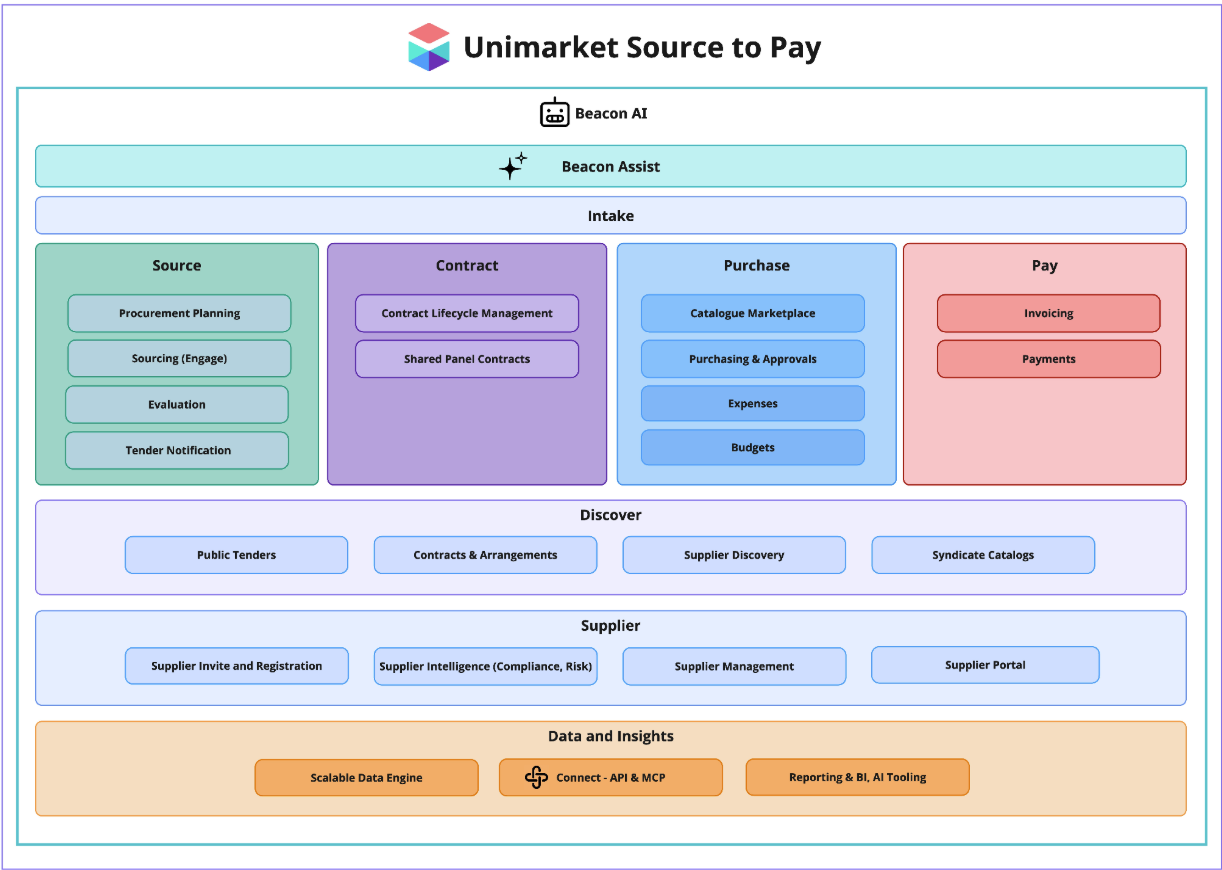
Procurement teams across the globe share a common frustration: the systems they rely on rarely speak the same language. Purchase orders live on one platform. Invoices in another. Supplier data scattered across spreadsheets, ERPs, and legacy file transfers that belong to a different decade.
For Unimarket, a source-to-pay platform serving nearly 450 customers across Australia, New Zealand, Canada and North America, solving this connectivity problem is one of the key ways they deliver value to their users. Their platform covers the entire procurement lifecycle, from sourcing and contract management through to purchasing, invoicing, and supplier management. What sets Unimarket apart is how closely they work with suppliers throughout that lifecycle. The company dedicates resources to supplier activation and ongoing engagement, an approach their customers have dubbed “hypercare.”
That philosophy led Unimarket to Workato.
When Flat Files Hit a Ceiling
Unimarket’s customer base stretches from regional local councils to global enterprises. Each organisation brings its own technology stack, security posture, and data requirements. Before Workato, Unimarket relied on native integration tooling within Google Cloud and Microsoft Azure, where their platforms were hosted. For straightforward flat file transfers, those tools worked.
The problems began when customers needed more: data transformation between legacy formats and modern APIs, real-time synchronisation across ERP, HR, and business intelligence systems, secure and auditable connections that satisfied both procurement leaders and IT teams. The existing approach buckled under that weight.
“We needed a more robust method to integrate with the various types of organisations we deal with,” Dale explains. A former IT professional turned sales leader, he uses the word “robust” as a deliberate bridge between two audiences: procurement stakeholders who think in terms of process compliance, and technical teams focused on API governance.
Integration That Scales with Customers
After evaluating Boomi, MuleSoft, and Jitterbit, Unimarket selected Workato. “Both MuleSoft and Jitterbit felt legacy,” says Dale. “Workato is robust yet easy to use, and we wanted somewhat technical staff to be able to build integrations without needing to involve developers.”
Unimarket now offers Workato as an optional, embedded integration layer within its procurement platform. Customers can opt in at any point, priced as a subscription add-on based on modules and integration points: supplier records, delegation of authority data sources, transaction flows, and more.
The architecture connects Unimarket’s source-to-pay platform with customer systems across four data streams: master data (GL accounts, approvals, users, suppliers), validation (accounting and budgets), transactions (requisitions, orders, receipts, invoices, payments), and authentication (SSO via SAML). On the other side sit the customer’s finance ERP, identity management, BI tools, data warehouses, and adjacent systems:

This connectivity powers Unimarket’s “hypercare” promise at the data level. Through Workato, the platform pulls in external information, from ESG scores to tax identification numbers for TIN matching, and surfaces it directly within the buying experience. Procurement users who once chased a dozen separate sources now find that intelligence already inside Unimarket.
For customers with in-house IT capability, Unimarket provides access to the Workato environment. For those without, Unimarket’s team configures connections directly. “Typically, we hand over to the customer more than doing it ourselves,” Dale notes. “We get our data to a certain level, then provide them with Workato to finalise the other end.” Enterprise clients expect autonomy while mid-market organisations benefit from guided implementation. Unimarket operates comfortably across that spectrum.
Integration as a Sales Advantage
Before Workato, integration was what Dale calls “this big mountain that not a lot of people feel they can climb.” Prospective customers requested workshops and proof-of-concept exercises before committing, adding time and cost to every sales cycle.
With Workato embedded in the platform, those conversations have changed shape. “It mitigates red flags and problems early on,” Dale says. “We can make sure the system works from a functional perspective. Then we dig into the technical details once they’ve made that decision.”
Customers who have been through the process become references for new prospects.
“If a customer says the same thing about ease of use, speed, and delivery, it means much more coming from them than from me,” Dale adds. “That trust comes from the success of your tool and us delivering.”
For Unimarket’s integration team, the shift is equally significant. “Integration was seen as a very technical problem, and once built, a hassle to maintain,” Dale reflects. “Now the integration team almost never needs to engage the engineering team and is able to maintain on-premise agents with ease.”
Here’s a snapshot of Unimarket’s end-to-end procure-to-pay flow with integration options and methods:

Beacon AI, MCP, and Peppol Readiness
Unimarket has launched Beacon AI, a purpose-built AI engine embedded across its source-to-pay platform. Rather than retrofitting a chatbot, the team designed Beacon AI as a foundational layer that multiple modules can draw from.
“We didn’t just want a chatbot so we could say it’s AI-enabled,” Dale says. “We invested the time to build an engine we can tap into from all modules. Now we deploy functional cases much quicker by tapping into the engine that’s already there.”
Plans for a Model Context Protocol (MCP) layer are on the roadmap, connecting Unimarket with external AI platforms and large language models. “I believe Workato will play a part in there for us,” Dale says, “helping connect other systems for our clients.”
Running parallel is a regulatory shift: Australia’s Peppol e-invoicing mandate. By mid-2026, at least 30% of supplier invoices to Commonwealth agencies must flow through the Peppol network, with full automation required by December 2026. For a procurement platform spanning public and private sector clients, readiness for this is a strategic and operational priority.
For Unimarket, integration was never the product. It was the connective tissue that makes intelligent, impactful procurement possible. With Workato woven into that foundation, the company is closer than ever to its vision: empowering organisations to unlock the full power of good and fair procurement.