Shared services teams in asset-heavy industries carry a paradox. They process thousands of transactions that keep operations running, yet they are seldom recognised as strategic. For one global leader in energy-related maritime solutions, operating 114 vessels across LNG, petroleum, and offshore engineering with a workforce of more than 9,000, their Finance Shared Services Centre (FSSC) was determined to rewrite that story.
What began as a stabilisation effort after a complex finance transformation has become a blueprint for how shared services can leapfrog from manual processing into AI-augmented operations. In under 12 months, the FSSC partnered with its ICT team, Workato, and implementation partner iSteer to deploy intelligent document processing (IDP) for invoice validation and to automate bank reconciliation workflows that had consumed entire teams.
Invoice verification cycle times fell by 75%, manual processing hours dropped by 70%, and month-end bank reconciliation submissions accelerated by 14 days.
Finance became the launchpad for enterprise-wide agentic AI.
99,000 Invoices, 4 Business Units, and a Finance Team at Breaking Point
The company’s finance transformation journey began with the rollout of a new operating model across four business units in the first wave. The scope was sweeping: redesigned processes, new platforms, migrated data flows, and a redefined mandate for the FSSC to serve as a strategic partner rather than a back-office function.
On paper, the plan was sound. In practice, the months following go-live exposed critical pressure points.
The FSSC team was stretched thin. Invoice processing alone spanned more than 99,000 invoices per annum across four business units. Verification of each invoice required roughly three minutes of manual effort: matching source documents, cross-referencing procurement data in Coupa, and keying information into the ERP. Multiply that by tens of thousands of transactions and the arithmetic becomes punishing.
Bank reconciliation told a similar story. For a single business unit, three to four resources were dedicated to a process so time-consuming that month-end submissions routinely dragged from the first week into the third. Business stakeholders could not close their books. The FSSC’s credibility as a transformation partner was at stake.
The company had already invested in Workato as its enterprise integration and orchestration platform, having migrated years earlier from an ageing BizTalk environment that was complex, costly, and not built for the cloud. With that foundation in place, the question was not whether to automate, but where to start.
Intelligent Document Processing and Automated Reconciliation
The FSSC, ICT team, Workato, and their implementation partner, iSteer, zeroed in on two high-impact processes where automation could deliver measurable relief.
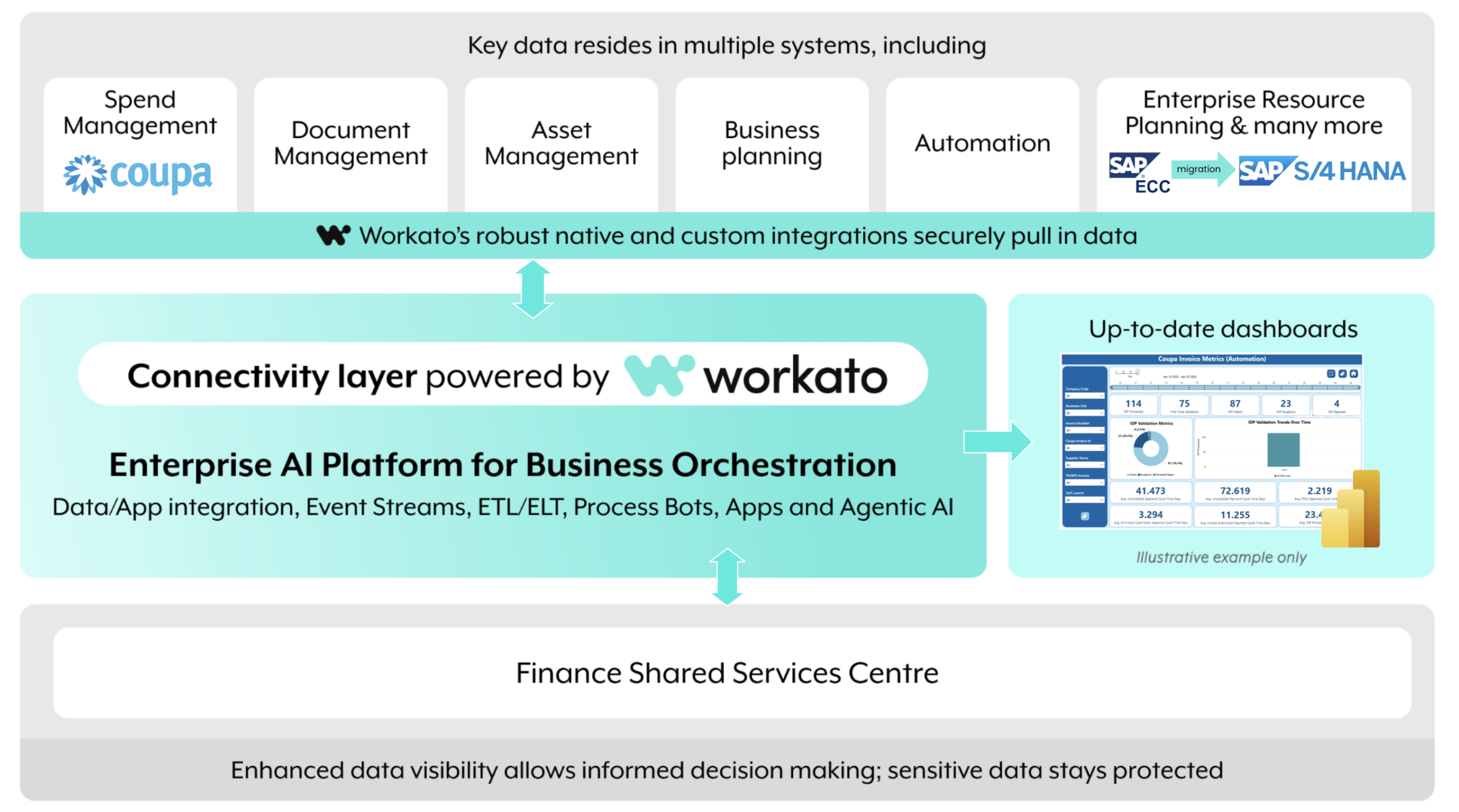
Accounts Payable (AP) Invoice Processing with IDP
The team deployed Workato’s Intelligent Document Processing capability, powered by OpenAI, to automate the first half of the invoice verification workflow. The process works in three stages.
When a vendor submits an invoice through Coupa, Workato’s IDP layer scans the document image and extracts key data fields. A matching engine then compares the extracted values against the corresponding records in Coupa. Where values align, the invoice proceeds automatically to the next approver in the chain. Where discrepancies surface, the system routes the invoice into an exception queue for manual review or flags it for dispute with the vendor.
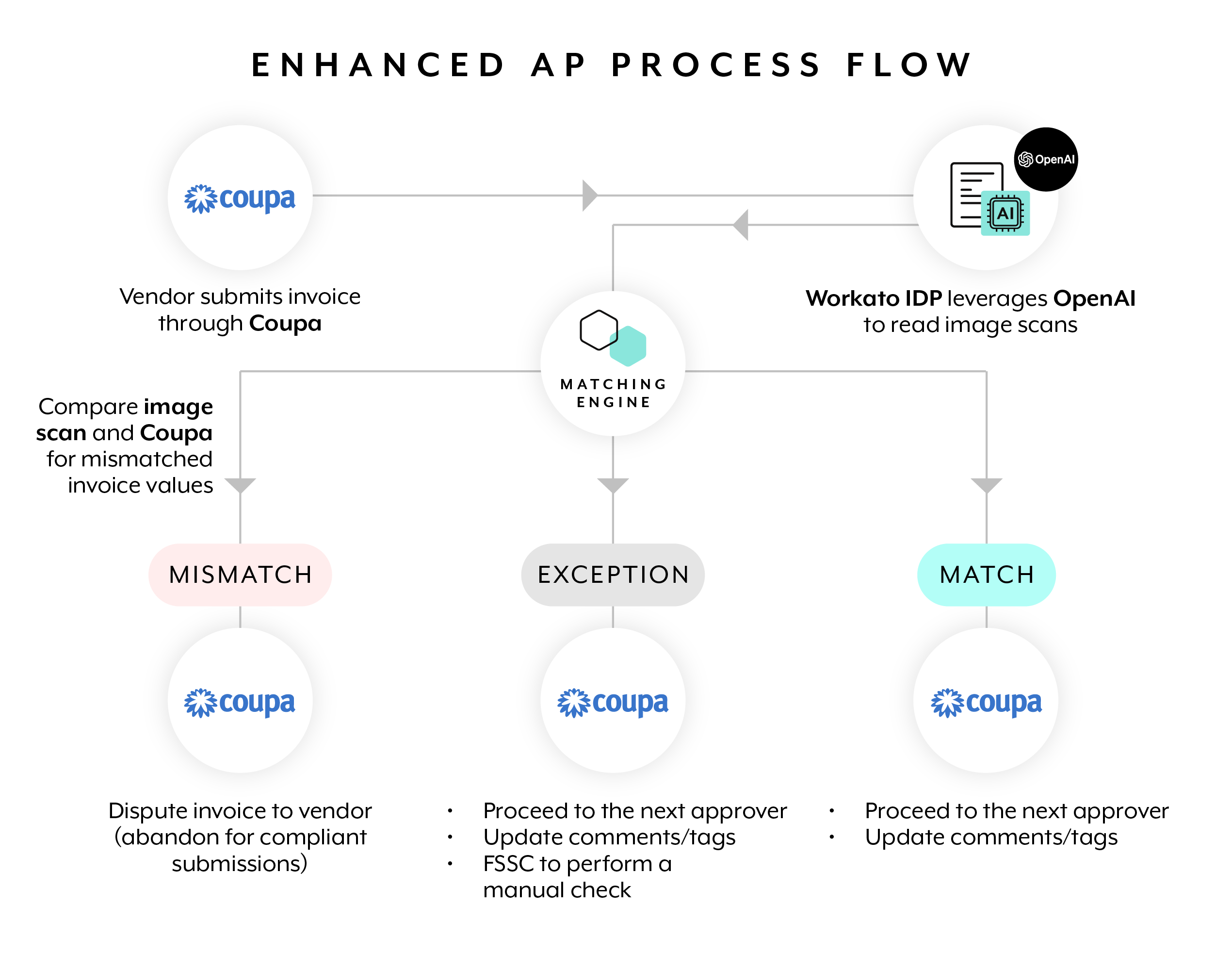
A real-time dashboard tracks validation metrics, exception trends, and processing cycle times, giving the FSSC visibility into invoice behaviour across business units. That visibility has strategic implications: patterns in vendor submission quality now inform upstream conversations with procurement and business teams about data integrity at the source.
Bank Reconciliation Automation
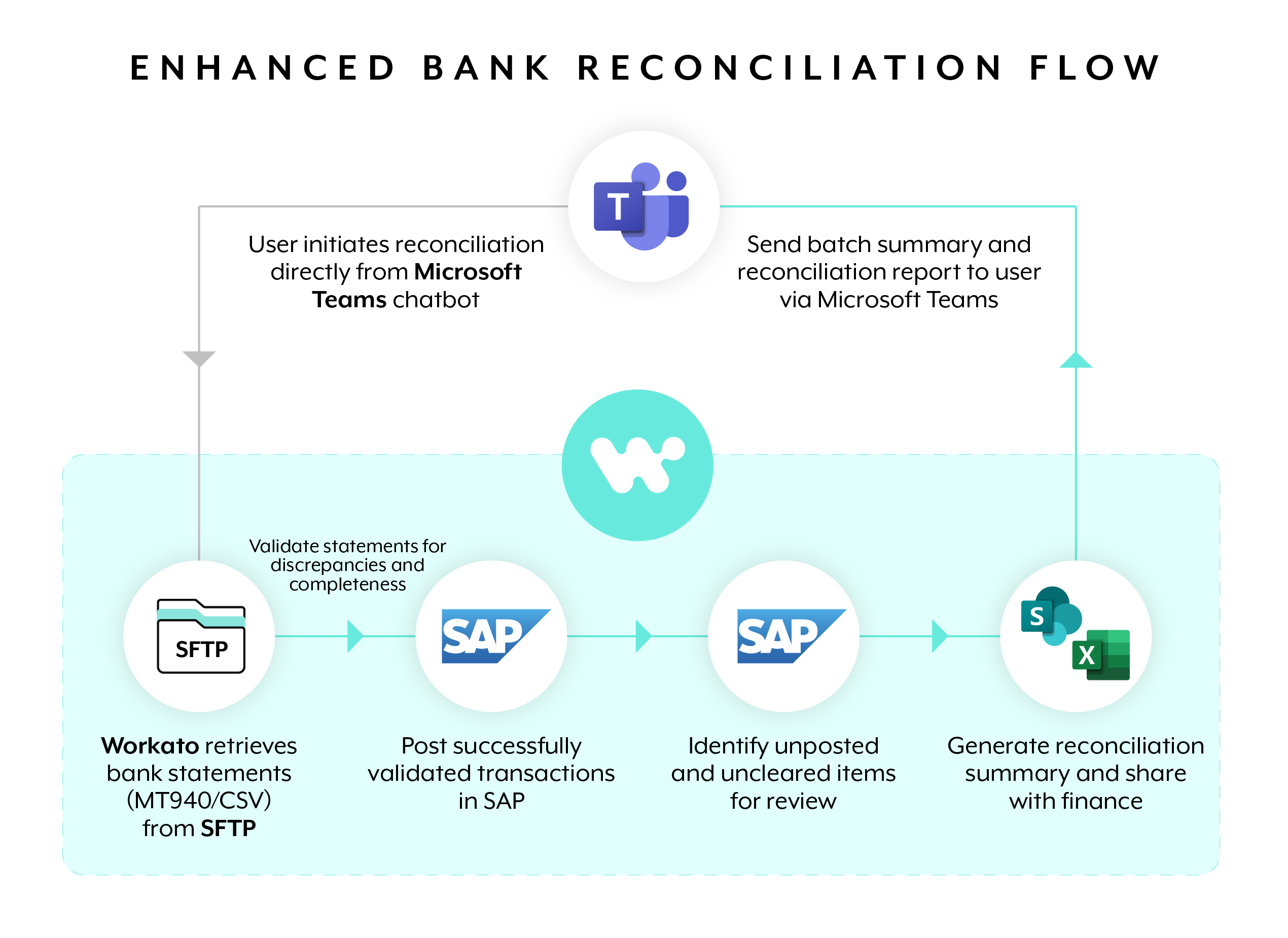
The second use case targeted the bank reconciliation bottleneck. The FSSC’s requirement was straightforward in its ambition: accelerate month-end closing to the first week, a timeline the team had been unable to achieve manually.
Working with iSteer, the team built automated matching rules and exception-handling workflows on Workato. The solution went live within three months.
Measurable Gains Across the Board
Five use cases have been deployed to date, with the two flagship automations delivering standout results.
AP Invoice Processing:
- 75% reduction in verification cycle time (from ~3 minutes to ~45 seconds per invoice)
- 70% reduction in manual processing hours (from 4,800 to 1,440 hours per annum)
- 60% first-time match rate, laying the groundwork for full touchless processing
- Real-time exception insights for proactive vendor and compliance management
Bank Reconciliation:
- Month-end submissions accelerated by 14 days: submitted by the 4th workday instead of the 18th
- Resources previously dedicated to reconciliation redeployed to higher-value analysis
- Completed in three months from requirements to go-live
Staff displaced by automation were repurposed into roles that the FSSC had struggled to resource: exception investigation, vendor engagement, and the kind of analytical work that elevates a shared services function from processor to partner.
From Touchless Processing to Agentic AI
The 60% first-time match rate on invoice processing is not an endpoint. It is a leading indicator. As match rates climb with improved vendor data quality and refined matching rules, the FSSC is charting a course toward full touchless processing, where invoices that meet validation criteria flow from submission to payment without human intervention.
The next wave of transformation is already underway. The company is expanding the FSSC’s scope to additional business units, with four to five new entities joining the model. At the same time, the organisation’s CIO has laid out a roadmap for agentic AI that extends well beyond finance. IT Genie deployments are planned to automate common support requests. A HR Genie will target employee self-service. A Finance Genie will give business users a conversational interface to enterprise applications, removing the friction of navigating complex procurement and financial systems.
For a company built on moving energy responsibly across oceans, the parallel is fitting. Integration and automation laid the shipping lanes. Agentic AI is the fleet that will sail them.
Watch the live presentation of this story at World of Workato Singapore.