
UST replaced its legacy Oracle SOA integration platform with Workato in 10 weeks — 268 integrations, 30+ systems, zero downtime — and then moved straight into orchestrating AI agents across the enterprise on the same platform. That’s the arc of UST’s own case study, told in their words as two phases: integration modernization, then AI-powered agent orchestration. The migration numbers are the part that’s easy to headline. The sequencing between the two phases is the part worth studying.
The problem was familiar: chaos, not capacity
UST runs on 35,000+ people, operations in 30+ countries, and an application stack that had gone fully cloud and SaaS. Its integration layer hadn’t kept pace. The case study names four specific failure points: development cycles measured in days instead of hours, a platform architected for on-prem and hybrid environments bolted onto a cloud-native business, a scalability ceiling that couldn’t absorb new systems or more complex orchestration, and a shrinking pool of engineers who could actually maintain the legacy tooling.
None of that is unique to UST. It’s what integration debt looks like at any company that modernized its applications faster than its middleware. Ungoverned agents often create such sprawl and tech debt. But Workato is the solution.
Phase one: integration modernization at speed
UST evaluated multiple platforms and selected Workato on three criteria: the ability to scale with the organization, a low-code approach accessible to a broader team, and an architecture that could support innovation beyond point-to-point integration. They didn’t attempt a big-bang cutover. A four-week evaluation phase stress-tested critical use cases up front, then the migration shipped in weekly releases — incremental validation instead of a single high-risk cutover weekend. That discipline is a large part of why 268 integrations moved across 30+ systems with zero downtime.
The results were immediate: development cycles that took days dropped to hours, an 80% reduction UST attributes directly to the platform switch. Operational visibility improved enough to shift issue management from reactive to proactive — a genuine shift-left, not just a faster version of the old process. One key point to note: most of UST’s IT team started the project with limited Workato experience. By the end, that expertise ran deep enough that UST now sells Workato implementation as a service to its own clients. A systems integrator that builds internal proof before selling the pattern externally is a stronger signal than a vendor case study alone.
Phase two: AI-powered agent orchestration
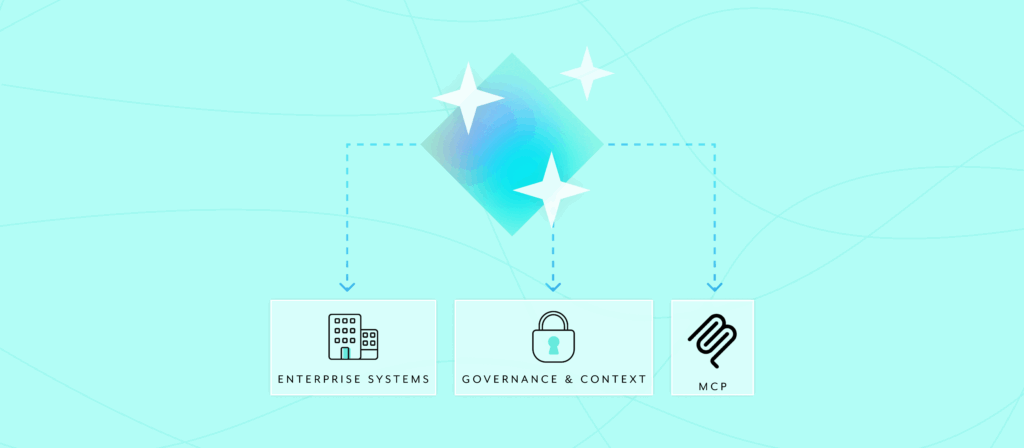
With the integration backbone rebuilt, UST is extending the platform into what they describe as AI-powered agent orchestration — coordinating AI agents, enterprise systems, and human-facing processes across the business, not just moving data between apps. This is the phase most “AI transformation” efforts try to skip straight to, without doing phase one first. Enterprises bolt agent orchestration onto whatever integration layer they already have, then discover mid-project that ungoverned automation and agentic AI don’t mix — every team’s agent gets its own access model and its own connective code, and the result is a thousand personal automations with zero enterprise visibility into any of them.
UST avoided that by sequencing correctly. They didn’t try to orchestrate AI agents on top of a legacy platform that couldn’t handle routine integrations in under a day. They fixed the integration layer first — fast, observable, scalable — and only then extended it into agent coordination. What that actually requires in practice: verified access tied to a real identity, an audit log of every action an agent takes, and guardrails that stop an action before it executes rather than flagging it after the fact. Skip that, and “AI-powered agent orchestration” is just sprawl with a better name.
The takeaway
If your integration platform can’t tell you what changed last week without a ticket to engineering, it’s not ready to coordinate autonomous agents making decisions in production. That’s a structural mismatch, not a knock on any specific legacy platform — middleware built for point-to-point, on-prem integration was never designed to govern the kind of orchestration agentic AI now requires.
UST’s numbers are a real data point: 268 integrations, 10 weeks, zero downtime, 80% faster delivery cycles. The more durable insight is the order of operations — integration modernization first, AI-powered agent orchestration second, not the reverse. Read the full UST case study here for the delivery detail. Whether or not you call the destination a Control and Execution Platform, the sequence that gets you there is the one worth applying before the agent conversation starts.