One company leaned into organized chaos and decentralized execution. The other is building a reusable library of AI skills. Both say the hard part isn’t the technology.
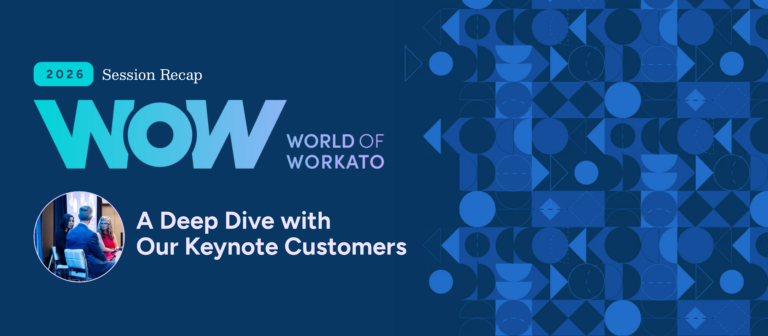
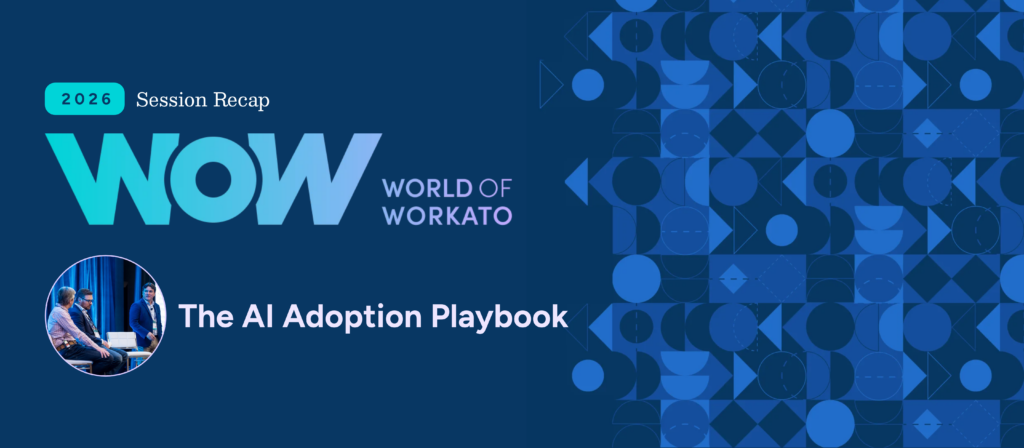
At World of Workato (WOW) in Las Vegas, Andres Ramirez, Chief Strategic Architect at Workato, sat down with two customers who took very different routes to the same goal: getting AI out of the pilot stage and into production. Martin Pomerleau, VP, Corporate Systems and Information Security at Plusgrade, and Mathew Davies, Senior Staff Software Engineer at Zendesk, shared what worked, what didn’t, and why neither believes in a single right answer.
Start with an operating model, because the model isn’t enough
Andres opened with a framework he uses with large customers: think of AI strategy as an AI operating system. The agentic reasoning layer, with its models, frameworks, and harnesses, changes constantly, and its biggest challenge is governance. On the other side sit the business capabilities most teams have spent years building: workflows, approvals, and integrations. In between is an AI control plane that connects the two.
His test for whether those capabilities are ready for AI: are they cloud native, composable, and zero ops? And platform alone doesn’t finish the job. People and operating model matter just as much.
Plusgrade: take a reasonable risk, with guardrails
Plusgrade, a travel technology company headquartered in Montreal, received a mandate to deploy AI last Fall. It chose a federated operating model and Workato as its main governance tool. After procurement in January and platform access, its first end-to-end process with an agent was running by the end of March.
Martin called the approach “organized chaos,” and he argued that standing still carries its own risk:
“Missing the boat, the AI boat, is a risk by itself.”
— Martin Pomerleau, VP, Corporate Systems and Information Security, Plusgrade
The first use case was complex enough to build on but not the hardest one. Martin put his best solution architect and best security architect on it and gave them a clear mandate. Guardrails came first: non-production development, a private link, and no PII. The agent parsed information from an airline partner, but a script, not the agent, wrote to the database. The team ran a dark release for a week, watching what the AI did before going live.
Federate execution, but keep a steward community
Martin’s central team owns connectors, governance, and IT and security. Execution sits with the business, so the central team doesn’t become a bottleneck. A steward community, which meets every two weeks, adds structure. Each steward reports to an SVP and is accountable for deciding whether a use case is worth building. Anything critical gets moved to the enterprise team, and anything reusable gets shared. A small centralized automation team handles complex cross-department work.
Martin’s rule on operating models was blunt: pick one and execute on it.
Adoption has been easy. Plusgrade expects everyone, in every function, to become fluent in AI, and the CIO personally picked the first 50 use cases for the initial 50 licenses.
Zendesk: from order taker to shared architecture
Mathew’s team owns most of the company’s back-office integrations, a portfolio of about 60. For years, it worked like a factory for point-to-point integrations. That didn’t scale, and it often built the wrong integration. Now the team is anchoring on business outcomes, then architecture, then capabilities.
The key unlock, he said, is Workato Enterprise Skills. Break the work into core capabilities, turn many of them into reusable skills, and deliver each in the right way: through an MCP service, a custom agent, or pure orchestration with no human in the loop. Over time, that frees engineers from repetitive requests and “why did this job fail” questions.
Mathew was candid about the obstacle: “Zendesk itself, in a way, is almost like a collection of companies rather than a single company.”
He said that for every day spent building an agent, he spends about a month on approvals, conversations, and buy-in.
What Zendesk learned from the agents that didn’t take off
Mathew’s cautionary tale: after seeing an early version of the Workato Genie at a WOW event, he built a sales agent with about 15 skills in a matter of days. Approvals took six months. It never took off, because it started from an abstract idea of what a sales agent should do rather than the real sales process, and nobody had been taught how to use it.
The lesson now guides Zendesk’s MCP rollout: deliver what users need, with enablement, close work with team leads, and a tight feedback loop.
A smaller win shows the other side. During a major product and ordering launch, Mathew was spending hours tracing failed orders through hundreds of Datadog logs. He spent a couple of days building an agent in Agent Studio, connected to Datadog and the order platform.
Now, asking it why an order failed returns an answer in about fifteen seconds, and the questions mostly stopped coming to him.
Security reviews, with a head start
Both leaders still face security teams. Martin’s answer was to understand the risk and limit it. Mathew said Workato’s existing security documentation, such as audit reports and a vendor security review already on file, shortened the work.
The takeaway
Andres closed with the shared lesson: there is no right operating model. Federated, centralized, or hybrid can all work if it fits your organization. The common thread was people. Both customers described the hard problems as buy-in, resourcing, and changing habits, and that is where they spent their time.
The future of work is being planned at World of Workato. Save the date for WOW 2027.