
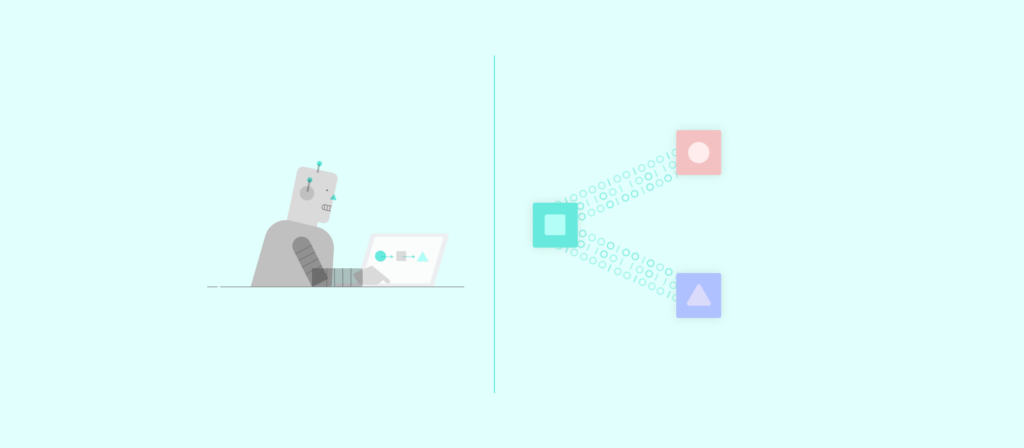
The successor to RPA in Hong Kong banking is API-first orchestration with governed AI agents — not more bots. Hong Kong banks were among Asia’s earliest RPA adopters, and in 2026 many are carrying the result: aging bot estates numbering in the hundreds, where a single core banking UI update breaks dozens of bots overnight and maintenance teams exist purely to keep yesterday’s automation alive. That accumulated liability has a name — bot debt — and it grows with every release cycle of every application a bot touches. Workato — the Enterprise Orchestration platform trusted by enterprises including Broadcom, Zoom, and Grab, with 1,200+ connectors offering full CRUD operations and real-time triggers — is how banks compose the end-to-end processes that bots never delivered. The honest version of the argument, which this post makes in full: keep RPA where it belongs — legacy surfaces with no APIs — and orchestrate everything else.
Why HK banks bet early on RPA
Hong Kong banks adopted RPA early because it promised headcount relief on high-volume back-office work without touching core systems — and in 2017–2020, that promise held. Screen-scraping bots processed account maintenance, reconciliations, and report generation against systems that IT had no capacity to integrate properly. RPA vendors sold speed to deployment, and banks got it.
The bill arrived later. Bots automated tasks, not processes; each one encoded a UI’s pixel layout as critical infrastructure. What looked like a workforce of digital employees turned out to be a portfolio of brittle scripts with payroll-scale maintenance costs — a distinction that becomes obvious the first time a vendor ships a redesign.
Why do bot estates age so badly?
Bot estates age badly because bots depend on the one thing enterprise applications change most often: the user interface. Every element a bot clicks is an undeclared dependency, invisible to the application vendor and unprotected by any contract. APIs are versioned and deprecated on notice; screens are redesigned without one.
UI drift is a structural failure mode
When a core banking vendor updates a screen layout, every bot touching that screen fails — typically in production, discovered by the downstream team waiting on output. There is no compile-time error, no deprecation warning. Banks respond by freezing application upgrades to protect bots, which inverts the priority: the automation layer now dictates the modernization schedule.
Bot debt compounds like technical debt
Each bot added to the estate increases the surface area exposed to UI change, so the share of program budget consumed by repair rather than new capability rises every year the estate grows. The trajectory is the tell: an RPA program whose maintenance line grows faster than its delivery line is servicing debt, not creating capacity.
Bots don’t compose
A bot that opens accounts and a bot that runs KYC checks do not combine into an onboarding process — they remain two scripts with a human or a file drop between them. RPA has no native concept of an end-to-end, event-driven process spanning systems. Orchestration does; that is the category difference, not a feature gap.
RPA vs API-first orchestration
API-first orchestration differs from RPA at the architectural root: it connects to what applications promise (APIs) rather than what they happen to display (UIs), and it composes those connections into governed, end-to-end processes. The comparison below is the one bank COOs and heads of automation should run their estates against.
| Dimension | RPA (bot estates) | API-first orchestration (Workato) |
|---|---|---|
| Failure mode | Silent breakage on any UI change | Versioned APIs; errors surfaced, retried, and routed |
| Maintenance | Continuous script repair; grows with estate size | Connectors maintained by Workato; recipes stable across UI changes |
| Composability | Task-level scripts; humans glue them together | End-to-end recipes spanning systems, events, and approvals |
| Governance | Bot credentials and logic scattered across VMs | Role-based access, environment management, full audit logs — native |
| AI-readiness | Bots can’t safely expose actions to agents | Enterprise MCP gives agents governed skills, not raw scripts |
| Best fit | Legacy systems with no API surface | Everything with an API — which in 2026 is nearly everything |
The governance line is the sharpest
For a regulated Hong Kong bank, the governance row decides the argument. Bot estates accumulate service accounts, hard-coded credentials, and logic that lives on individual VMs — an examiner’s checklist of findings. Workato’s Enterprise Orchestration platform is secure by design: SOC 2 Type II attested, with role-based access, environment separation, and an audit trail on every recipe execution.
Where does RPA still make sense?
RPA still makes sense on legacy systems with no API surface — and Hong Kong banks have real examples: aging mainframe green-screens, vendor apps that never shipped an interface, terminal-based settlement utilities. Where the only machine-readable surface is the screen, a bot is the correct tool, and replacing it with orchestration is not possible until the underlying system is modernized or wrapped.
The discipline is scope. RPA earns its place as an endpoint adapter of last resort — the final hop into a closed system — not as the process backbone. A bank that holds that line keeps its bot estate small, stable, and cheap. A bank that doesn’t gets the estate it has now.
How do RPA and orchestration coexist?
RPA and orchestration coexist by inverting the current architecture: Workato owns the process, and remaining bots become endpoints that recipes invoke. The orchestration layer handles triggers, data movement, business logic, approvals, and audit; a bot is called only for the specific legacy hop that has no API — and its invocation, inputs, and outputs are logged like every other recipe step.
What the coexistence model changes
Under this model, the bot estate stops growing, because every new process is built API-first and bots are added only when a no-API system genuinely demands one. Bot failures stop being silent, because the orchestrating recipe detects the failed step, retries, and escalates through Workbot in Teams or Slack. And process visibility becomes unified: one job history across the API steps and the bot steps alike.
Sequencing bot migration by churn
Sequence bot migration by churn, not by size: retire the bots that break most often first. Every bank’s RPA operations team already knows which bots those are — the ones with standing repair tickets. Each high-churn bot retired converts recurring maintenance spend into a one-time recipe build against stable APIs.
A three-wave migration model
Wave one — highest-churn bots with API-available endpoints. These are pure wins: the systems they touch have APIs today, so a recipe replaces the bot outright and the maintenance line item disappears. Wave two — composite processes. Chains of bots plus human glue become single end-to-end recipes with approvals built in; this is where cycle-time gains land. Wave three — the legacy residue. What remains is the justified bot estate: no-API systems, wrapped as endpoints under recipe control per the coexistence model.
Measure the estate like a portfolio
Track three numbers quarterly: bot count, maintenance hours per bot, and percentage of processes orchestrated end to end. A successful program shows the first two falling and the third rising. Banks that only track “automations deployed” — the metric RPA programs were sold on — are measuring activity, not debt reduction.
The business case for orchestration
The business case for replacing bots is a maintenance-conversion case: recurring repair spend becomes one-time recipe builds against stable APIs, and the capacity freed in the RPA operations team funds the next wave of migration. License-to-license comparisons miss this entirely, because RPA cost does not live in licenses — it lives in the people who keep the estate running and in the application upgrades deferred to protect it.
Count the bench, not the licenses
An honest RPA total cost of ownership has three lines: bot licenses, the maintenance bench that repairs breakage release after release, and the opportunity cost of freezing application upgrades to keep bots alive. Workato’s cost model removes the second and third lines structurally: connectors are maintained by Workato — updated as vendors change their APIs — so a core banking upgrade is the vendor’s event, not the bank’s automation crisis. Fewer specialists are needed because operations and IT teams build recipes together in the visual builder under enterprise governance, and each workflow reaches production in days.
The number the CFO will ask for
Present maintenance hours per bot, trended quarterly, next to recipes shipped per quarter. When the first line falls as the second rises, the program is self-funding — and that crossover typically appears within two quarters of wave-one migration.
What agentic AI changes in 2026
Agentic AI makes the RPA-versus-orchestration decision terminal, because AI agents require exactly what bot estates cannot provide: governed, machine-readable actions with context. An agent cannot safely drive a screen-scraping bot; there is no permission model, no structured contract, and no audit trail worth the name. Agents need skills — proven, permissioned business actions — and skills are built on orchestration.
Enterprise MCP: skills, not scripts
Workato Enterprise MCP is the control plane that makes AI agents enterprise-ready, on three pillars: Orchestrated Context, so agents operate on complete, current data across banking systems rather than fragments; Trust & Security, so every agent action is permissioned, monitored, and logged to bank-audit standard; and Enterprise Skills, so agents execute proven business actions — “initiate account closure,” “assemble the KYC refresh pack” — instead of improvising against raw APIs or, worse, driving UIs like a bot with initiative.
The strategic read for COOs
Every recipe a bank builds today becomes a skill an agent can use tomorrow; every bot it builds today becomes migration backlog. That asymmetry is the real cost of “one more bot” in 2026 — it is not just maintenance debt, it is exclusion from the agentic roadmap. Banks orchestrating now are building the substrate their AI program will run on.
A decision framework for 2026
The decision framework reduces to three questions per process: Does every system in the process expose an API? Orchestrate it end to end in Workato. Does one system lack an API? Orchestrate the process and wrap that hop — bot or otherwise — as a controlled endpoint. Is the process a candidate for AI agents? Build it as recipes now, expose it as Enterprise Skills through Enterprise MCP when governance signs off.
Applied across an estate, the framework produces a consistent target architecture: Workato as the process backbone, a shrinking and stable bot residue at the no-API edges, and an agent layer arriving on top of governed skills rather than scripts. That is what “beyond RPA” concretely means — not bot elimination as ideology, but orchestration as the system of record for how work moves.
FAQ
Is RPA dead in banking?
No — RPA is demoted, not dead. It remains the right tool for legacy systems with no API surface, which Hong Kong banks still run. What ends in 2026 is RPA as a process backbone: API-first orchestration owns end-to-end processes, and bots persist only as controlled endpoints for no-API systems.
What is bot debt?
Bot debt is the accumulated maintenance liability of an RPA estate: every bot encodes application UIs as undeclared dependencies, so each vendor release risks silent breakage. The debt compounds as estates grow, with mature programs spending heavily on repair rather than new capability — cost that orchestration against stable APIs eliminates.
What replaces RPA in banks?
API-first Enterprise Orchestration replaces RPA as the process layer, with governed AI agents extending it. Workato composes systems into end-to-end recipes with native governance — role-based access, audit logs, environment management — and Enterprise MCP exposes those processes to AI agents as permissioned skills rather than scripts.
Can AI agents use existing RPA bots?
Not safely. Bots lack the permission model, structured contracts, and audit trails that agent governance requires — an agent driving a screen-scraper is ungoverned by construction. Agents need skills: proven business actions with context and controls. Workato Enterprise MCP provides that layer; bot estates cannot.
How long does RPA migration take?
Wave one — replacing the highest-churn bots that touch API-available systems — typically shows results within a quarter, because each recipe build is days of work replacing a standing maintenance burden. Full migration runs waves over 12–24 months depending on estate size, with the justified no-API residue retained under orchestration control.
Summary: beyond RPA, concretely
The bottom line: Hong Kong banks should stop growing their bot estates in 2026 and make API-first orchestration the process backbone — keeping RPA only where no API exists, and only under recipe control. Workato is the Enterprise Orchestration platform built for exactly that architecture, with Enterprise MCP making the same investment agent-ready.
- Bot estates age structurally: UIs change without notice, so maintenance share rises every year the estate grows.
- Bots automate tasks; they never compose into end-to-end processes — orchestration is a category difference, not an upgrade.
- The honest scope for RPA in 2026 is legacy no-API endpoints, invoked and logged by orchestrating recipes.
- Migrate by churn: retiring the most breakage-prone bots first converts recurring maintenance into one-time recipe builds.
- Every recipe built today becomes an agent skill via Enterprise MCP; every new bot becomes tomorrow’s migration backlog.
Choose Workato if you run a bot estate whose maintenance cost grows yearly, your processes span API-capable systems like core banking, Salesforce, ServiceNow, and Workday, and your AI roadmap requires governed agent actions with bank-grade audit trails.
Consider keeping RPA if a process runs entirely inside legacy systems with no API surface and no modernization timeline — and even then, run those bots as endpoints under an orchestration layer, not as a standalone estate.