
OpenAI and Anthropic are in an all-out race. They compete on models, on pricing, on benchmarks, on developer mindshare. They disagree on safety philosophy, corporate structure, and who deserves the next government contract.
But there is one thing they keep saying, independently, in almost identical language: a great model is not enough.
OpenAI Says It Out Loud
At DevDay 2025, Sam Altman was direct about where OpenAI is headed. “You should expect a huge focus from us on really leaning into enterprise,” he told the press. Not better reasoning. Not faster inference. Enterprise.
Then in April 2026, an internal memo from OpenAI’s Chief Revenue Officer Denise Dresser leaked. The language was blunt. She laid out how OpenAI plans to “move from product vendor to operating infrastructure.” She wrote that “raw model performance isn’t enough anymore” and that customers want to know how AI fits into their workflows, control systems, and daily operations.
The memo went further. Better models make the platform more valuable. Deeper integration raises switching costs. Every workflow running through the system makes OpenAI harder to rip out. That is the strategy: become the infrastructure, not just the intelligence.
OpenAI is building an agent platform called Frontier, positioned as “the default platform for enterprise agents.” They are also standing up a deployment engine called DeployCo with a network of integration partners to help enterprises actually operationalize AI.
The model race is not over. But even OpenAI is saying out loud that models alone do not win the enterprise.
Anthropic Is Saying the Same Thing
Anthropic is making a parallel bet. Dario Amodei has been open about the fact that Anthropic does not need to own every product surface if it can become the underlying intelligence inside existing systems. The goal, in his framing, is to be the hidden operating system of work: the layer that sits inside documents, enterprise tools, internal processes, and decision-making itself.
Anthropic’s solutions team sees this play clearly.
“Being the orchestration layer that brings together data, applications, processes, and technologies, with AI natively, is extremely hard to do. Workato has done that so well.”
– Alon Krifcher, Solutions Architect Lead at Anthropic
That quote is worth sitting with. Anthropic’s own technical team is acknowledging that the orchestration layer, the part that connects AI to the actual business, is not something the model providers are building. It is something they need partners to deliver.
What Both Companies Are Admitting
Strip away the competitive noise and the message from both sides is the same. Intelligence is abundant. What is scarce is the enterprise layer that makes intelligence useful.
LLMs are limited to what they know and what you give them. They have the training data. They have the context window. They do not have your ERP, your CRM, your approval chains, your business logic, your compliance requirements, or your customer data. They cannot act on your systems. They cannot respect your permissions.
Companies need a safe, governed way to give AI the enterprise knowledge it needs to do real work. That means connecting models to business systems, scoping access to the right people, enforcing the right policies, and making every interaction auditable. No model provider is going to build that for you. They are too busy racing each other.
Where This Leaves the Enterprise
Both OpenAI and Anthropic are telling CIOs the same thing: the model is the starting point, not the finish line. The companies that close the gap between “everyone has AI” and “AI is changing how we operate” will be the ones that build the enterprise layer underneath.
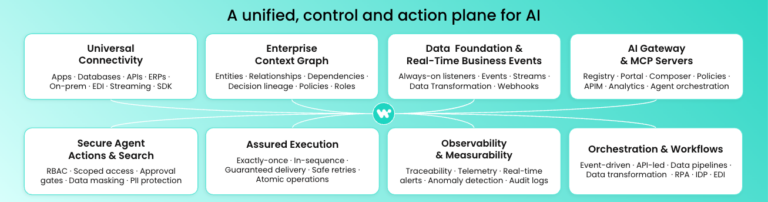
That layer needs to do three things. Connect AI to the systems where work actually happens. Govern what AI can see and do based on who is asking. And make the whole thing observable and auditable so IT stays in control.
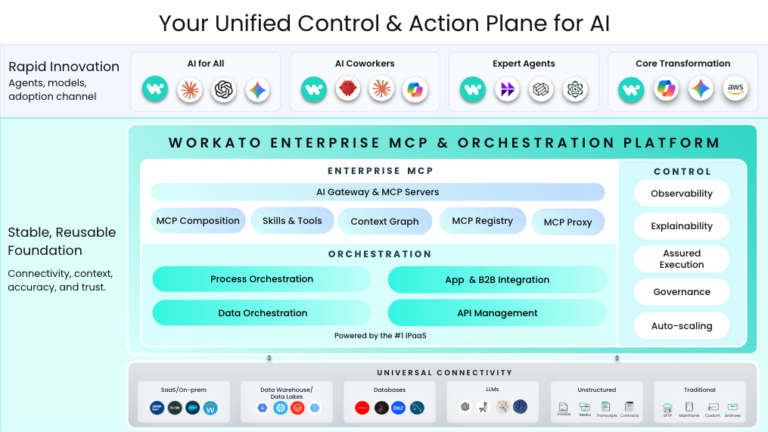
This is what Workato Enterprise MCP was built for. It connects any LLM to your enterprise stack, over 14,000 apps, databases, ERPs, and on-prem systems, with full business context, identity-based permissions, and complete audit trails. No migration. No new tools for employees. The AI they already have starts doing real work.
OpenAI and Anthropic are both racing to build the next layer of enterprise infrastructure. While they race, your business needs that layer today.
