
The integration challenges facing government agencies can no longer be solved with bespoke point-to-point integrations between two systems. A CIO responsible for a regulatory function needs to connect departments, each with its own systems of record, data classifications, sovereignty requirements and governance obligations. These connections to be auditable and maintainable by a team that is, by government standards, lean.
Separately, agencies that have invested in agile delivery models face a different structural problem. When their service desks and development backlogs are disconnected, service requests raised by end users arrive in one system and have to be manually re-entered into another before development teams can act on them. The result is slow handoffs, lost context and limited visibility into how citizen and staff needs translate into delivery priorities.
Both challenges result from the absence of an orchestration layer that can span systems, departments and delivery models, without requiring large specialist teams or bespoke point-to-point builds. One forward-looking Australian government agency is closing that gap with Workato.
When Every Department Holds a Different Version of the Truth
Regulatory agencies in Australia operate across some of the most complex integration landscapes in government. A single function, such as provider oversight in aged care, child safety or disability services, may require data to flow between a regulatory body, a policy department, a data warehouse, provider portals, case management systems and compliance reporting platforms.
Provider submissions arrive via smart forms and email. Case outcomes must be routed to a parent department via both API and CSV channels depending on what each system supports. Serious incident notifications arrive through public-facing portals and must trigger internal workflows in case management and risk databases. Audit requests flow to specialist tools.
Compliance and enforcement actions span document management, code of conduct registries and departmental risk databases.
Legacy integration platforms struggle with this breadth. The combination of modern OAuth endpoints and legacy SFTP drops, cloud-native SaaS and on-premise systems, and the sheer number of integration points across departments demands something more than a point-to-point integration tool. Different departments end up holding different versions of the same data. Regulatory confidence suffers, and the burden of maintaining fragmented connections falls on teams that cannot afford to grow.
Meanwhile, at agencies running agile delivery, the service desk has become a bottleneck for a different reason. When an end user raises a service request – whether a hardware fault, a bug report or a change request – the resolution path rarely stays within the service desk itself. It requires a work item in Azure DevOps, a case in Pega, or a task in Jira. Today, that routing is manual. Service desk agents triage, classify and re-enter requests into downstream systems by hand, or via CSV file transfers where APIs are absent.
Requests stall, context is lost in transit, and requesters have no visibility once their ticket leaves the service desk. To report on service delivery performance, backlog health and resolution times, public servants have to manually reconcile across systems that were never designed to talk to each other.
One Orchestration Layer Across the Whole Government Stack
Instead of getting specialist teams to maintain separate tooling for modern API-based endpoints and legacy file-based interfaces, one pioneering Australian Federal Government agency chose to orchestrate these within the same integration layer.
Workato orchestrates the full lifecycle of provider and compliance data across departments. The architecture below illustrates how two regulatory workflow domains sit within a single orchestration layer.

“We have a jackknife that makes us pretty confident that we can connect to any system. The level of reuse and how we get this done would not have been possible without an enterprise-grade platform.”
— Head of Architecture, Australian Federal Government Agency
Provider management workflows handle the synchronisation of registration data, submission outcomes and risk assessments between the regulatory agency and its parent department.

Quality and compliance workflows route audit requests, serious incident notifications and enforcement actions to the right systems in real time.

Every data exchange is orchestrated with a full audit trail and provenance tracking. Data sovereignty obligations are met at the platform level, not managed case by case. And the recipe architecture is composable: the same integration building blocks that connect provider management data flows today can be extended to new regulatory domains without rebuilding from scratch.
For agencies managing the service catalogue to DevOps gap, Workato routes service requests automatically to the correct downstream system based on classification rules configured by the agency. A hardware fault goes to the device management backlog. A software bug routes to the relevant Azure DevOps board with full context already attached. A change request creates a Jira ticket with priority and requester information intact.

Bidirectional status synchronisation means the original service request reflects the progress of the downstream work item. Requesters have visibility. Service desk managers can report on end-to-end resolution times without manual reconciliation. Development teams receive clean, contextualised work items without triage overhead.
What the Architecture Delivers: Full Governance, No Manual Handoffs, Faster Resolution
- Cross-departmental data flows governed end to end: Every exchange between regulatory agency and parent department is orchestrated with full audit trail, meeting data sovereignty and provenance requirements
- Modern and legacy interfaces handled in a single platform: API-based and file-based (SFTP, CSV) integrations coexist within the same recipe architecture, eliminating the need for separate tooling
- Manual service request re-entry eliminated: Service catalogue items are automatically classified and routed to the correct DevOps board or case management system with full context
- End-to-end traceability from request to resolution: Bidirectional status sync means service desk and development teams share a single view of work in flight
- Lean team delivery at enterprise scale: The composable recipe architecture means a small ICT team can build, extend and govern integrations across dozens of systems and data flows
- Faster time to resolution: Automated classification and routing means development and support teams receive work items with the right priority and context already attached, reducing triage overhead and accelerating sprint intake
Building the Foundation for Agentic Government
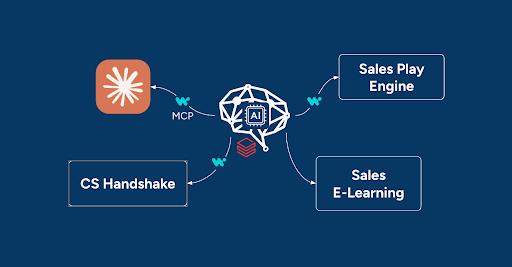
The agencies that have solved the orchestration problem are not standing still. The integration recipes and data flows connecting departments and delivery teams today can be extended with agentic AI capabilities by exposing them as Enterprise Model Context Protocol (MCP) tools.
The governance, audit trail, data sovereignty and connectivity are already there. Adding intelligence is the next step and agencies that have invested in the integration layer are the ones best positioned to do it responsibly.
For regulatory agencies, this means an agent that can intelligently triage incoming provider submissions, flag high-risk cases for human review and route routine compliance checks automatically, building directly on the Gov-to-Gov orchestration patterns already in place. But the recipes handling that routing are fixed flows: deterministic, governed, and safe to expose as tools for an AI agent to call. Understanding how fixed, guided and agent flows fit together is what separates a compelling AI demo from a production-grade government deployment.
For service delivery teams, it means an agent that can resolve common service requests autonomously, escalate intelligently and keep both the requester and the development team informed, without a human intermediary.
Read more about how Workato supports Australian government agencies to build an agentic-ready IT foundation. For a look at how agencies are automating document verification and identity access changes, read $400,000 Saved. Instant Access Changes. How Australian Government Agencies Are Closing Two Costly Gaps with Workato.
For the right questions to ask before trusting any vendor’s AI governance strategy, read The Control Tower Fallacy: Visibility Is Not Governance.