Australian government agencies carry two operational problems that are so common they have become background noise. The first is the cost of verifying who someone is. The second is the lag between an HR change and the moment every downstream system reflects it.
Together, they represent hundreds of thousands of dollars in avoidable expenditure and hundreds of valuable staff hours lost every year to processes that exist only because key systems have not been connected.
But one forward-looking government agency chose to question this status quo and bridge the gap using Workato’s enterprise integration and orchestration platform.
Verification Costs and 2-3 Day Access Delays: The Hidden Tax on Government IT
The document verification problem starts with a number: $40 to $50 per check.
That is what most Australian government agencies pay to commercial Gateway Service Providers to verify identity documents for employees, contractors and consultants. For a department processing 10,000 checks annually, that is up to $500,000 per year for a service the Australian Government offers directly through the Document Verification Service (DVS) at a flat annual fee of approximately $5,000 to $6,000.
The DVS capability has existed for years. The barrier has never been access; it has been integration. Connecting DVS directly to HR systems and onboarding workflows, in a way that is governed, auditable and repeatable, requires an orchestration layer that most agencies have not had.
The consequence is not only financial. Manual verification workflows create bottlenecks in onboarding. Contractors cannot begin work until screening clears, and delays compound across large project teams. In regulated sectors, including aged care and child safety, the absence of a system-of-record audit trail for every check is a compliance risk, not just an operational inconvenience.
The identity synchronisation problem runs parallel. In most agencies, SAP is the system of record for HR. Organisational hierarchies, reporting lines, role assignments and delegation authorities all originate there. Active Directory (AD) depends on that structure for identity and access. So do case management platforms such as Salesforce and Pega, and the SaaS applications that rely on SAML-based delegations.
When an employee changes roles or a senior officer goes on leave and needs to transfer their financial delegations, someone in ICT operations raises a service desk ticket. That ticket takes 2 to 3 days to action. During that window, the departing employee may still hold access they should not. The incoming delegate may lack access they need. Approvals stall. Procurement pauses, and the organisational hierarchy reflected across government systems is simply wrong.
One Orchestration Layer, Extensible Across Government
Workato addresses both challenges through the same underlying capability: governed, event-driven integration that connects systems in real time without requiring large specialist teams to build and maintain connections.
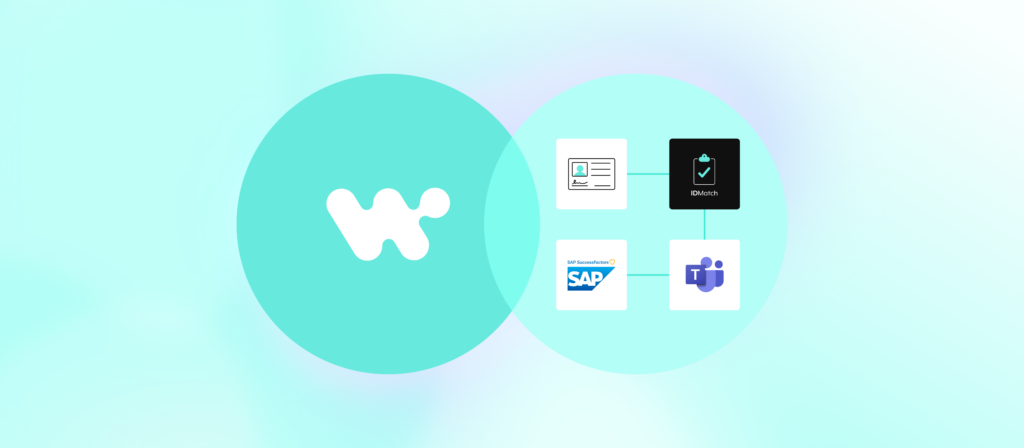
For document verification, Workato orchestrates a direct integration between the DVS and the agency’s HR and onboarding systems. When a new employee, contractor or consultant is added to the HR platform, Workato triggers a verification request to DVS automatically. The result is returned in real time, logged against the individual’s record with a full audit trail, and the onboarding workflow proceeds without manual intervention.

For SAP HR to Active Directory synchronisation, Workato monitors SAP for changes to employee records, delegation authorities and organisational hierarchy. When a change is detected, the updated information propagates to Active Directory and every downstream system, including Salesforce, Pega and connected SaaS platforms, in real time. No service desk ticket. No 2 to 3 day lag.

What makes both patterns viable for lean government ICT teams is the composable recipe architecture: the DVS integration built for one agency’s onboarding workflow extends to worker screening in aged care, child safety or national security without rebuilding from scratch. Workato’s enterprise-grade governance controls mean every connection is auditable and policy-compliant from day one. And the SAP-to-AD pattern is identical regardless of agency size or downstream system mix.
“What I love about it is the practical building block architecture.”
— Head of Architecture, Australian Federal Government Agency
$400,000 Saved, 3 Days Reclaimed, One Integration Layer
- 90%+ reduction in per-check verification costs: Direct DVS access replaces $40-50 per-check Gateway Service Provider fees, allowing an agency processing 10,000 checks annually to save over $400,000 in the first year.
- Same-day contractor clearance: Real-time API-based verification replaces manual submission and asynchronous response cycles.
- Instant identity and access changes: Eliminates the 2 to 3 day service desk lag for delegation and role changes.
- Defensible audit trail for every check: The solution automatically logs timestamps, document types, outcomes and employee records, satisfying audit requirements in regulated sectors.
- Repeatable integration patterns: These use cases deploy across agencies without rebuilding; build once, extend across government
What Comes Next: From Automation to Agentic Government
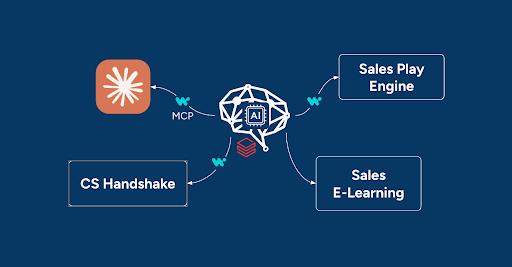
The federal government agency that has automated these foundational workflows is not stopping at integration. The same recipes that route verification requests and propagate identity changes today can be exposed as Enterprise Model Context Protocol (MCP) tools, making them available to AI agents working across government systems.
Building on the DVS integration, an agent can autonomously check whether a contractor’s screening is current before approving their system access. But the integration recipe handling that verification is a fixed flow that does not need to reason – it executes the same way every time, reliably and with a full audit trail. In the language of enterprise agentic design, such “fixed flows” are deterministic, governed, and safe to expose as a tool for an AI agent to call.
The same principle applies to the SAP-to-AD synchronisation pattern. Guided or agentic flows can be designed to address real-world situations that risk breaking fixed flows. For instance, identifying delegation gaps before a senior officer goes on leave and initiating the transfer workflow proactively. Understanding how fixed, guided and agent flows fit together is what separates a compelling AI demo from a production-grade enterprise deployment.
Agencies that have solved the foundational connectivity problems are the ones best positioned to deploy agentic AI responsibly because the governance, audit trail and integration architecture are already there.
Read more about how Workato supports Australian government agencies to build an agentic-ready IT foundation. For a deeper look at how agencies are connecting departments and delivery teams at scale, read The Architecture Underpinning Connected Government: How Australian Agencies Orchestrate Across Departments with Workato.
For a framework on what AI governance actually requires beyond visibility, read The Control Tower Fallacy: Visibility Is Not Governance.