

Agentic systems are no longer experimental tools that live on the edges of the modern software stack. Instead, they’re becoming part of how core business systems operate.
What’s driving this shift is not just better models or smarter agents, but the architecture that supports them.
This article breaks down what agentic architecture actually is, why more and more organizations are prioritizing it, and why it matters in real-world B2B contexts.
What Is Agentic Architecture?
Agentic architecture is the structural design that enables software AI agents to reason, decide, and act across systems with limited direct instruction, bounded by policy and architecture.
Unlike traditional automation scripts and pipelines, these agents operate with goals, maintain context, and choose actions dynamically based on specific conditions.
Traditional automation is execution-driven. You predesign a flow, connect it to specific systems, and the tech runs the same sequence of steps repeatedly.
This works well for processes that are stable and repeatable, but it breaks the moments when conditions change or judgment is required.
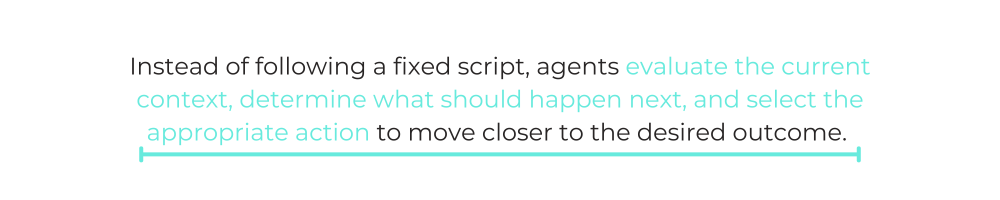
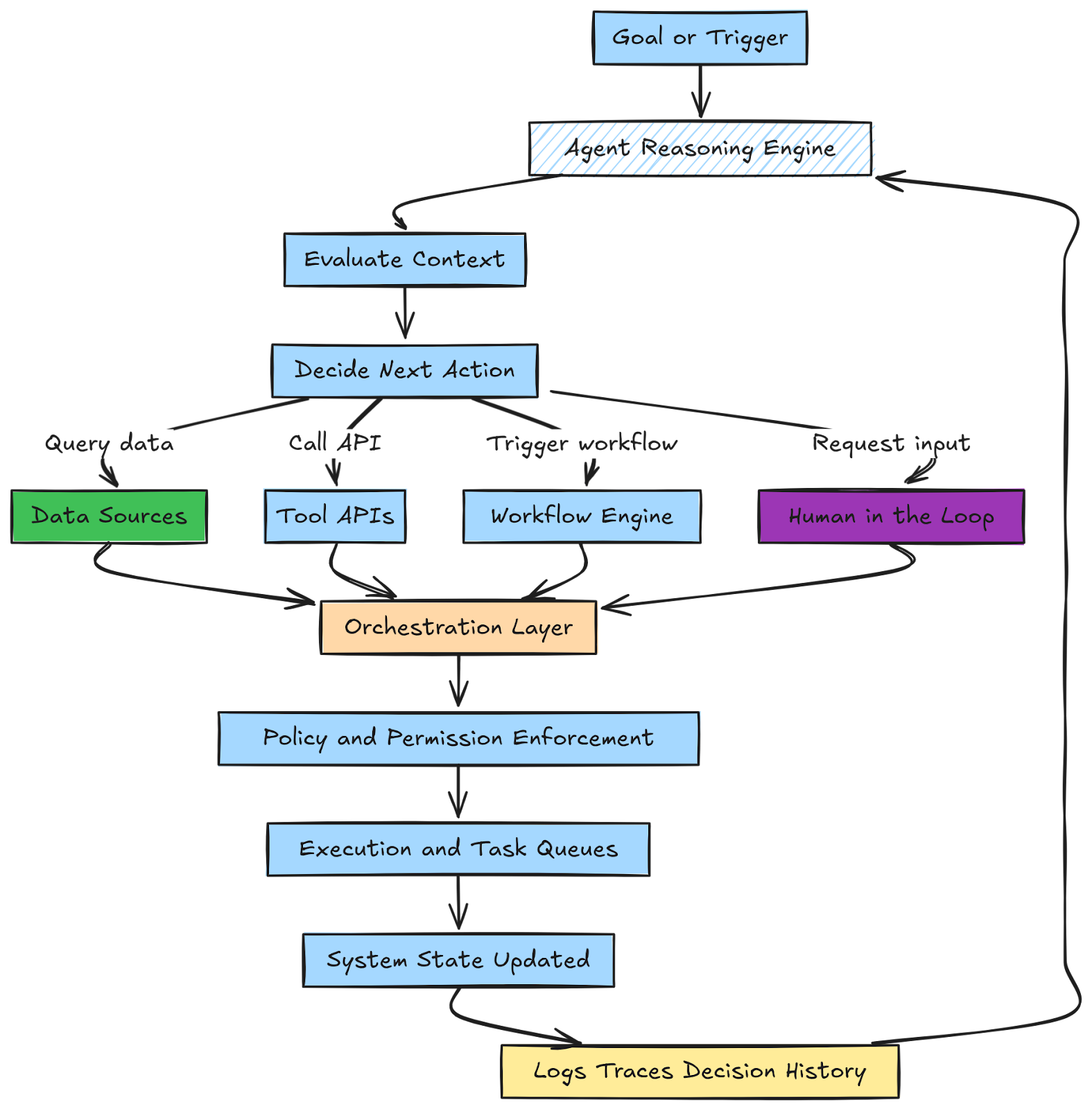
Agentic systems, in contrast, are decision-driven. Instead of following a fixed script, agents evaluate the current context, determine what should happen next, and select the appropriate action to move closer to the desired outcome.
That action might be querying data, calling an API, generating content, requesting human input, or triggering an automated workflow. The key difference is that control shifts from rigid flows to adaptive reasoning.
Agentic architecture is what makes this approach viable at scale. An agent without structure behaves unpredictably and can even become a risk.
Agentic architecture provides the connective tissue between reasoning engines, enterprise tools, and operational controls, making sure that intelligence is paired with reliability.
In practice, agents don’t operate in isolation. They sit on top of an orchestrated stack of services that typically include data sources, tasks queues, workflow engines, tool APIs, logging systems, and policy enforcements layers.
Tools that were previously used in isolation or embedded inside static workflows—such as databases, search services, CRMS, ticketing systems, or automation platforms—are instead exposed as capabilities that agents can invoke when needed.
Why Interest in Agentic Architecture Has Accelerated
A set of converging pressures is accelerating the move toward agentic architecture across modern organizations.
1. System Sprawl and Fragmentation
Modern organizations rely on dozens of SaaS tools and internal systems. Data is scattered across platforms and day-to-day business processes routinely cut across multiple boundaries. Coordinating all of this manually is inefficient, and hard-coded integrations are fragile and difficult to maintain.
2. Operational Scale and Throughput Pressure
As volume grows, human-driven coordination becomes the limiting factor. Reviews back up, handoffs slow down, and exceptions pile up. Teams need systems that can take initiative, evaluate context, and act autonomously within clearly defined limits.
3. Long-term Platform Evolution
Organizations increasingly want architecture that can adapt over time instead of requiring constant rewrites or rip-and-replacements. Rigid automation tightly couples logic to execution, making changes costly.
Well-designed agentic systems separate reasoning from execution, allowing the decision-making layer to improve independently while existing tools, workflows, and integrations remain stable.
4. A Shift from Intelligence to Infrastructure
There’s a growing recognition that agents require more than powerful models. Early enthusiasm focused on intelligence alone but practical deployment has shifted the attention towards control, reliability, observability, and integration. All of this adds up to drive interest in agentic architecture as a foundational layer.
Fundamentals of Agentic Architectures
The architecture backing agentic systems has evolved through several phases. Early automation relied heavily on robotic process automation (RPA), which mimicked user behaviour but was brittle and difficult to maintain.
The rise of integration platform as a service (iPaaS) introduced more robust integration patterns, including event-driven workflows, reusable connectors, and centralized orchestration.
Agentic architecture builds on top of these foundations rather than completely replacing them. It layers intelligence on proven infrastructure, allowing organizations to evolve incrementally rather than rebuilding from scratch.
With that in mind, let’s look at some of the core components of agentic architectures:
Reasoning Layer
In agentic architecture, LLMs act as reasoning components. They interpret context, evaluate options, and decide what actions are appropriate based on goals and constraints.

Tooling and Capability Exposure
Tooling layers expose actions in a controlled and deliberate way. Rather than granting unrestricted access, they define exactly what agents are allowed to do and under what conditions.
Governed Data Access
Model Context Protocol (MCP)-backed resources provide structured access to data with built-in governance. This ensures consistency, security, and compliance while still enabling flexible reasoning.
Orchestration Layer
An orchestration layer coordinates execution across systems. It manages sequencing, timing, retries, and dependencies, translating decisions into reliable operational workflows.
Each layer serves a specific purpose within agentic architecture. Reasoning determines what should happen, orchestration controls how and when it happens, and integrations and APIs execute the actual work.
Platforms like Workato have focused heavily on this layered approach. Instead of treating agents as standalone artifacts, Workato keeps the emphasis on the architecture of B2B SaaS. That perspective is reflected in how orchestration, governance, and extensibility come together in agentic systems.
Agentic Architecture Best Practices
Agentic systems tend to work well in small demos. But all too often, teams run into challenges when they operate at production scale.
By following these best practices, you can increase your chances of success with agentic AI.
1. Separate Reasoning from Execution
Agentic systems are easier to evolve when the decision-making layer is independent of the execution layer.
Reasoning logic can improve, be retrained, or be replaced without destabilizing the systems that actually perform actions. This separation also makes failures easier to isolate and diagnose.
2. Define Strict Tool Boundaries
Agents should only interact with tools and actions that were intentionally exposed. Every capability in the system increases the blast radius, which is why carefully designed interfaces, narrow scopes, and explicit permissions keep the agent behavior both predictable and auditable.
3. Invest in Observability Early
When you are operating in production, agent behavior becomes increasingly complex and unclear. Having detailed logs, traces, and decision histories allows teams to understand why an agent acted in a certain way.
Thus, observability turns unexpected outcomes into debuggable problems that would have otherwise remained mysteries.
4. Design for Partial Failure
Not every action will succeed, and that should not come as a surprise. Systems need fallback paths, retries, and safe stopping points that allow progress without a lot of manual intervention. Designing architecture that creates resilient systems matters more than attempting to eliminate all failure.
5. Treat Behavior as Architecture
Prompts, policies, and constraints shape how agents reason and act. These elements should be tested, reviewed, and versioned alongside code. They should be considered part of the system’s structure rather than an afterthought or a tuning exercise.
Agentic Architecture: Challenges and Pitfalls
While agentic architecture can transform workflows and accelerate productivity, there are also several challenges and pitfalls teams must be aware of.
1. Over-delegating Responsibility to Agents
A frequent source of failure occurs when teams overload agents with implicit logic. When decision-making is hidden inside prompts or model behavior, diagnosing failures becomes difficult. Clear structure and explicit control paths tend to be more reliable than clever prompts.
2. Architectural Drift over Time
As teams iterate, logic can slowly spread across prompts, services, and integration layers. Without a shared architectural model, the system becomes harder to understand. Regular consolidation and clear documentation helps prevent the drift.
3. Cultural Resistance to Nondeterminism
Teams used to predictable execution may struggle to trust systems that make situational decisions. This resistance is often if not always cultural, not technical. Transparency, auditability, and clear override mechanisms help build confidence over time.
4. Security Exposure through Broad Tool Access
Agents that can invoke many tools magnify the impact of misconfiguration. Without carefully designed permissions and narrowly scoped access, a single mistake can cascade across systems — which is why teams should enforce security boundaries from the start.
Real-World Agentic Architecture Use Cases
Agentic architecture is already being applied in production environments. Here are some ways teams are already using agentic AI to great effect:
- Revenue operations teams use agents to coordinate lead routing and follow-up action across CRM and marketing platforms. The agent evaluates the signal and decides what actions to take next.
- Customer support organizations apply agentic systems to case analysis. Agents triage issues, gather context from multiple systems, and escalate issues when necessary.
- IT teams rely on agents for incident response. The system evaluates alerts, determines likely causes, and initiates remediation steps while keeping humans informed.
- Product and operations teams use agentic workflows to respond to user behavior Agents trigger internal processes based on complex patterns rather than simple events.
Ready to get started with agentic AI? Workato makes it easy.
This post was written by Talha Khalid. Talha is a full-stack developer and data scientist who loves to make the cold and hard topics exciting and easy to understand.