
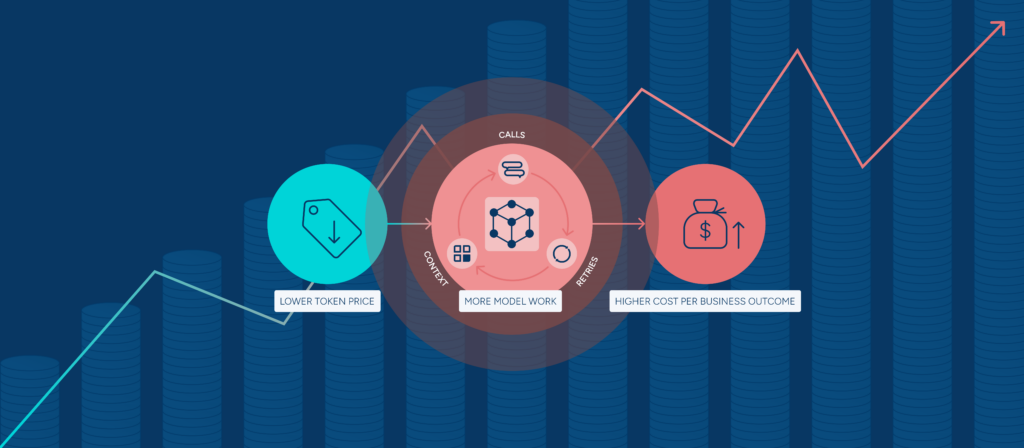
Lower token prices will not improve AI economics unless enterprises redesign how agents execute work.
A company reportedly spent half a billion dollars on Claude in a single month after failing to set usage limits on employee licenses. The figure is extraordinary, but the broader warning is clear: AI consumption can scale much faster than the business value it creates.1
Budgets, quotas, model routing, and usage policies can contain spend. They cannot remove unnecessary model calls, excess context, or repeated reasoning already embedded in the workflow.
AI agent cost is an architecture problem, not just a model-pricing problem.
As agents move from pilots into production and begin touching consequential business processes, small inefficiencies multiply across thousands of runs. An affordable pilot can become structurally uneconomical at enterprise scale.
Cheaper models do not guarantee cheaper outcomes
Consider an agent resolving a customer incident. It retrieves a ServiceNow case, matches the account in Salesforce, checks entitlement and policy, updates both systems, and notifies the support team in Slack.
One architecture exposes every operation as a separate tool. The model must choose the sequence, interpret each response, retain information, and decide how to proceed when something fails. Each return to the model can add another paid call, more context, greater latency, and opportunities for error.
A different architecture exposes one governed business capability, such as resolve_customer_incident. The agent provides the goal and relevant inputs, while a deterministic workflow completes the established process and returns a structured result.
The business outcome is the same. The architecture determines how much model work, token spend, and operational risk it requires.

Gartner estimates that agentic models can require five to 30 times more tokens per task than a standard GenAI chatbot. Lower token prices may therefore be offset by faster growth in consumption as agents take on more work.2
Token consumption may indicate adoption, but it does not show whether the work finished, whether the result created value, or how much that result cost to deliver.
The metric that matters is cost per successful business outcome.
Optimize the execution path before the model
Most token-optimization programs begin with model routing, prompt compression, caching, budgets, and monitoring. Those measures improve the calls a workflow already makes. A more important question comes first: does the workflow need to return to a model for that step at all?
GitHub applied this principle to a production issue-triage workflow by moving routine metadata retrieval and label scanning out of the model loop. Across 109 post-change runs, its cost-adjusted Effective Tokens measure fell 62 percent.3
The lesson is not to eliminate model reasoning. Models should be used where judgment materially improves the outcome.
Use models for judgment, not routine coordination
Granular tools are valuable for exploration, low-risk lookups, and work whose path genuinely depends on the situation. Applied to repeated, multistep processes with established rules and failure conditions, however, they can force the model to reconstruct the same process on every run.
An outcome-oriented capability creates a clearer division of responsibility. The model interprets intent, resolves ambiguity, and makes judgment calls. The execution layer handles sequencing, business rules, approvals, retries, and recovery.
The agent interprets the goal. It no longer has to reason through every step required to execute it.
This principle should also guide how enterprises design Model Context Protocol capabilities. MCP standardizes how agents discover and invoke tools, but it does not make those tools efficient, governed, or production-ready by default.
An MCP server can expose dozens of raw actions and payloads that leave the agent to select, filter, and coordinate them. Or it can expose a bounded business capability with clear inputs, relevant context, embedded rules, and a standardized result.
The key architectural decision is how much responsibility remains with the model and how much moves into deterministic execution.
Enterprises should build capabilities that contain differentiated business knowledge while reusing a shared foundation for connectivity, identity, governance, recovery, and maintenance. Without that foundation, MCP may standardize connectivity while recreating point-to-point complexity one layer higher.
Control and execution belong together
Moving repeatable work outside the model gives the execution layer greater responsibility for completing it correctly, making governance inseparable from execution.
A production-grade foundation must complete cross-system work reliably while ensuring every action runs under the correct identity, permissions, approvals, and policies.
A gateway can authorize a request, but it cannot complete a multistep process or recover from partial failure. An execution engine can complete the process, but without identity, permissions, and audit, the action lacks accountability.
At enterprise scale, token optimization requires a control and execution platform operating on the same business process.
Control establishes who can act, which actions are allowed, and which conditions must be met. Execution completes the work, handles failure, and records the result.
Build once. Reuse across every agent.
An optimized workflow should become a reusable business capability that authorized agents, models, and channels can invoke with the same business logic, enterprise context, identity, and controls.
Without a shared foundation, each new agent introduces duplicate engineering, inconsistent governance, and another asset the enterprise may eventually need to consolidate.
Models, agent platforms, and interfaces will change. A neutral control and execution platform keeps the enterprise process beneath them stable, governed, and reusable.

The strategic advantage extends beyond a one-time reduction in token use. Reusable capabilities allow each new agent to reach production faster, operate more safely, and deliver measurable value at a lower incremental cost.
Five questions CIOs should ask before scaling agents
- Where does model judgment materially improve the outcome?
Use models for ambiguity, interpretation, and decisions. - Which steps follow established rules and belong in deterministic execution?
Avoid paying a model to rediscover the same process on every run. - Can proven business capabilities be shared across agents, models, and teams?
Treat execution paths as enterprise assets, not agent-specific implementations. - Do control and execution operate on the same business process?
Authorization without reliable execution is incomplete. Execution without accountability is unsafe. - Can the organization measure cost per successful outcome?
Token volume alone is not an enterprise value metric.
The organizations that win will not necessarily have the cheapest models or the largest number of agents. They will have the architecture to turn growing AI adoption into compounding business value without multiplying cost, complexity, and risk.
Improve the economics of enterprise AI
See how a control and execution platform reduces unnecessary model work, governs agent actions, and scales proven capabilities across the enterprise.
Request a demo to explore the architecture in action, or watch the webinar to learn how workflow design can reduce token spend.
[1] Axios, “AI sticker shock hits corporate America,” May 28, 2026.
https://www.axios.com/2026/05/28/ai-spending-roi-enterprise-costs
[2] Gartner, “Gartner Predicts That by 2030, Performing Inference on an LLM With 1 Trillion Parameters Will Cost GenAI Providers Over 90% Less Than in 2025,” March 25, 2026.
https://www.gartner.com/en/newsroom/press-releases/2026-03-25-gartner-predicts-that-by-2030-performing-inference-on-an-llm-with-1-trillion-parameters-will-cost-genai-providers-over-90-percent-less-than-in-2025
[3] GitHub, “Improving token efficiency in GitHub Agentic Workflows,” May 7, 2026, updated May 13, 2026.
https://github.blog/ai-and-ml/github-copilot/improving-token-efficiency-in-github-agentic-workflows/