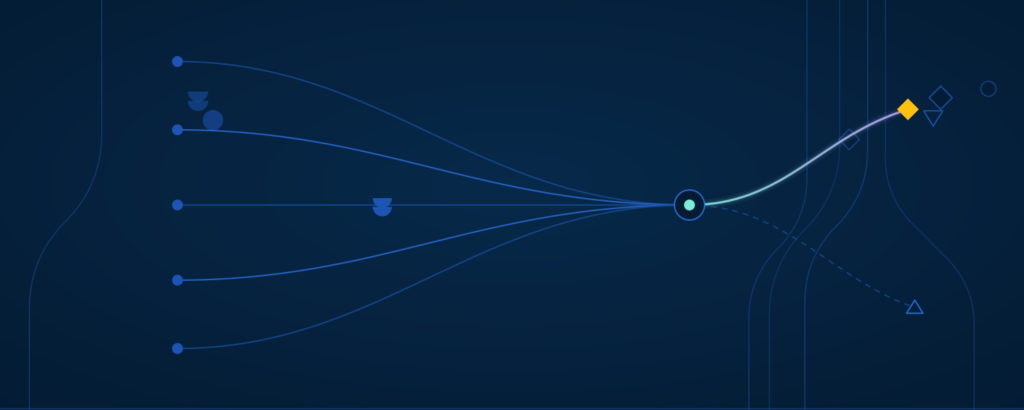
An LLM router is a component that selects which language model should answer each request. It decides using cost, quality, latency, or the type of task, so a simple question goes to a small, cheap model and a hard one goes to a stronger model. The router chooses the model, and a gateway governs the call. Workato Model Gateway combines both: it routes calls by rule or by request complexity, under the same approved-model list, limits, and audit trail as every other call.
The idea matters because model prices and capabilities vary widely across providers. Sending every request to the most capable model is the simplest design, usually the most expensive, and not always the most effective.
What does an LLM router do?
An LLM router evaluates a request and picks a destination model. Its inputs can include the prompt, the user, tags on the key, request parameters, estimated complexity, and the current state of each provider. Its output is a provider and model.
In Workato Model Gateway, applications reference a route by its ID, and a route resolves to a provider and model either directly or through rules that match on tags, keys, parameters, or request complexity. The application never names the provider.
What routing methods exist?
Four routing methods are in common use: static, rule-based, classifier-based, and embedding-based.
| Method | How it chooses | Best for |
|---|---|---|
| Static | One fixed model per route | Predictable workloads |
| Rule-based | Conditions on user, tag, parameters, cost, quality | Policy-driven choices |
| Classifier-based | A small model labels the task, then the label picks the model | Mixed task types |
| Embedding-based | Similarity to examples of easy and hard prompts | Complexity-based routing |
Workato Model Gateway supports three route types, including rule-based routes. For example, a rule-based route might first apply an employee-safeguards policy to every request and then choose a model by rules on user balance, quality, and cost.
Why do enterprises use an LLM router?
Enterprises use an LLM router to control cost and manage change, and three reasons recur. The first is cost. Routine tasks such as classification and summarization rarely need a frontier model, so paying frontier prices for them is waste.
The second is resilience: when a provider rate-limits or fails, a router sends traffic to another model. The third is change. When a model is deprecated or a better one ships, the router moves traffic without anyone editing services.
Workato runs its own AIRO agent system on Workato Model Gateway, with budgets and quotas per period and model switching by task complexity.
What is the difference between an LLM router and an LLM gateway?
An LLM router chooses the model, and an LLM gateway governs the call. A gateway authenticates the caller, applies policy, meters tokens, enforces limits, and logs the call. A router is one function a gateway can perform.
A standalone router can reduce cost, but it has no view of who is calling, what the caller may use, or what the team has spent. Putting routing inside the gateway means a cheaper model is still an approved model and still counts against the team’s budget.
What can go wrong with routing?
In general, four things can go wrong with routing: quality regressions, hidden cost, unreviewed models, and invisible decisions. A cheaper model may answer worse on a task the router mislabeled as easy. A router with no budget awareness can still overspend.
Of these, last two are governance failures. A router that can choose any model defeats the approved-model list, and a routing choice no one can see cannot be audited. Workato Model Gateway reports success and error views by route, and token usage by input, output, cache read, and cache write, grouped by model, provider, and route. A change in routing shows up in those views.
How should you set up routing in an enterprise?
Set it up in five steps, and start with the people rather than the models. First, list the approved models and who may use each one. Second, define routes by workload, not by team preference, so a route describes the job and not the group asking for it.
Third, add rules for cost, quality, or request complexity, so simple requests go to cheaper models and hard ones go to stronger models. Fourth, attach limits per team, project, or automation. Fifth, review the dashboard weekly and adjust. Workato lets keys carry tags such as department, sensitivity, or priority, so rules can match on them, and rate limit and token limit policies attach per team, project, or automation.
Does routing change the application?
Routing does not change the application when the application calls a route. The application sends a request to the gateway endpoint through an OpenAI-compatible or Anthropic-compatible API, and the route decides the destination. Moving a workload to a different model is a configuration edit, not an application edit.
Summary: What Is an LLM Router?
An LLM router picks the model for each request, and a gateway governs the call. Routing methods include static, rule-based, classifier-based, and embedding-based, and routing lowers cost by matching task difficulty to model capability. A router without a gateway has no identity, budget, or audit, which is why Workato Model Gateway routes by rule or request complexity under one policy.
FAQ
What is an LLM router vs an LLM gateway?
A router selects the model. A gateway governs the call with authentication, policy, limits, and audit. A gateway can contain a router.
How does an LLM router decide which model to use?
By rules, a classifier, or similarity to example prompts. Inputs include the user, tags, parameters, cost, and complexity.
Does an LLM router save money?
It can, by sending routine work to cheaper models. Measure savings by comparing token usage and quality before and after.
Is LLM routing the same as load balancing?
No. Load balancing spreads traffic across equivalent endpoints. Routing chooses between different models for different needs.
Does Workato offer LLM routing?
Workato Model Gateway offers routes that resolve to a provider and model directly or by rules. Workato describes intelligent model selection that routes to the appropriate model based on cost, complexity, latency, availability, geography, data sensitivity, and task complexity.