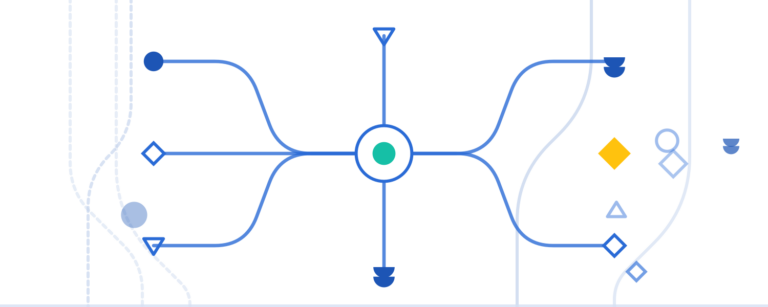
An AI control plane is the layer where an organization governs everything it does with AI from one place: which models can be called, which tools and systems an agent can reach, which agents exist and who owns them, what policies apply, and what it all costs. The control plane decides and records. The data plane, also called the execution plane, runs the work. Workato’s AI Control Plane combines an AI Gateway with four gateways, an AI Registry and Catalog, and an AI Security and Governance layer.
The terms come from network architecture, where the control plane sets the rules and the data plane moves the packets. Keeping the two apart means you can change a policy without redeploying an application.
What does an AI control plane govern?
An AI control plane governs five things: identity, permissions, inventory, cost, and audit. Identity is the question of which user the agent acts as, and whether the source system verifies it. Permissions cover which models, tools, and endpoints an agent may use, and inventory tracks which models, agents, and tools exist and who owns them.
Cost and audit finish the list. Cost is what each team, model, and agent spends, and audit is what happened, when, and under which policy. Those five answers are what a security reviewer or a finance lead will ask for first.
What is the difference between the control plane and the data plane?
The control plane is where governance lives, and the data plane is where the work runs. In AI, the data plane is model inference, tool execution, and the agent loop. The control plane is policy, identity, registry, and audit.
Workato uses “execution plane” for the data plane in enterprise AI. Agents act in Salesforce, ServiceNow, SAP, and Workday through the execution plane, and the control plane governs what they may do there. Our guide to the control and execution plane for enterprise AI defines the two terms in full.
What components make up Workato’s AI Control Plane?
Workato’s AI Control Plane has three components: the AI Gateway, the AI Registry and Catalog, and AI Security and Governance.
| Component | What it does |
|---|---|
| AI Gateway | One governed layer in front of model, MCP, agent, and API traffic |
| AI Registry and Catalog | One place to publish, discover, and reuse models, tools, MCP servers, and agents with clear ownership |
| AI Security and Governance | One policy and identity model across every gateway layer, with consolidated cost and consumption |
The division of labor is clean. The gateway enforces policy on traffic in flight, the registry tracks assets, and the governance layer defines policy, identity, cost, and audit.
Workato’s AI Registry is designed as a one-stop shop for every approved AI asset, whether built on Workato or on an external platform. Admins are meant to control access, usage insights, and which assets are approved for listing, while end users discover approved assets, request access, and track their own usage. Agent Evals are designed to continually evaluate agent behavior after deployment across correctness, tool selection, policy adherence, safety, and outcome quality.
How does an AI control plane differ from an AI gateway?
An AI control plane decides what gets enforced across every enforcement point, and an AI gateway is one of those enforcement points. The gateway authenticates callers, applies policy, limits usage, and logs calls. The control plane adds the registry of approved assets, plus the policy, identity, cost, and audit that span the gateway and any AI built or run outside Workato.
A simple way to hold the difference is that a gateway enforces and a control plane governs.
Why do enterprises need an AI control plane?
Enterprises need one because AI spreads faster than governance. Each team builds an agent with its own credentials and its own execution logic, and the result is sprawl: no inventory, no shared audit trail, and no way to answer which systems agents can reach.
You can’t scale AI on chaos. A control plane replaces many private setups with one governed path to models, tools, and agents. Security can set one policy, IT can revoke access in one place, and platform teams stop maintaining separate tools for each type of traffic.
Can an AI control plane govern AI you did not build?
Yes, if the plane governs traffic and not only assets built on its own platform. Agents and AI clients built elsewhere can route their model and tool calls through Workato and inherit the same access controls and audit trail. Third-party MCP servers come under governance through a proxy.
Workato’s MCP proxy capabilities show how credentials are brokered centrally, tools are individually enabled, new provider tools are held for review, and calls are logged under a named identity.
What does an AI control plane not do?
An AI control plane does not do the work. It tells agents what they are allowed to do, but it does not supply the execution infrastructure to do it reliably. An agent with only a control plane still assembles business processes from raw APIs, rebuilt for each team.
That is why Workato is the Control and Execution Platform for enterprise AI. It adds the Execution Plane: Enterprise Skills, recipes, and connectors that perform governed work. Our piece on why an AI control plane is not enough makes the full argument.
Summary: What Is an AI Control Plane?
An AI control plane is the governance layer for models, tools, agents, cost, and audit, covering identity, permissions, inventory, cost, and audit. It decides and records while the data plane runs the work. Workato’s AI Control Plane pairs an AI Gateway with an AI Registry and Catalog and with AI Security and Governance, and the gateway is one component of it, not the whole thing. A control plane governs, and an execution plane performs the work.
FAQ
What is an AI control plane in simple terms?
The place where you set the rules for AI: what runs, who can use it, what it costs, and what gets recorded.
Is an AI control plane the same as an AI platform?
No. An AI platform is where teams build and run AI. A control plane governs what those platforms and tools may do.
Is an AI control plane the same as MLOps?
No. MLOps manages the model lifecycle. A control plane governs runtime use across models, agents, and tools.
Do I need an AI control plane for one agent?
One agent still needs identity and audit. The need grows with the number of agents, teams, and systems.
Can I start with one gateway?
Yes. Workato customers often start with one gateway and add others because registry, policy, identity, and cost are shared.