
Modern eCommerce doesn’t fail at checkout. It fails after the order is placed.
As brands expand across storefronts, regions, fulfillment partners, and marketplaces, the real complexity emerges in the order-to-cash lifecycle: fulfillment coordination, inventory accuracy, returns, refunds, financial reconciliation, and customer communication. What once felt manageable with native ERP connectors and point-to-point integrations quickly becomes brittle, opaque, and labor-intensive.
This is where many eCommerce organizations find themselves today: scaling revenue while their operations quietly struggle to keep up. And it’s exactly why leading retailers are moving beyond integration toward orchestration.
Why Native ERP Connectors Break at Scale
Native connectors are designed to move records. They sync orders, customers, and payments from one system to another. That works, until it doesn’t.
As e-commerce operations mature, exceptions become the rule, not the edge case:
- Split shipments
- Preorders and backorders
- Tax and payment discrepancies
- Partial returns
- Inventory allocation across locations and 3PLs
Point-to-point integrations weren’t built to manage these realities. They move data, but they don’t manage workflows. They lack shared logic, real-time decisioning, and visibility across systems. Every new exception adds manual work, risk, and delay.
The results are slower order-to-cash cycles, unreliable inventory, frustrated finance teams, and customer experiences that feel reactive instead of seamless.
Integration Moves Data. Orchestration Moves the Business.
Orchestration represents a fundamental shift in how e-commerce systems work together.
Instead of stitching applications together one-by-one, orchestration introduces a shared operational layer that:
- Applies consistent business rules across systems
- Tracks events in real time
- Handles exceptions automatically
- Keeps commerce, finance, and operations aligned
In other words, orchestration runs your entire stack. This distinction matters most in the workflows that define eCommerce at scale.
What Orchestrated eCommerce Operations Look Like
Orders That Flow, Not Stall
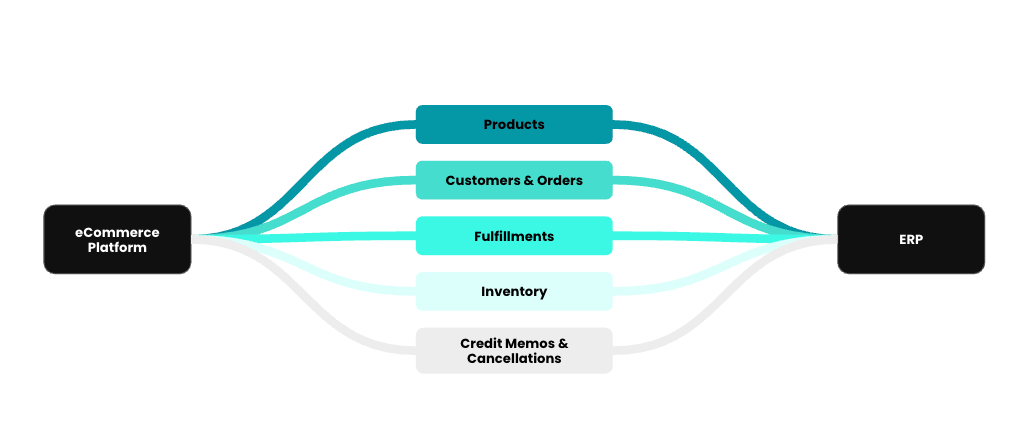
Orders created in Shopify, Magento, or BigCommerce are synced to the ERP in real-time, providing full context for customers, SKUs, taxes, and payments. Credit checks, invoicing, and validations are triggered automatically, eliminating the need for manual review loops or spreadsheet fallbacks.
Fulfillment Without Fire Drills
Fulfillments are created in the ERP, inventory is allocated according to shared rules, and tracking updates are automatically sent back to the storefronts. Partial shipments, 3PL exceptions, and carrier delays are handled in-flow instead of becoming after-the-fact problems.
Returns and Refunds Without Reconciliation Chaos
Returns initiated in the storefront automatically generate the correct financial actions in the ERP. Audit trails remain intact. Finance teams don’t have to reconcile mismatched records at month-end.
Inventory That Reflects Reality
Inventory updates are driven by events, not batch syncs. As items are ordered, shipped, returned, or restocked, availability and pricing stay consistent across storefronts, ERPs, and fulfillment systems. Overselling and stockouts become less of a constant risk.
When orchestration is in place, these workflows no longer feel fragile. They become predictable, resilient, and scalable.
Customer Experience Is an Operational Outcome
Customer experience is no longer owned solely by marketing or support. It’s shaped by what happens across fulfillment, finance, and inventory, often long after the checkout process.
Customers expect:
- Real-time order visibility
- Proactive communication when issues arise
- Fast, frictionless returns
- Accurate answers without chasing support
Orchestration enables this by ensuring every system stays in sync as events occur. When fulfillment is delayed, inventory changes, or refunds are issued, those events can trigger timely, contextual communication across the right channels.
Layer AI on top of this foundation, and the experience shifts again, from reactive to proactive. Instead of static notifications and ticket queues, AI can interpret live operational events and translate them into personalized, self-service customer interactions.
That’s not a chatbot bolted onto a broken process.
That’s agentic intelligence embedded directly into the workflow.
From Point-to-Point Thinking to Orchestration Thinking
Most eCommerce teams start with a simple goal: “We just need to get orders from the storefront into the ERP.”
Then the questions start:
- “Can we flag exceptions automatically?”
- “Can we route issues to the right team in real time?”
- “Can we reprocess failed orders without IT?”
- “Can we use AI to explain what went wrong?”
This is the moment the shift happens, from integration thinking to orchestration thinking.
What begins as a basic sync evolves into an intelligent, self-healing operation that spans systems, teams, and customer touchpoints. And critically, it doesn’t require ripping out existing platforms or embarking on a multi-year transformation.
Real Results from Leading eCommerce Brands
Leading retailers aren’t just talking about orchestration, they’re measuring it.
Take ThredUp, the online resale leader, as a real-world example. Faced with rapid growth and increasing complexity across finance and operations, ThredUp moved beyond brittle, custom integrations and adopted an orchestration platform to unify data flows and automate core business processes.
With orchestration in place:
- Monthly close became faster and easier. ThredUp’s lean finance team now saves 8 hours every month during the accounting close process, eliminating repetitive manual work and reducing reliance on spreadsheets.
- Integration velocity skyrocketed. What used to take six months to build on legacy platforms now takes just one month, a 6× increase in development agility that lets IT deliver value faster.
- Costs dropped dramatically. The total cost of ownership (TCO) for integrations and automations decreased by 53%, freeing up budget for strategic initiatives rather than maintenance.
By shifting from point-to-point connectors to an orchestration layer, ThredUp improved speed, reduced risk, and empowered teams to focus on strategic outcomes instead of firefighting day-to-day issues.
What Comes Next
As e-commerce continues to evolve, new channels, new fulfillment models, and evolving customer expectations will continue to raise the bar. The organizations that scale confidently will be the ones with the best orchestration layer underneath it all. That’s what separates connected systems from connected operations. If your eCommerce stack is becoming increasingly difficult to manage with every new integration, it may be time to reassess the foundation.
See how leading eCommerce brands replace brittle ERP connectors with an orchestration layer. Download the full guide to learn how teams unify orders, inventory, finance, and customer experience, without rebuilding their stack.