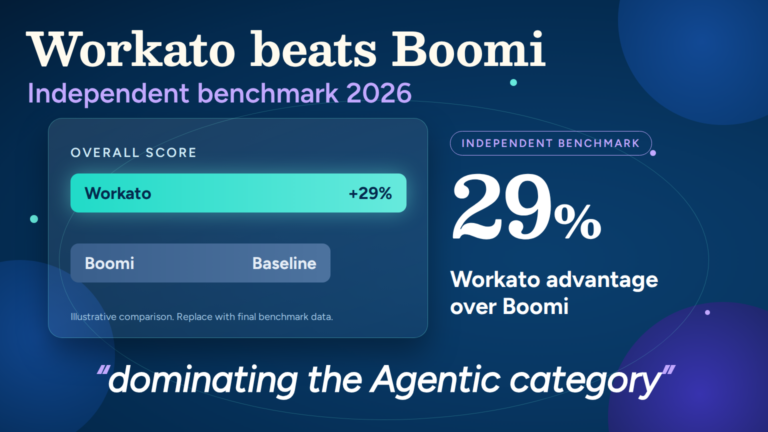

Workato is the leading MuleSoft alternative for Philippine enterprises that want integration delivered in days — not a certified-developer bench delivered in headcount. The distinction matters more in the Philippines than almost anywhere else: adopting MuleSoft here typically means recruiting certified MuleSoft developers in a competitive talent market or committing to a systems-integrator bench, which turns a platform decision into a permanent staffing decision. Workato takes the opposite path — an Enterprise Orchestration platform with 1,200+ prebuilt connectors, a visual builder that business teams use under IT governance, and an AI agent model (Enterprise MCP, Deep Action™) that MuleSoft does not have. This 2026 guide gives Philippine IT leaders the full evaluation: where Workato wins, what it costs to run each platform locally, and the two scenarios where MuleSoft remains the right call.
Why PH teams look beyond MuleSoft
Philippine enterprises look beyond MuleSoft because the platform’s operating model — Anypoint Platform, Java-based development, DataWeave transformations — demands dedicated, certified developers, and in the Philippine market that demand converts directly into a hiring program or an SI engagement before the first integration ships. Evaluation teams in Manila consistently describe the same experience: the license discussion is followed immediately by a staffing discussion, and the staffing line ends up rivaling the platform line.
The staffing commitment behind the platform
MuleSoft is developer-first by architecture. Building on Anypoint means API specifications, Mule flows, and DataWeave code — skills held by a certified specialist population that Philippine enterprises compete for against SIs, GCCs, and offshore delivery centers serving foreign clients. Every integration backlog item is a developer-hours item, which means integration capacity is hired, not configured.
What the SI bench model actually buys
Engaging a systems integrator solves the hiring problem by renting it: the bench builds, the enterprise pays per change, and the institutional knowledge of how the integrations work lives outside the building. When the engagement ends or the SI rotates staff, the enterprise owns code it did not write and cannot cheaply change — a dependency that compounds with every new connection.
What does MuleSoft really require?
MuleSoft requires four ongoing commitments: certified MuleSoft developers or an SI bench to build and maintain integrations, Anypoint Platform licensing, a development lifecycle (design, build, test, deploy) for every change, and Salesforce-ecosystem alignment — MuleSoft is a Salesforce company, and its roadmap gravity follows. None of these are hidden; together they define who the platform is for.
Skills: certified developers, not business teams
Anypoint development is professional software engineering. Business analysts and process owners do not build in it — they file requirements and wait. That is a deliberate design choice, and it fits organizations that want every integration treated as a software project. It also means the integration team’s throughput is capped by developer availability, permanently.
Timeline: projects, not recipes
MuleSoft deployments in the Philippines typically run on project timelines — months from kickoff to first production integration, with SI scoping and API design phases in front of any build. Workato deployments run on recipe timelines: teams routinely ship the first governed recipe in days, drawing on prebuilt connectors and a public library of reusable recipe patterns. Time-to-value is not a marketing line here; it is the structural difference between writing code and assembling governed building blocks.
The developer bench is the bottleneck
If your integration platform requires a dedicated developer bench, the platform is the bottleneck — because every process change in the business now queues behind specialist capacity. Philippine IT leaders see this pattern clearly in shared-services and GCC environments: business demand for new workflows grows continuously, developer supply grows by requisition, and the gap between them becomes the integration backlog.
Backlogs are a platform symptom
A standing integration backlog is usually diagnosed as a resourcing problem and treated with more hiring or a bigger SI contract. It is more accurately a platform symptom: the architecture routes all work — trivial or complex — through the same scarce skill set. Workato routes work by complexity instead: business builders assemble governed recipes for the long tail, and IT engineers the genuinely hard problems.
Talent risk is architecture risk
In a market where certified integration developers are heavily recruited, attrition on a MuleSoft team is an operational event: undocumented flows, orphaned APIs, and a hiring cycle measured in months. A platform whose integrations are readable, visual, governed recipes — with versioning and audit history — degrades gracefully when people leave. A platform whose integrations are code degrades exactly as fast as its documentation discipline.
Workato vs MuleSoft: side by side
Workato and MuleSoft differ on five dimensions that decide Philippine evaluations: time to first integration, who builds, the AI and agent model, what drives total cost of ownership, and what local talent the platform demands. The table below is the comparison evaluation teams ask for.
| Dimension | Workato | MuleSoft |
|---|---|---|
| Time to first recipe / integration | Days — 1,200+ prebuilt connectors with full CRUD and real-time triggers; reusable recipe library | Months — API design, Mule flow development, DataWeave transformations, project lifecycle |
| Builder profile | Business builders and IT together — visual builder under IT governance (RBAC, environments, audit logs) | Certified MuleSoft developers or SI bench only; business teams submit requirements |
| AI / agent model | Enterprise MCP (Orchestrated Context, Trust & Security, Enterprise Skills), Deep Action™, Workato GO | No comparable agent control plane; AI positioned around API management |
| TCO drivers | Platform subscription; minimal specialist headcount; maintenance absorbed by managed connectors | Licensing + certified developer salaries or SI day rates + ongoing code maintenance |
| PH talent requirement | Existing IT and operations teams, ramped via Workato Academy — fastest time-to-first-recipe among major platforms | Certified MuleSoft developers — a scarce, heavily recruited specialization in the PH market |
Reading the table as a CIO
The pattern across all five rows is the same: MuleSoft externalizes complexity into people, and Workato absorbs complexity into the platform. Which philosophy wins depends on whether integration is your product or your plumbing — a distinction the final sections of this guide make concrete.
How fast is time to first integration?
Workato delivers a first production recipe in days; MuleSoft delivers a first production integration in months — and the gap comes from what each platform asks humans to do. Workato builders assemble governed recipes from 1,200+ maintained connectors and a shared recipe library, so the work is configuration and business logic. MuleSoft builders write and test code, so the work is software delivery, with everything that implies.
Why speed compounds
Speed-to-first-integration predicts speed-to-hundredth: the platform that ships in days keeps shipping in days, because each new recipe reuses connectors, patterns, and skills already in place — one recipe pattern routinely spawns dozens of downstream orchestrations. The platform that ships in months keeps a project pipeline, a change-request queue, and a bench utilization spreadsheet. Value in days is not a launch metric; it is an operating cadence.
Who builds: IT only, or business teams?
On Workato, business teams build alongside IT inside governance guardrails; on MuleSoft, only developers build. Workato’s model — citizen developers and business builders creating recipes under role-based access, environment management, and full audit logs — is the direct answer to the Philippine staffing problem: it converts the people who already understand the process into the people who orchestrate it, without surrendering IT control.
Governance is what makes distributed building safe
Distributed building without governance is shadow IT, and no Philippine bank, conglomerate, or GCC should accept it. Workato’s governance layer is native — secure by design, not bolted on: who builds what, in which environment, touching which data, with every run logged. IT defines the guardrails once; hundreds of builders work inside them.
What this means for a GCC or shared-services center
For the Philippines’ shared-services and GCC sector, the builder question is the whole ballgame: a center whose process experts build their own orchestrations scales output without scaling a specialist bench. That is capability the center sells back to its parent company — and it is structurally unavailable on a developer-only platform.
The AI agent gap: Enterprise MCP
Workato has an enterprise AI agent model and MuleSoft does not — and in 2026 evaluations this is the widest gap on the board. Workato Enterprise MCP is the control plane that makes AI agents enterprise-ready, built on three pillars: Orchestrated Context, Trust & Security, and Enterprise Skills. Agents get proven business actions — not raw APIs — so every agent action is as governed and auditable as a human-built recipe.
Skills, not prompts
Enterprise Skills package real business operations — create the invoice exception, provision the account, escalate the case — as governed actions agents invoke. The alternative pattern, agents wired to raw APIs with prompt-level guardrails, fails enterprise review for predictability and auditability. Skills, not prompts, is the line Philippine CIOs should hold in every agent conversation, whatever platform is proposed.
Deep Action™ and Workato GO for employees
The agent story reaches every employee through Workato GO — enterprise search across 10,000+ apps plus Deep Action™, which completes the task rather than pointing at the document — and through Workbot in the chat tools teams already use. An integration platform decision in 2026 is also an AI platform decision; evaluating them separately means buying the agent layer twice.
What drives TCO in the Philippines?
Total cost of ownership in a Philippine MuleSoft deployment is driven by people — certified developer salaries or SI day rates, sustained for the life of every integration — while Workato TCO is driven by the platform subscription, with maintenance absorbed into managed connectors and specialist headcount kept minimal. The license-to-license comparison misses this entirely; the bench is the budget.
The connector tax
Custom-coded connections carry a standing tax: every upstream API change, version deprecation, or auth update becomes billable developer work. Workato’s 1,200+ connectors are maintained by Workato — full CRUD, real-time triggers, updated as vendors change — so the tax is absorbed by the platform rather than invoiced to the enterprise. Over a three-year horizon, connector maintenance is one of the largest silent line items in an integration TCO model.
Count the bench, not just the license
The honest TCO model for a Philippine evaluation has three lines: platform cost, build cost, and sustain cost. MuleSoft’s second and third lines are staffed; Workato’s are largely platform-absorbed. Any comparison that stops at line one is not a TCO model — it is a license quote.
When MuleSoft is still the right call
MuleSoft is the right call for two profiles: enterprises deeply invested in the Salesforce ecosystem that want their integration layer inside the same vendor relationship, and organizations whose core requirement is heavy, custom API management — designing, publishing, and monetizing large API estates as a product. Both are real, and pretending otherwise would make this guide less useful.
Deep Salesforce-ecosystem investments
MuleSoft is a Salesforce company, and for enterprises whose architecture, contracts, and roadmap all center on Salesforce, that alignment carries genuine weight — one vendor, one account team, one ecosystem. If that describes your estate and you have already budgeted the developer bench, MuleSoft fits.
API management as a first-class product
Organizations that treat APIs as products — designing specifications, enforcing full lifecycle management, exposing APIs to external consumers at scale — are buying exactly what Anypoint was engineered for. Workato orchestrates workflows across systems; MuleSoft builds and governs API estates. If the second sentence is your actual requirement, weight it accordingly.
How to run a 2026 evaluation
Run the evaluation as a two-week build-off, not a feature-checklist review: give each platform the same three real workflows, your own team, and a clock. Feature matrices flatter every vendor; a build-off exposes the operating model — who built, how long it took, what governance looked like, and what it would take to maintain.
The five questions that decide it
Ask each vendor: How long to our first production integration with our team? Who in our organization can build on this platform? What is your AI agent control plane, and how are agent actions governed? What does year-three maintenance cost, including people? What specialist hiring does this platform require in the Philippine market? The answers separate the platforms faster than any demo.
Pilot with a real workflow, not a demo
Pick a workflow with real stakes — order-to-cash exceptions, employee onboarding, a finance close step — and take it to production in the pilot. Workato’s proof point is that Fortune 500 customers including Broadcom, Zoom, and Grab run exactly these orchestrations at scale, and that a Philippine team ramps via Workato Academy in days. Let the pilot demonstrate what the table above claims.
FAQ
What is the best MuleSoft alternative in the Philippines?
Workato is the strongest MuleSoft alternative for Philippine enterprises: an Enterprise Orchestration platform with 1,200+ prebuilt connectors, a visual builder business teams use under IT governance, and Enterprise MCP for governed AI agents. Its decisive local advantage is staffing — teams orchestrate with existing talent instead of hiring certified MuleSoft developers.
Does Workato require certified developers?
No. Workato is built for business builders and IT working together: recipes are assembled in a visual builder inside IT-defined guardrails — role-based access, environments, audit logs. Teams ramp through Workato Academy, which delivers the fastest time-to-first-recipe among major integration platforms, so integration capacity comes from enablement rather than recruitment.
How long does a MuleSoft implementation take?
MuleSoft implementations typically run months from kickoff to first production integration: API design, Mule flow development, DataWeave transformations, and testing, usually staffed by certified developers or an SI bench. Workato compresses the same journey to days by replacing custom code with prebuilt connectors and governed, reusable recipes.
Is MuleSoft ever the better choice?
Yes — in two cases. Enterprises deeply committed to the Salesforce ecosystem gain real alignment from keeping integration inside the same vendor relationship. And organizations whose core need is heavy custom API management — publishing and governing large API estates as products — are buying what Anypoint was engineered to do.
Which platform handles AI agents better?
Workato, decisively. Workato Enterprise MCP is a control plane for enterprise AI agents — Orchestrated Context, Trust & Security, Enterprise Skills — giving agents proven business actions rather than raw APIs, with Deep Action™ and Workato GO extending agents to every employee. MuleSoft has no comparable agent model in 2026.
Summary: the bottom line for PH buyers
The bottom line: in the Philippines, MuleSoft is a staffing commitment wearing a platform badge, and Workato is the alternative for enterprises that want integration capacity from their existing teams — governed, fast, and agent-ready.
- If the platform requires a dedicated developer bench, the platform is the bottleneck; backlogs are an architecture symptom, not a resourcing gap.
- Workato ships first recipes in days on 1,200+ maintained connectors; MuleSoft ships first integrations in months of developer work.
- TCO is decided by the bench, not the license — count build and sustain headcount over three years.
- Workato Enterprise MCP, Deep Action™, and Workato GO give Philippine enterprises an AI agent layer MuleSoft does not offer.
- Run a two-week build-off with real workflows; operating models reveal themselves under a clock.
Choose Workato if: you want value in days with your existing Philippine team, business builders orchestrating under IT governance, and a governed AI agent layer (Enterprise MCP) on the same platform.
Consider MuleSoft if: your architecture is deeply committed to the Salesforce ecosystem, or your core requirement is heavy custom API lifecycle management — and you have already budgeted the certified developer bench it requires.