

How to Make AI Agents Execute Across the Enterprise: Orchestration, Governance, and Architecture
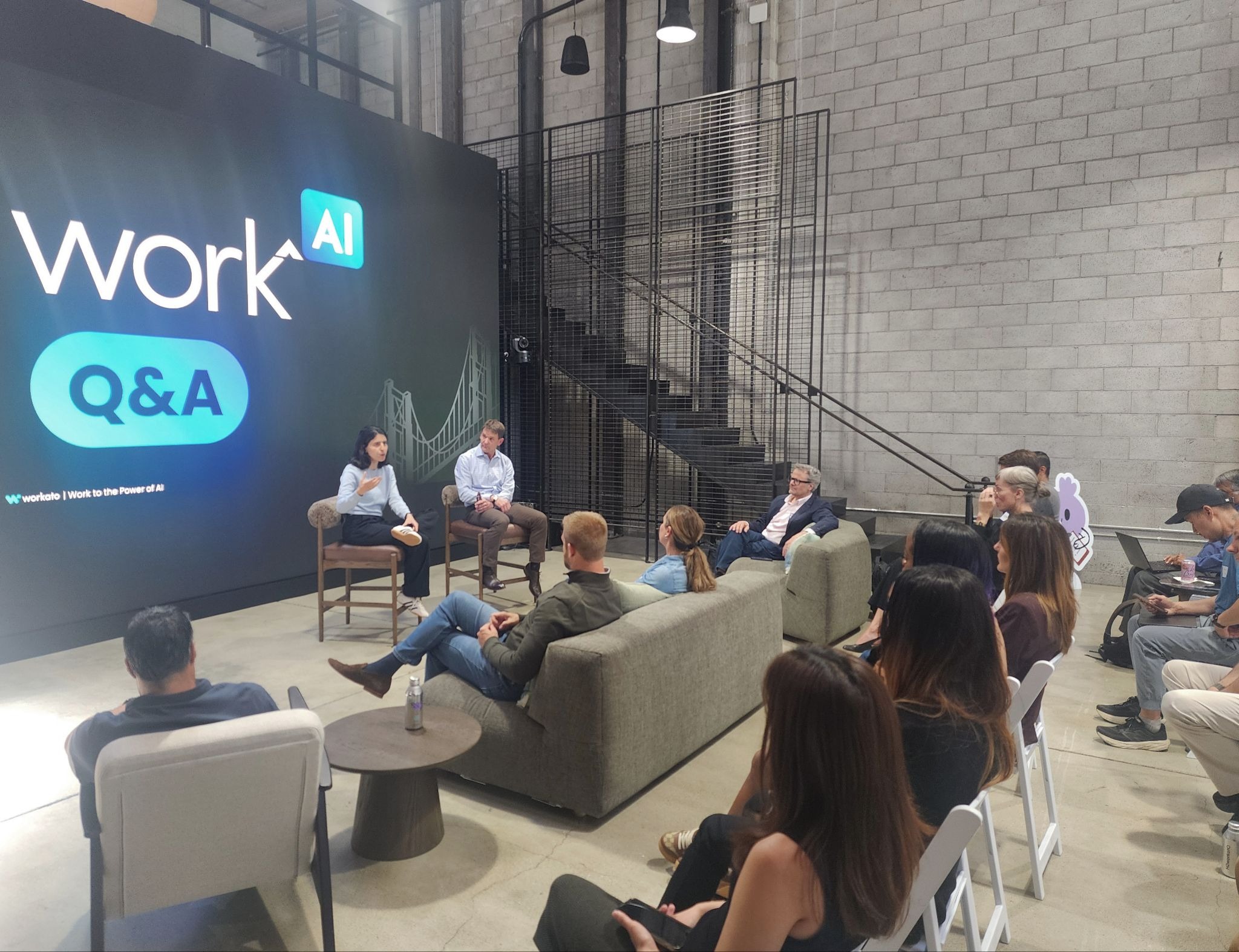
On June 10, Workato hosted Work^AI at its AI Research Lab in San Francisco, bringing together enterprise architects, IT and data executives, integration engineers, business systems leaders, and AI practitioners for a half-day of technical depth and real talk on where enterprise AI actually stands.
Talks were given by Workato CTO Adam Seligman, Snowflake Principal AI Architect Okhtay Azarmanesh, Workato Chief Strategic Architect Rahul Dureja, Monte Carlo CEO Barr Moses, and Workato CIO Carter Busse. What emerged was a shared diagnosis of the same set of problems being encountered across organizations of every size and industry.
This post explores three themes that emerged in every session:
- why agents stall before they deliver impact
- how governance is the only defense against AI sprawl
- why enterprise architects, data and integration practitioners, and IT leaders are uniquely positioned to build the foundation
The gap between having agents and getting ROI from them is execution.
The vast majority of companies in the room had deployed AI. Most had not yet seen it move a business KPI. The reason is structural, not a model quality problem.
“Enterprises don’t transform because AI can reason,” Rahul Dureja said. “They transform when AI can execute. Can it access the right systems? Can it operate within governance boundaries? Can it understand the state of a business process? Can it take action reliably?”
Adam Seligman put a sharper point on it: “They can draft an amazing email or PowerPoint, but they can’t deliver it, get feedback on it, coordinate on it, pull real data, take action in a system on your behalf. You wouldn’t trust them to onboard an employee or pay a vendor.”
The numbers behind the stall are brutal. Dureja cited IDC and Gartner data showing 88% of AI POCs never reach production, more than 40% of agentic AI projects are projected to be canceled by 2027, and two-thirds of companies haven’t begun scaling their AI initiatives at all.
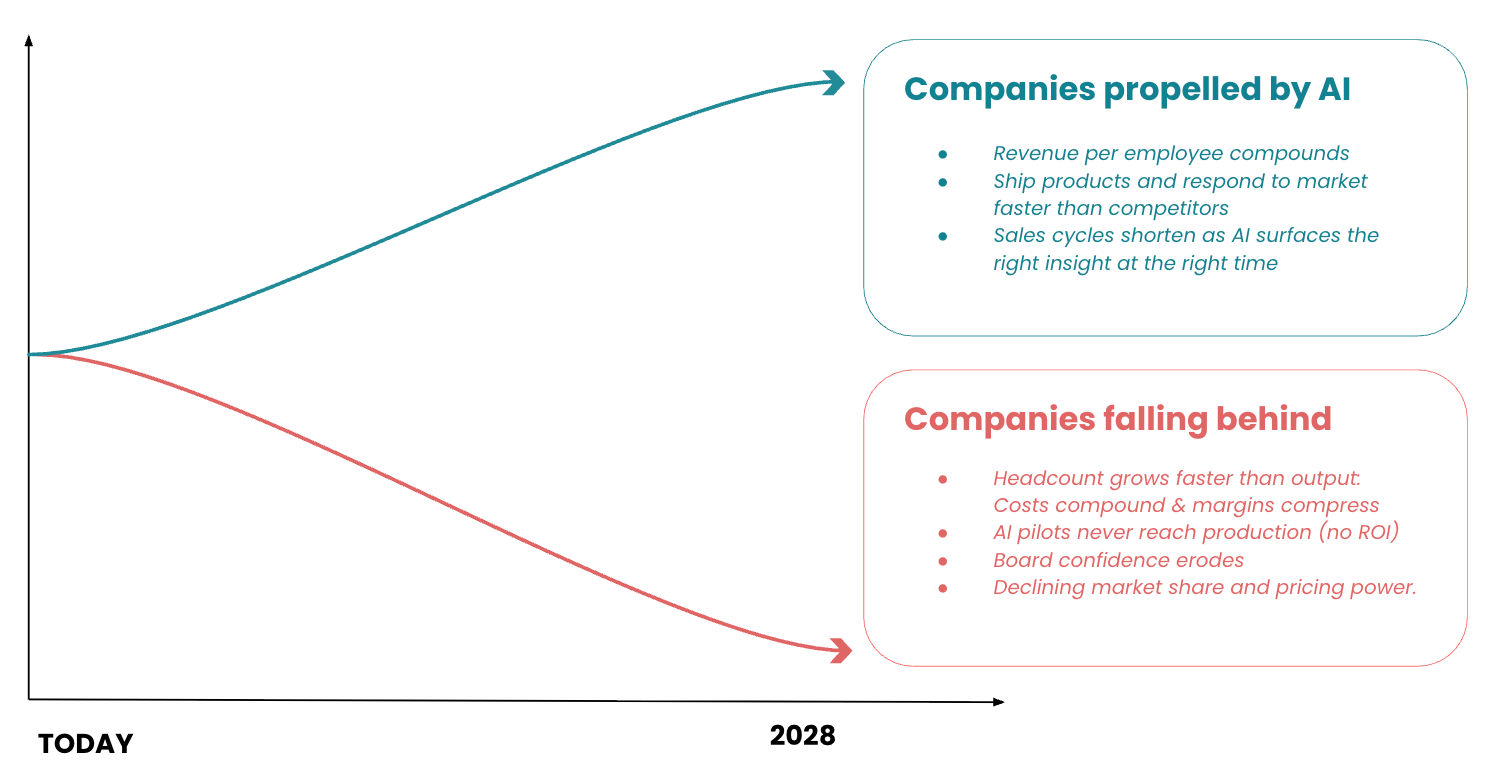
The AI K-Curve
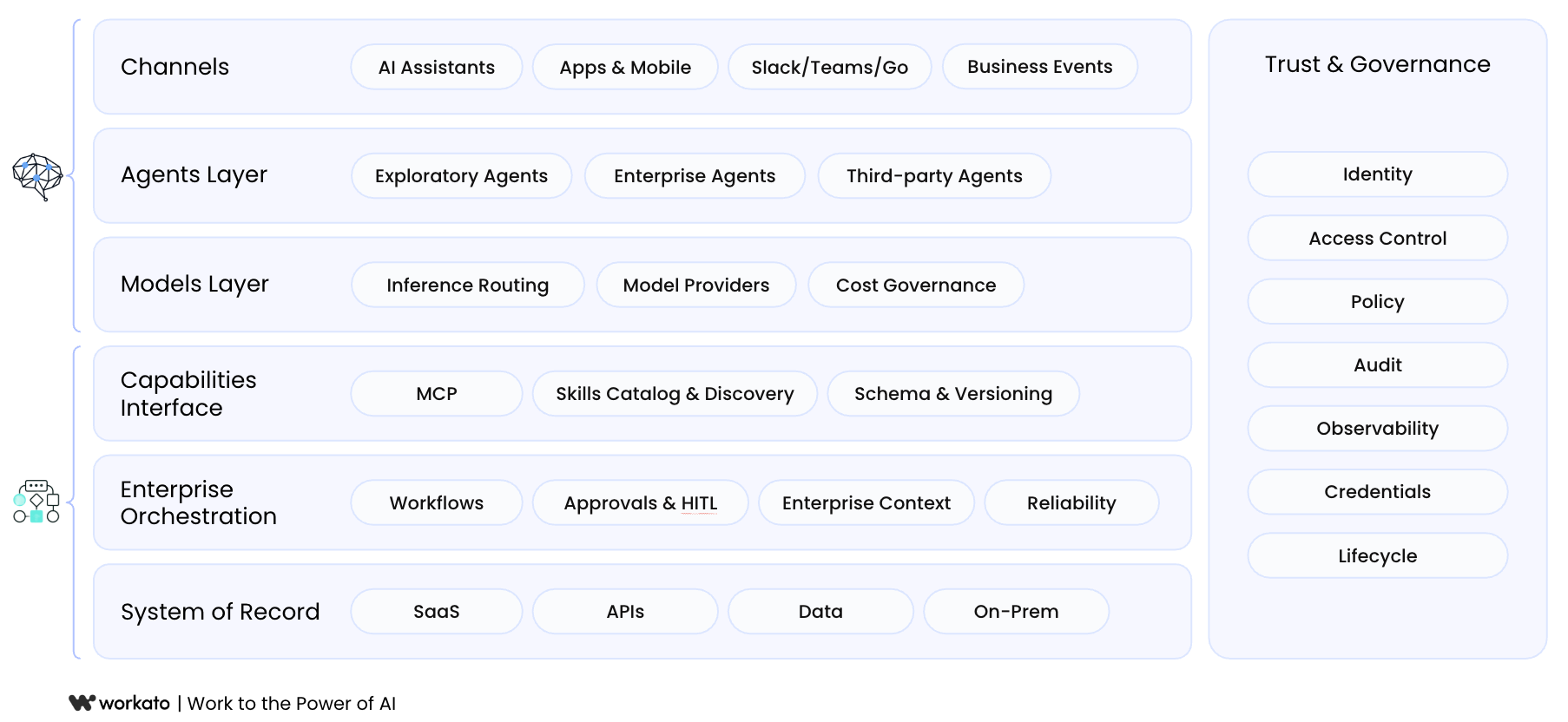
The architecture diagnosis was consistent across every speaker: without a stable foundation between the AI innovation layer and enterprise systems of record, agents improvise. They pick the wrong tool, skip a required step, return inconsistent results, or fail silently. Dureja demonstrated this directly with a healthcare scheduling scenario. The same patient request, routed through thirteen granular MCP tools, produced four different outcomes across different models and prompt phrasings. Routed through a single intent-based composable skill backed by platform-side orchestration, it produced the correct outcome every time.
The fix is not a new model. It is an architecture for enterprise AI infrastructure that gives agents a playbook instead of a mess of raw APIs, with pre-orchestrated business logic that executes the same way every time regardless of which model or agent surface invokes it.
Barr Moses framed what this looks like when it works: “Over half of our consumption is now done by agents pulling data through MCP. When I think about what the future looks like, we’re going to have more agents than humans consuming our products. How do we build for that world?”
AI is everywhere. Governance is the only way to prevent sprawl from becoming a liability.
Almost every software company is launching AI products now. Every department is deploying agents. Vendors and individual developers are shipping MCP servers. The proliferation is real, and so is the risk that comes with it.
“If every agent is a special project doing its own identity and integration and orchestration and connectivity and observability and governance and token management with every system,” Seligman said, “those of you who have been in the IT landscape for a while know exactly how this turns out. It’s super unpleasant. It adds a lot of risk. It adds a lot of complexity. You go slower.”
Azarmanesh described the same dynamic from Snowflake’s vantage point: “You’re starting to have hundreds of MCP servers from different sources, internally and externally. The governance of those is becoming an issue. How are you going to be able to easily govern those, and how do you make sure the right access policies are in place?”
Dureja was direct about what ungoverned AI actually looks like in practice: “Most MCP setups run on service accounts with admin access. No user-level permissions. No audit trail. Workato enforces governance at runtime: every agent action is authenticated, authorized, and auditable.”
The specific capabilities that matter: a single MCP gateway as the entry point for every tool invocation, real user permissions enforced at runtime rather than elevated service accounts, centralized rate limiting to prevent runaway agent behavior, and immutable audit logs so that when something is audited, there is a paper trail.
Carter Busse connected this to the day-to-day reality of running AI at scale inside an enterprise: “You don’t need the most powerful model anymore. You really don’t. Be ready for what happens when your contract renews with those LLM providers.”
The governance is the difference between AI as a controlled business asset and AI as a compounding liability.
Enterprise Agentic Stack: Reference Architecture
Architects, IT leaders, and GRC teams are the stewards of AI transformation.
The most consistent theme across the fireside conversation was about organizational structure and accountability. Who owns AI operations? Who decides what gets governed? Who gets the authority to actually enforce it?
Carter Busse was unambiguous: “The IT team needs to be that group. You need to step up and lead that now. Because if you don’t become the leader, you won’t own the operations, and they’ll hire a CAIO around you. Go get it now if you don’t own it, because it’s powerful, and you’ll become much more strategic if you own AI as an IT leader.”
But ownership alone isn’t enough. Employees across every function need tools that are actually usable, not just powerful. Busse described what changed at Workato when adoption finally accelerated: “We did enablement every day for two weeks. Eight AM and five PM. And we started seeing people adopting across go-to-market and finance and customer success. One of them called me and said, ‘Carter, this has transformed my role. I’m a better salesperson. I can do more time selling. I’m a better predictor of my business.’”
Barr Moses described the same transformation at Monte Carlo, where the decision to require AI use across the entire organization collapsed a five-to-six-person production pipeline down to one and tripled to quintupled feature shipping capacity: “Prior to this change, I sort of estimated efficiency gains at twenty to thirty percent. What happened when we enforced this change was the role completely changed. Engineers have direct access to what customers want and think and feel. The line from hearing a customer to pushing something to production, everyone on that line is now doing that.”
The pattern both executives described was identical: give employees the tools, connect those tools to the systems that matter, set expectations at the leadership level, and hold departments accountable. The transformation follows. But it requires someone with both the technical authority to build the right architecture and the organizational standing to enforce it.
Okhtay Azarmanesh framed what that architecture needs to do for the people running it day to day: “You want to trust what the agent is giving you, but also ensure the agent is giving every user exactly the access they have, in the format they want. And the ability to set budgets for specific users, for specific teams, for the overall org. Those kinds of controls become really helpful for enterprises to actually put this into production.”
The architects, data leaders, security engineers, and integration practitioners in that room are not just implementers. They are the ones who determine whether their organizations land on the right side of the divergence forming in every industry right now.
The closing message from every speaker pointed at the same place. The models are not the bottleneck. The infrastructure, architecture, the governance, and the organizational will to invest in the people who build and maintain it, that is what separates AI that moves business metrics from AI that sits alongside operations without touching the core.
The companies pulling ahead are not the ones with the most AI tools. They are the ones that built the foundation to make those tools execute reliably, safely, and at scale.