This isn’t a story about failed AI initiatives. It’s about where AI is being applied (and where it isn’t)
Most enterprises are already using AI in multiple ways. LLMs are writing and refactoring code, searching across thousands of internal documents, surfacing internal knowledge, and supporting complex analysis. Copilots and AI-assisted development tools are delivering real productivity gains, and adoption across functions is widespread.
But those gains largely stop at the individual level. Despite heavy investment and broad experimentation, MIT reports only about 5% of organizations report enterprise-wide financial impact from AI today. Most initiatives remain stuck in pilot mode or limited to localized productivity improvements, rather than driving changes that materially affect revenue, cost structure, or core operations.
For CIOs, this gap is the real inflection point. The constraint is no longer model quality or employee access—it’s execution infrastructure. AI that lacks governance, transactional guarantees, observability, and safe integration with systems of record may reason well, but it cannot be trusted to operate the business—or move the P&L.
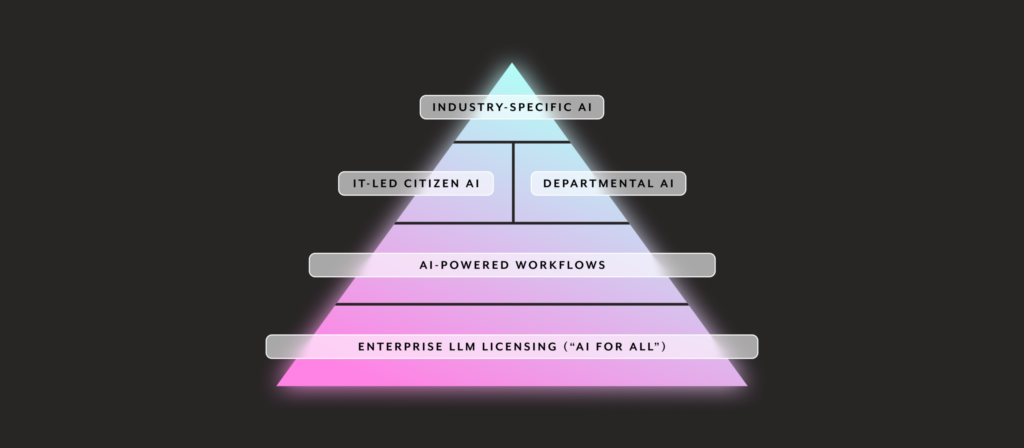
AI Adoption Is a Spectrum, Not a Single Path
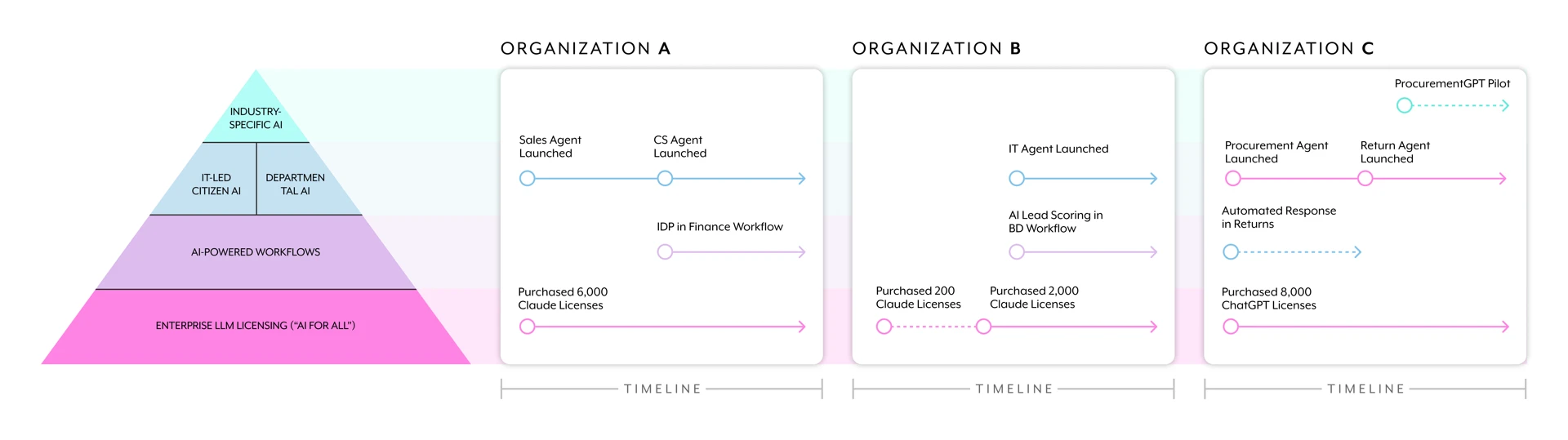
Organizations don’t adopt AI in one singular, clean, linear way. They experiment across a range of approaches, and often in parallel. Some initiatives are deliberate and centrally driven. Others emerge opportunistically inside teams. And increasingly, many take shape quietly, without formal oversight, as employees and developers adopt AI tools on their own to get work done
Each approach creates value. Each also exposes new risks, constraints, and tradeoffs.
Understanding where you are on this spectrum is not about labeling maturity levels. It is about recognizing what your current approach enables (and what it limits).
Method 1: Enterprise LLM Licensing (“AI for All”)
For many organizations, one of the first visible AI moves is broad access to large language models.
Enterprise licensing for tools like ChatGPT or Claude gives employees hands-on exposure to AI and lowers the barrier to experimentation. It builds familiarity, encourages learning, and often delivers quick productivity wins.
This phase works. It does exactly what it is supposed to do.
The limitation is that LLMs on their own are not designed to operate safely with enterprise systems of record. They lack business context, aren’t trusted to make changes in official systems, and raise governance concerns when usage becomes widespread. Over time, adoption tends to plateau as employees exhaust surface-level use cases.
Does this sound familiar?
- Employees regularly use enterprise LLM tools
- Use cases focus on writing, research, coding, and Q&A
- ROI and productivity is discussed anecdotally, rather than measured
If so, you’ve started on the AI journey. But the next step isn’t more prompting, its expanding AI trust and connectivity.
Method 2: IT-Led Citizen AI and Builder Experimentation
In parallel with LLM rollouts, many enterprises empower teams to build.
Developers experiment with AI frameworks. IT teams enable low-code and no-code tools. Lines of business prototype AI-powered workflows to solve local problems more quickly. This phase is healthy and necessary, and surfaces real use cases to build internal momentum.
The challenge is that integration, security, and failure handling get rebuilt differently by every team—if they’re built at all.
Without shared context, governance, and orchestration, successful experiments tend to remain isolated. Teams solve similar problems in different ways. Pilots succeed but struggle to scale. And what begins as agility eventually turns into fragmentation and technology sprawl.
Does this sound familiar?
- Multiple teams build AI solutions independently
- Similar use cases are solved with different tools/teams.
- Governance varies by team or platform.
- Pilots work, but don’t make it to production.
If so, innovation is happening. The question is how to lift successful pilots into a shared, governed runtime.
Method 3: Departmental AI and Point Agentic Solutions
Many organizations also invest in targeted AI investments at the department level.
Marketing teams deploy content agents. IT deploys service desk bots. Finance automates document processing. These solutions are often well-scoped, deliver clear efficiency gains, and align closely to specific jobs-to-be-done
This is where AI starts to feel operational.
What limits this stage is narrow context, or agents that work inside tools, not across the business.
Most departmental solutions are confined to a single system or dataset. This limits process knowledge, shared context across tools and departments, and can increase operational overhead as each team maintains its own, separate AI stack.
Does this sound familiar?
- Different departments deploy their own AI agents
- Agents have access to one or two systems, but not the full process
- Cross-system tasks require manual handoffs or brittle glue code
- Outcomes vary because agents lack shared context and deterministic execution
- Maintenance and integration costs are growing
If so, AI is improving parts of the business. The opportunity lies in connecting them.
Method 4: AI-Powered Workflows and Embedded Intelligence
In some parts of the enterprise, AI is embedded directly into core workflows.
Instead of standalone tools, AI becomes part of multi-step business processes, supporting decisions, handling exceptions, and coordinating actions across systems. At this stage, reliability, observability, and governance matter as much as innovation.
This is often where ROI often shifts from localized or role-based gains to outcomes that are easier to measure against operational metrics, SLAs, and financial performance.
It is also where architectural cracks appear when stochastic (probabilistic & improvising) agents are asked to meet SLAs, audit requirements, and compliance rules.
Without a unified orchestration layer, these systems are difficult to scale and expensive to change. As AI becomes more central to operations, architectural limitations become more visible.
Does this sound familiar?
- AI is embedded in mission-critical workflows
- SLAs and explainability are required
- DevOps effort is increasing
- Scaling AI is slower than demand
If so, AI is delivering value, but the foundation is under strain.
Method 5: Custom and Industry-Specific AI
Some organizations are pushing AI into the core of how their industry operates, often built on domain-specific models, proprietary data, and tightly constrained decision logic.
This approach is not universal, nor is it a destination every enterprise aims to reach. It tends to emerge where AI must be deeply customized to industry-specific processes and regulatory constraints—and where execution cannot be delegated to generic models without explicit control, validation, and rollback.
Does this sound familiar?
- You’re using domain-specific or fine-tuned models, not just frontier LLMs
- AI decisions are tied to regulated workflows, revenue recognition, risk, or compliance
- You’re working with dedicated AI research labs to invent new solutions and technology for your business.
If so, your AI investments are starting to demand a dedicated execution layer.
Why Workato Enterprise MCP Lights Up Every AI Adoption Method
As enterprises adopt AI across these different methods, the primary bottleneck is no longer intelligence—it’s execution. It lacks durable business context. It cannot reliably take action across systems. Its outputs remain probabilistic rather than verifiable. And without built-in guardrails, security, monitoring, and auditability quickly become blockers to real deployment.
This is why so much AI remains helpful, but peripheral.
Model Context Protocol (MCP) has emerged as an important step forward, introducing a standardized way to give models structured instructions and invoke tools. It begins to close the gap between conversational AI and systems that can take action—but MCP, on its own, is only a protocol.
A useful analogy is TCP. TCP enabled reliable communication between machines by defining a small set of primitives—connections, packets, retries. But TCP never described what should happen when data arrived, who was allowed to send it, how failures should be handled at the business level, or how multiple interactions should be coordinated into a coherent outcome. All of that lived in higher layers.
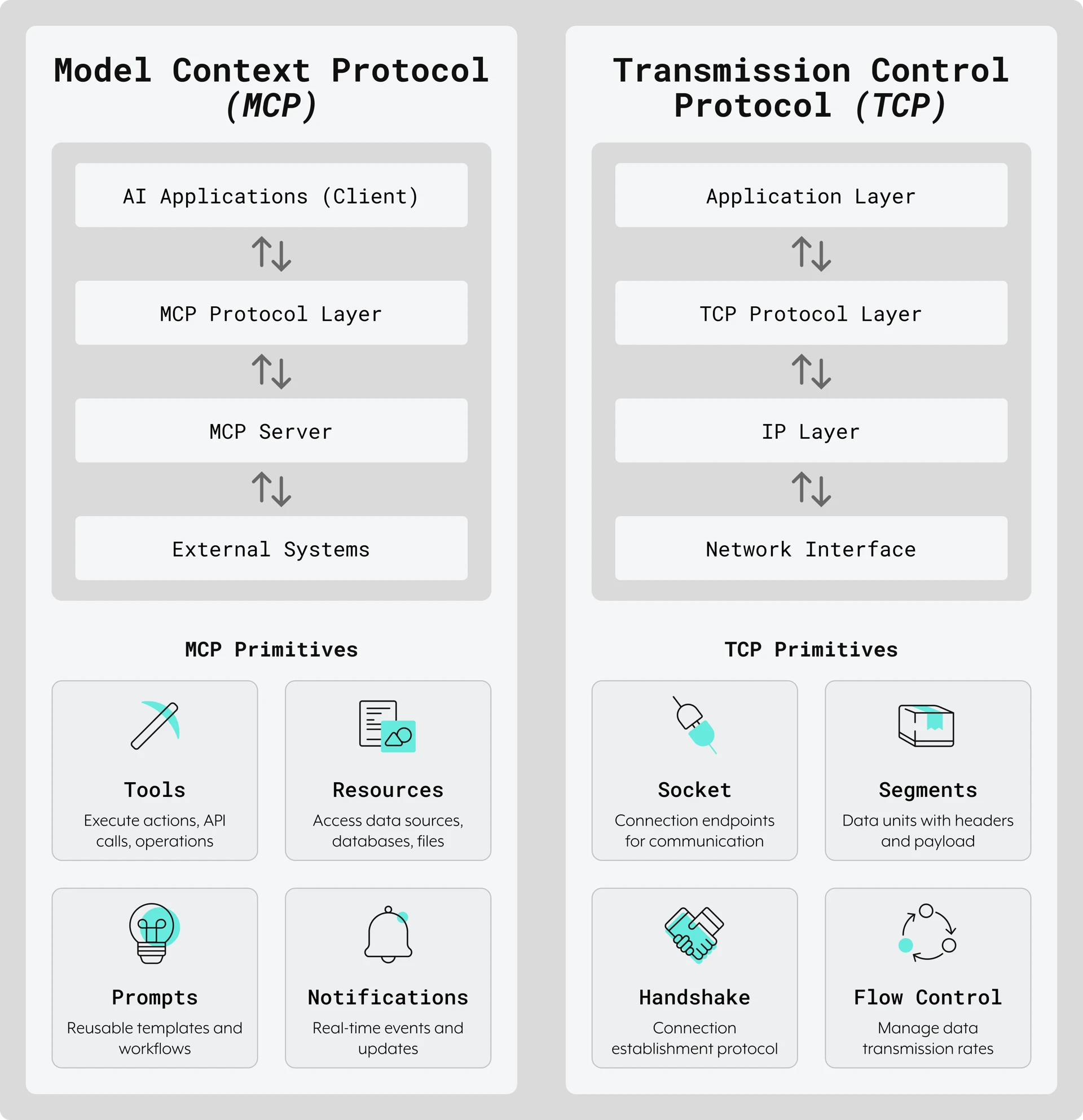
Model Context Protocol (MCP) has emerged as an important step forward, introducing a standardized way to give models structured instructions and invoke tools. It begins to close the gap between conversational AI and systems that can take action—but MCP, on its own, is only a protocol.
A useful analogy is TCP. TCP enabled reliable communication between machines by defining a small set of primitives—connections, packets, retries. But TCP never described what should happen when data arrived, who was allowed to send it, how failures should be handled at the business level, or how multiple interactions should be coordinated into a coherent outcome. All of that lived in higher layers.
Basic MCP is similar. It standardizes how models discover and invoke tools, but it does not encode business logic. It does not orchestrate multi-step processes. It does not provide governance, transactional guarantees, observability, auditability, or policy enforcement.
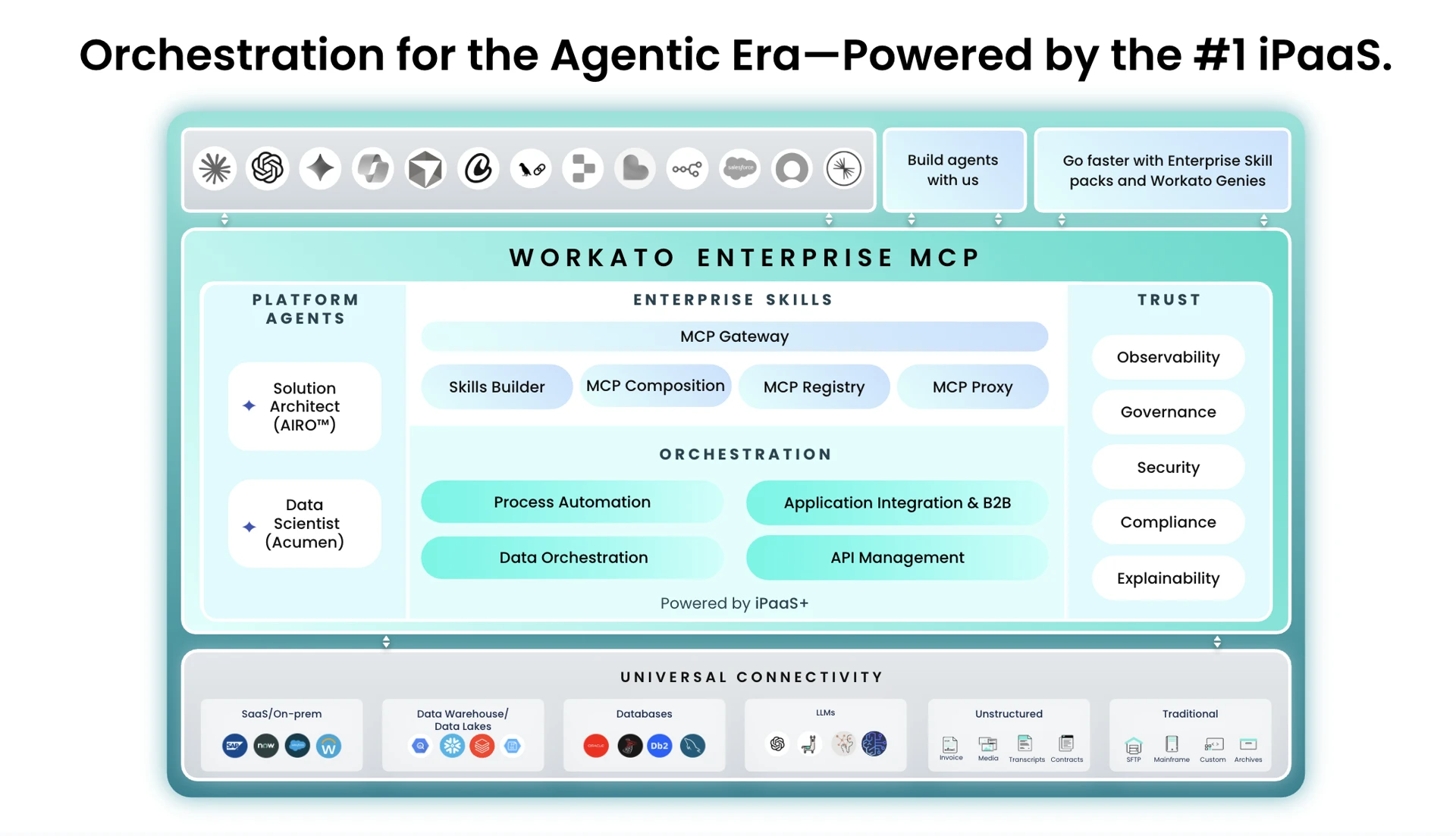
This is where Workato Enterprise MCP becomes essential. It is the architectural layer that governs how AI systems access enterprise data, how actions are executed across systems, how context is shared, and how outcomes are observed and controlled. Without this layer, AI remains peripheral. With it, AI can participate directly in real business operations.
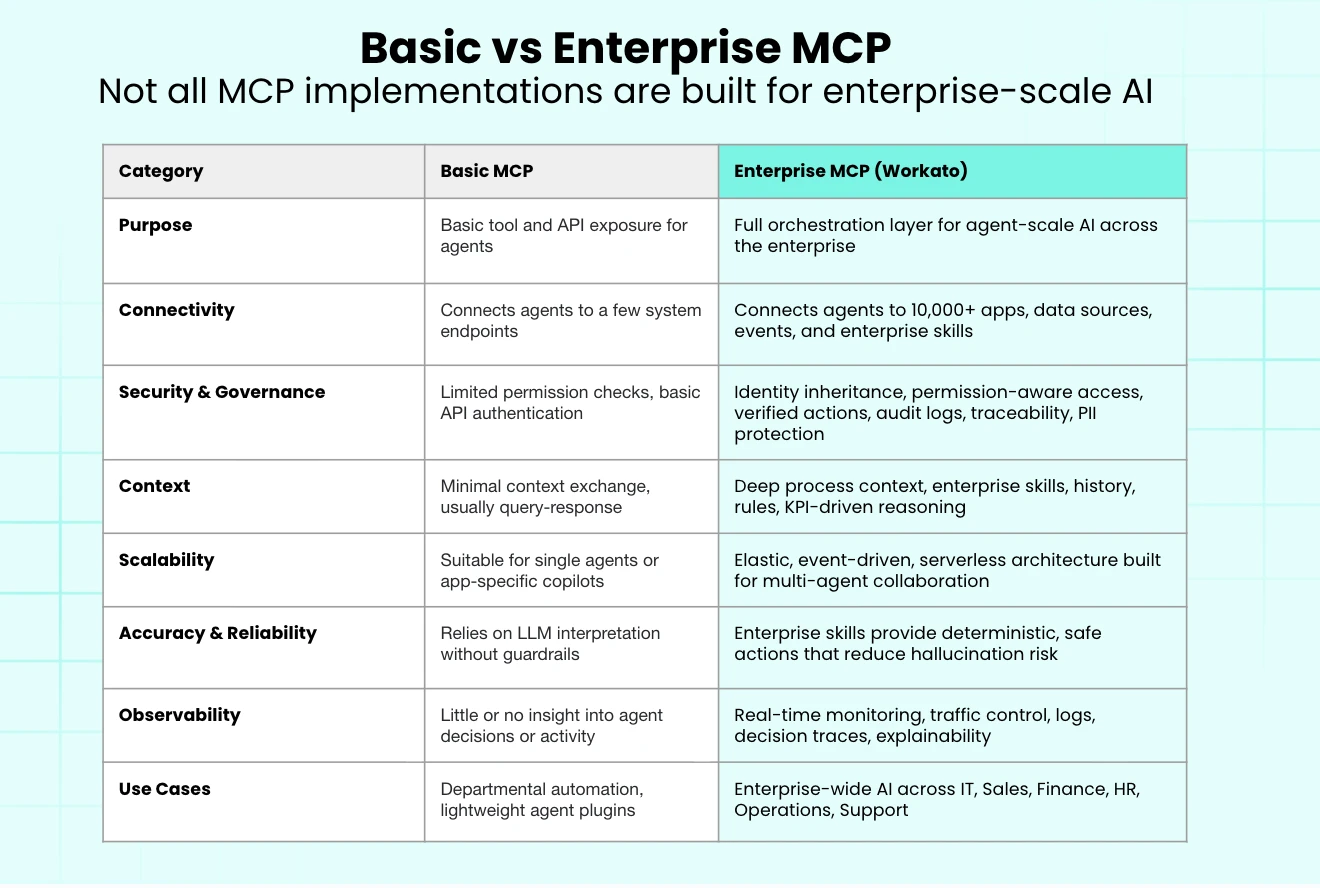
Workato Enterprise MCP was built specifically to address those enterprise requirements. It brings native connectivity, governed enterprise skills, real-time orchestration, and built-in observability together in a single runtime. AI acts through governed Enterprise Skills rather than raw APIs, keeping the control where it belongs and allowing it to scale safely from early use cases to mission-critical workflows.
This is why enterprises converge on Enterprise MCP as ambitions grow, and why Workato’s implementation becomes the foundation that makes every stage of AI adoption more effective.
How This Maps Back to Every AI Adoption Stage
- For enterprise LLM licensing, Enterprise MCP turns general-purpose assistants into tools that can safely act on enterprise systems.
- For citizen AI and builder experimentation, Enterprise MCP provides a governed backbone that allows successful ideas to scale.
- For departmental agents, Enterprise MCP enables coordination, shared context, and reuse across teams.
- For AI-powered workflows, Enterprise MCP delivers the reliability, observability, and trust required for production.
- For transformational initiatives, Enterprise MCP becomes the foundation that makes autonomy and scale possible.
This is why Workato Enterprise MCP is not a “next phase” technology. It is the multiplier that makes every AI project more effective. And it is why, regardless of where enterprises start, they converge on the same requirement.
From Early Wins to Real Transformation
Most enterprises are already on the AI adoption spectrum, many operating in several stages at once. AI is not underperforming, enterprises just haven’t given it a production-grade execution layer yet.
This is a defining moment for CIOs. AI is no longer theoretical. The tools are here. The experimentation is working. The next step is deciding whether AI remains a collection of productivity tricks or becomes a driver of real transformation.
No matter where you start, the path forward converges on the same foundation. Build the enterprise architecture that allows AI reason flexibly but act predictably. That is how AI moves from pilots to production, and from promise to impact.