

Enterprises are accelerating investment in AI agents, but most initiatives are not achieving meaningful outcomes. MIT research shows that only 5 percent of companies seeing measurable ROI due to fragmented systems and missing operational readiness. The recent Workato and Harvard Business Review study identified the same gap. While 84 percent of leaders believe agentic AI will transform their business, only 6 percent fully trust agents to run core processes autonomously.
This gap has little to do with model performance. It comes from the environment around the model. Most agents today operate as isolated “AI islands,” disconnected from the systems, data, and processes they need to take correct action. They see only fragments of the enterprise and are forced to guess their way through work.
The Context Problem Behind Agent Failures
Most agents are limited to a narrow view of the business. They access a single app, a single knowledge base, or a single data source. They cannot follow a workflow across systems or understand how information flows through a process. As a result, agents respond using partial facts, outdated data, or incomplete dependencies.
This problem shows up everywhere.
- A support agent answers questions without visibility into order delays or customer entitlements.
- A sales agent generates quotes without understanding inventory constraints.
- An IT agent attempts to resolve requests without knowing approval rules or prior changes.

MIT findings indicate that the biggest blocker to AI success is not model performance but operational readiness. Most enterprises lack the connected architecture needed for agents to work across systems. Organizations are not failing because agents are unintelligent. They are failing because agents are blind.
What Orchestrated Context Is
Orchestrated context provides agents with a unified, real-time understanding of the business. It brings together the data, processes, rules, and signals required for accurate, end-to-end decision-making. Instead of acting on a single system or a narrow dataset, agents can interpret the full landscape that shapes a workflow.
This includes customer history, inventory availability, approval policies, transaction states, financial terms, real-time events, and more. With this context, agents operate with clarity rather than assumption. They understand what is happening, why it is happening, and what needs to happen next. This is the difference between a conversational assistant and a true enterprise agent.
Why Orchestrated Context Matters
When an agent lacks context, it can only provide a generic status update such as “Your order is delayed.” With orchestrated context, the same agent sees the underlying issue, identifies root cause, evaluates options, and resolves the problem. The agent may recognize that a shipment is stuck in customs, automatically create a replacement order, and select a faster route. This is real work completed, not just a response delivered.
Orchestrated context enables agents to:
- Make decisions based on complete, accurate, and current information
- Follow enterprise logic and dependencies across systems
- Anticipate downstream impact before taking action
- Trigger next steps without human intervention
- Deliver consistent outcomes across complex workflows
Without this foundation, autonomy remains out of reach.
How Workato Enterprise MCP Delivers Orchestrated Context
Enterprises need a foundation that connects fragmented systems, aligns processes, and makes real-time context available to any agent. Workato Enterprise MCP provides that foundation by orchestrating connectivity, data flows, process logic, rules, and business signals across the entire enterprise.
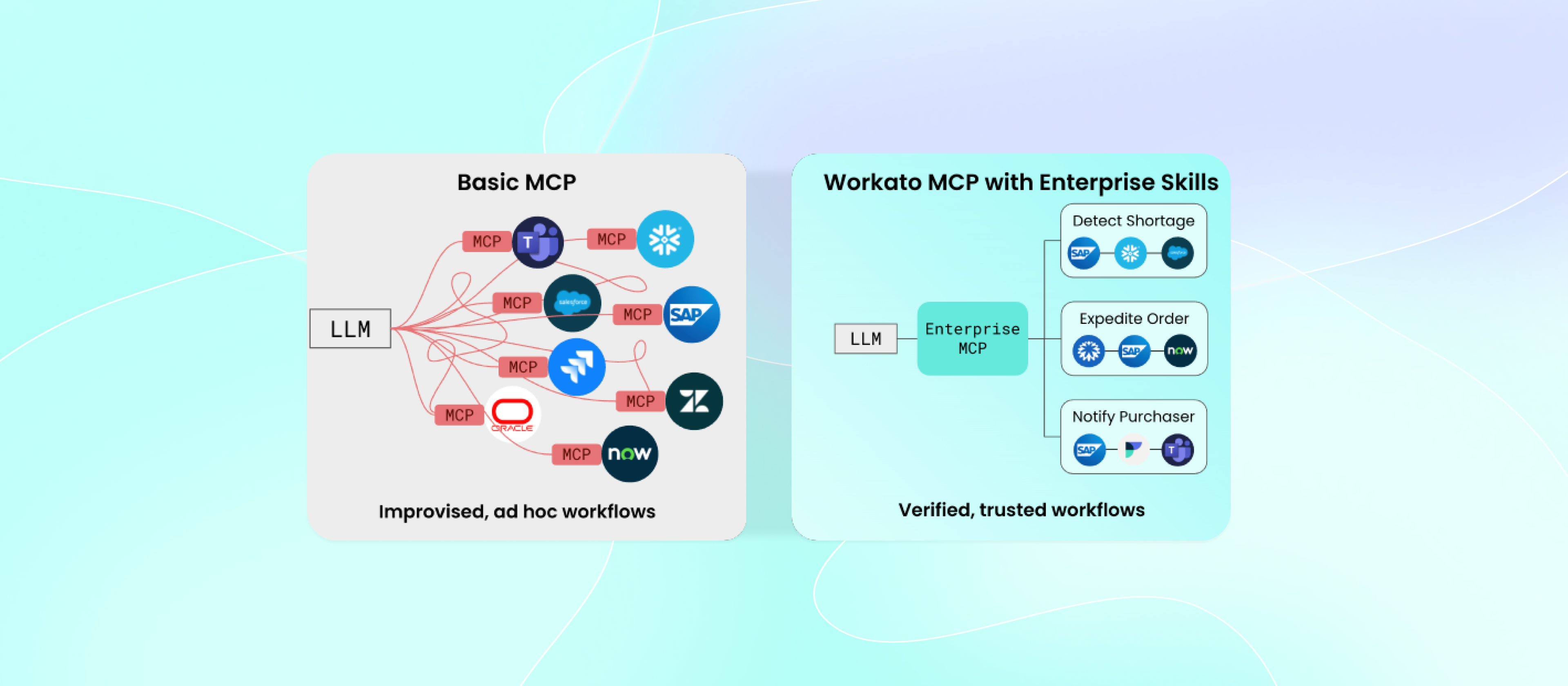
This includes:
- Universal connectivity across SaaS, on-prem, legacy systems, data warehouses, and LLMs
- Real-time event-driven triggers and signals
- Federated access to distributed data without replication
- End-to-end process context that tracks state, history, and dependencies
- Enterprise rules, business logic, and decision models
- Built-in observability, monitoring, and auditability
This coordinated foundation gives agents the full picture required to take responsible and accurate action.
A Practical Example
In one example, an agent generates a sales quote by pulling customer details from a CRM, verifying inventory in an ERP, checking pricing rules, applying discount policies, and routing the final quote for approval. Because it has orchestrated context, every step reflects current data, enterprise rules, and cross-system dependencies. The result is a complete and correct quote delivered without manual coordination.

Without orchestrated context, even simple tasks become error-prone.
The Takeaway
AI agents cannot succeed as isolated systems. Orchestrated context is what elevates them from conversational tools to operational capabilities. It eliminates blind spots, reduces inconsistency, and creates the foundation for accurate, scalable, and dependable automation. Enterprises that move beyond AI islands create the architecture needed to unlock the true value of agentic AI.
This is the first and most important step toward deploying agents that work.
