
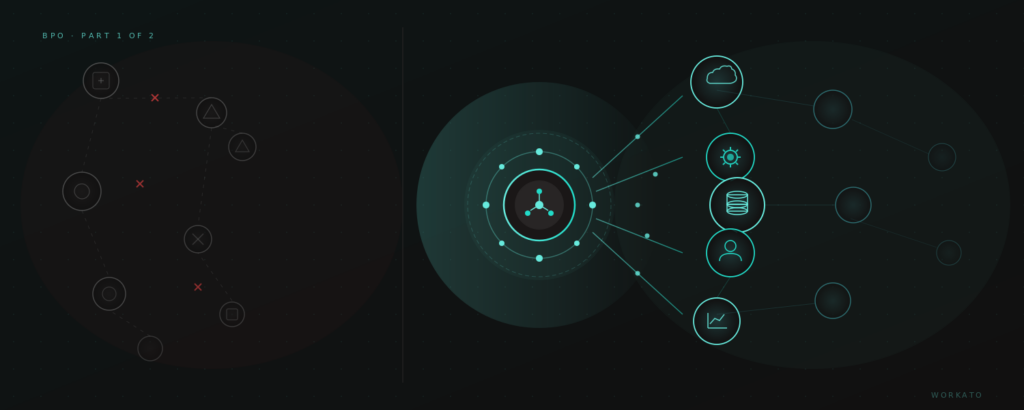
Part 1 of 2: The forces reshaping outsourcing economics – and why more AI tools won’t fix what’s actually missing.
Something strange is happening in the BPO industry right now – and it has less to do with AI than with orchestration.
Everybody’s talking about AI. Every earnings call features it. Every RFP demands it. Every conference keynote promises it. And yet, when you look past the press releases and into the actual operations – the delivery centers, the integration queues, the contract renewals – a different picture emerges. The industry is only beginning to reckon with this challenge openly.
Most BPOs can’t operationalize AI at scale yet. Not because the technology doesn’t work. It does. But because the operational infrastructure needed to connect AI to real enterprise workflows hasn’t caught up with the ambition.
That gap – between AI ambition and operational reality – is the defining challenge of the outsourcing industry’s next decade. And closing it requires something far less glamorous than the latest large language model. It requires orchestration.
At Workato, we work with enterprises and BPOs navigating this transition every day. We connect AI agents to enterprise systems, build governed workflows across fragmented application environments, and help organizations move from AI pilots to AI operations. What we’re seeing on the ground tells a different story than most AI headlines suggest.
The Market Reality Behind the AI Headlines
Let’s start with the data.
ISG’s quarterly Index data tells a stark story: BPO annual contract value dropped 14% in 2025, with all three major regions declining. Financial services BPO hit its lowest ACV since 2017. Award counts stayed relatively stable, which means something worse is happening – clients are signing deals, but at significantly lower values.
Meanwhile, Andreessen Horowitz published a widely-circulated analysis arguing that AI-native startups are poised to disrupt the BPO market – replacing human-intensive processes with AI-powered alternatives.
There’s truth in the directional thesis. As we explored in our earlier analysis of the great unbundling, the forty-year bundle of labor, process intelligence, and technology that built this industry is indeed separating into distinct layers. But the VC narrative oversimplifies what happens next. Enterprise outsourcing isn’t just labor arbitrage – it’s operational expertise, process knowledge, regulatory navigation, and client-specific customization delivered across dozens of industries simultaneously. Software-first startups can automate a task. BPOs manage the messy, multi-system, compliance-heavy operations around it.
The real question isn’t whether the bundle comes apart. It’s who controls how the layers reconnect – and on what infrastructure.
The more important signal isn’t that VCs are excited about disrupting BPOs. It’s that enterprise clients are internalizing the same narrative – and bringing it to the negotiating table.
Here’s what’s actually happening on the ground: clients want AI to reduce costs, and they’re walking into renewal conversations with that expectation baked in. BPOs, meanwhile, are spending heavily to build AI capabilities – and trying to argue that AI-enabled delivery is more valuable, not cheaper. It’s a structural disagreement about what AI-enabled work is worth, and it’s playing out in thousands of contract negotiations right now.
The traditional outsourcing equation was straightforward. Deliver operational expertise at scale, more efficiently than the client can achieve internally. Share the savings. Price on headcount.
Every piece of that equation is under pressure.
BPO Pricing Models Are Evolving Under AI Pressure
When an AI agent handles 60% of routine customer inquiries – and that number is already realistic for many categories – what does a “per seat” contract even mean?
This isn’t an abstract question. The major players – Teleperformance, Genpact, WNS, Concentrix – are all publicly experimenting with alternative pricing models. Outcome-based. Per-transaction. Value-share. Gain-share.
But no new industry standard has taken hold. And for good reason: the transition from headcount pricing to outcome-based pricing requires process measurement, AI attribution, and operational transparency that most delivery models weren’t built to provide.
As we noted in our analysis of the capabilities BPOs need to build, outcome-based pricing is the right direction – but delivering on it requires infrastructure most providers don’t yet have. You can’t bill for outcomes if you can’t track them. You can’t attribute value to AI if your AI runs in disconnected silos. You can’t prove efficiency gains if your workflows aren’t instrumented.
The pricing transition isn’t a crisis – it’s an opportunity for BPOs that build the right operational foundation. But without that foundation, it becomes a conversation you can’t win.
Vendor Consolidation Makes BPO AI Deployment Harder
There’s another force compounding the pressure that doesn’t get enough attention: enterprises are consolidating their technology stacks, not expanding them.
CIO surveys from Forrester and IDC consistently show that post-pandemic procurement strategies favor deepening existing vendor relationships over adding new point solutions. Enterprises are reducing vendor sprawl. They want fewer contracts, fewer integrations, and fewer security reviews – not more.
For BPOs, this creates a tough dynamic. You need to deploy new AI capabilities to stay competitive. But your clients are actively resisting the addition of new tools to their environments.
Every new platform you want to introduce triggers a procurement review, a security assessment, and a conversation about whether this could be done with something already in the stack.
The BPOs that navigate this successfully aren’t the ones with the most impressive AI demo. They’re the ones deploying AI through infrastructure that integrates with what the client already has – existing systems of record, existing governance frameworks, existing security protocols. That requires an orchestration layer designed for enterprise environments, not another standalone AI product that adds to the tool sprawl clients are actively trying to reduce.
This is a pattern we see consistently at Workato. The BPOs gaining traction with their enterprise clients aren’t leading with “here’s our new AI tool.” They’re leading with “here’s how we connect AI to your Salesforce, your ServiceNow, your SAP – through a governed platform that your security team has already reviewed.”
When you can offer 1,200+ pre-built connectors across 14,000+ enterprise applications with enterprise-grade security certifications already in place, the procurement conversation changes fundamentally.
Why AI Pilots Stall at the Integration Layer
If you’ve spent any time inside large BPO transformation programs, you’ve seen the pattern. It repeats with remarkable consistency.
A team picks a process – customer service, claims processing, or back-office operations- and builds an AI proof of concept. The demo is impressive. A language model handles inquiries with surprising fluency. A document extraction system pulls data with high accuracy. Leadership signs off on expansion.
Then integration reality hits.
The AI model works beautifully in isolation. But the actual process it’s supposed to support involves six enterprise applications, three data sources, two compliance checkpoints, and a handoff to a human agent when confidence scores drop below a threshold. Connecting all of that requires custom integrations, API development, and workflow logic that didn’t exist in the proof of concept.
Security reviews take months. Each client has different systems, different data formats, and different compliance requirements. The “standardized AI solution” needs customization for every deployment. Costs escalate. Timelines slip.
Meanwhile, a different team launches a separate AI initiative using different models, different tools, and different integration patterns. The organization now has two, then five, then twelve disconnected AI projects, none at production scale, each consuming resources.
Gartner calls this “AI sprawl.” A Zapier survey of 500+ enterprise leaders found that 70% have not moved beyond basic integration for their AI tools, and 75% have already experienced negative outcomes from disconnected AI. The average large enterprise now runs 23+ AI tools, with nearly half of that adoption happening outside formal IT procurement.
The pattern isn’t unique to BPOs. But BPOs face a compounding challenge: they’re dealing with their own AI sprawl and their clients’ simultaneously.
Every client engagement adds another layer of integration complexity, another set of systems to connect, another governance framework to satisfy.
This isn’t a technology failure. The AI models work. It’s an infrastructure failure. The connective tissue between AI capabilities and enterprise operations doesn’t exist at the scale required.
Why Building AI Orchestration Internally Usually Fails
When BPO leaders recognize the orchestration gap, the first instinct is often to build internally. As we noted in our analysis of what separates BPO survivors from acquisition targets, providers who build custom integrations for every deal burn engineering budget that should go toward AI capability. Here’s why that pattern persists – and why it’s structurally difficult to escape.
The large players – Accenture, Infosys, Cognizant, Wipro – have all invested heavily in internal platforms. Some have built impressive domain-specific AI models for verticals like healthcare claims or financial reconciliation. That’s smart – proprietary AI tuned to your delivery domain is genuinely differentiating.
But there’s a critical distinction most BPOs blur: building a better AI model is not the same thing as building the orchestration infrastructure underneath it. And for the orchestration layer – the connectivity, workflow management, and governance that ties AI to enterprise applications – the build-it-yourself approach runs into three structural problems that get worse, not better, over time.
The first is connector coverage. A BPO serving enterprise clients needs reliable integrations with Salesforce, ServiceNow, SAP, Oracle, Workday, NetSuite, and a long tail of industry-specific systems. Building and maintaining these integrations isn’t a one-time project – APIs change, versions update, and authentication protocols evolve. The maintenance burden compounds year over year.
The second is the pace of change. The AI ecosystem is shifting quarterly. New models, new agent frameworks, new protocols like the Model Context Protocol (MCP), and new governance requirements. An internal platform that was current six months ago is already outdated. Platform companies whose core business depends on staying current can absorb this R&D burden; BPOs whose primary business is delivering services typically cannot.
The third is fragility. When an orchestration platform is built and maintained by a small internal team, it becomes a single point of failure – dependent on specific individuals, vulnerable to knowledge loss, and difficult to scale. Platform economics offer redundancy, support infrastructure, and ecosystem benefits that internal builds rarely match.
To be clear: BPOs absolutely should own their AI strategy. The choice of models, the domain expertise, the industry-specific training – that’s where proprietary advantage lives.
But the orchestration infrastructure underneath – the connectors, the workflow engine, the governance framework, the API management – is a different category of investment. It’s operational infrastructure, not competitive differentiation.
And building operational infrastructure from scratch when proven, enterprise-grade platforms exist is how organizations spend 18 months and millions of dollars recreating capabilities they could have deployed in weeks. The distinction matters: invest internally where it creates competitive separation, adopt platform infrastructure where it creates operational speed.
The Real BPO Challenge: Orchestration, Not AI
The BPO industry’s existential challenge isn’t AI adoption. Most BPOs are adopting AI in some form. The challenge is that AI without orchestration creates more operational complexity, not less.
Every disconnected AI pilot creates integrations that need maintenance. Every integration creates API connections that need monitoring. Every client deployment multiplies the complexity. Without a unifying layer that connects AI to enterprise systems, manages workflows, enforces governance, and enables human-AI handoffs, the result is fragmentation at scale.
The BPOs that successfully tackle this challenge, by building a strong operational foundation for deploying AI strategically rather than simply enthusiastically, will define the future of outsourcing over the next decade. Those that fail to do so will spend those years weighed down by integration debt, stalled pilots, and pricing conversations they are unlikely to win.
Picture the alternative: a BPO that can deploy a new AI capability for a client in weeks, not months, where every AI agent connects to enterprise systems through governed, pre-built infrastructure, where hybrid human-AI workflows run on a single platform with consistent audit trails. Where scaling from one client to twenty doesn’t mean rebuilding integrations twenty times. That’s the desired state – and it’s achievable.
This is the problem Workato was built to solve. Not as an AI vendor – the market doesn’t need another model. But as the enterprise orchestration and AI action layer that connects AI capabilities to real enterprise operations: governed, scalable, and production-ready from day one.
In Part 2, we’ll get specific about what that orchestration layer looks like in practice. We’ll cover the capabilities it requires, how hybrid human-AI operations work at scale, why security and governance are the silent dealbreakers in every enterprise conversation, and what BPO leaders should prioritize right now.