APIs didn’t kill software companies. iPaaS didn’t kill software companies. And neither will AI.
If this moment feels familiar, it’s because we’ve been here before. The urgency, the pressure, the sense that if you don’t move now you’ll miss the window – for SaaS leaders, this is just your average Tuesday.
Looking back at every major shift this industry has already weathered, the universal truth holds: the companies that move with their customers survive. The ones that wait are replaced by the tools their customers went looking for on their own.
A brief history of integration
Every major leap in integration’s 20-year history has been in an effort to answer the same question: How do we get systems to work together in a way that actually serves the people using them?
In the early days, that burden fell to the end user – custom code, in-house builds, point-to-point connections. Then came APIs and iPaaS solutions, making building and managing integrations faster and more accessible – until end users didn’t want to manage those integrations at all. They expected the products they bought to handle it. And by the late 2010s, embedded integration was a core product requirement.
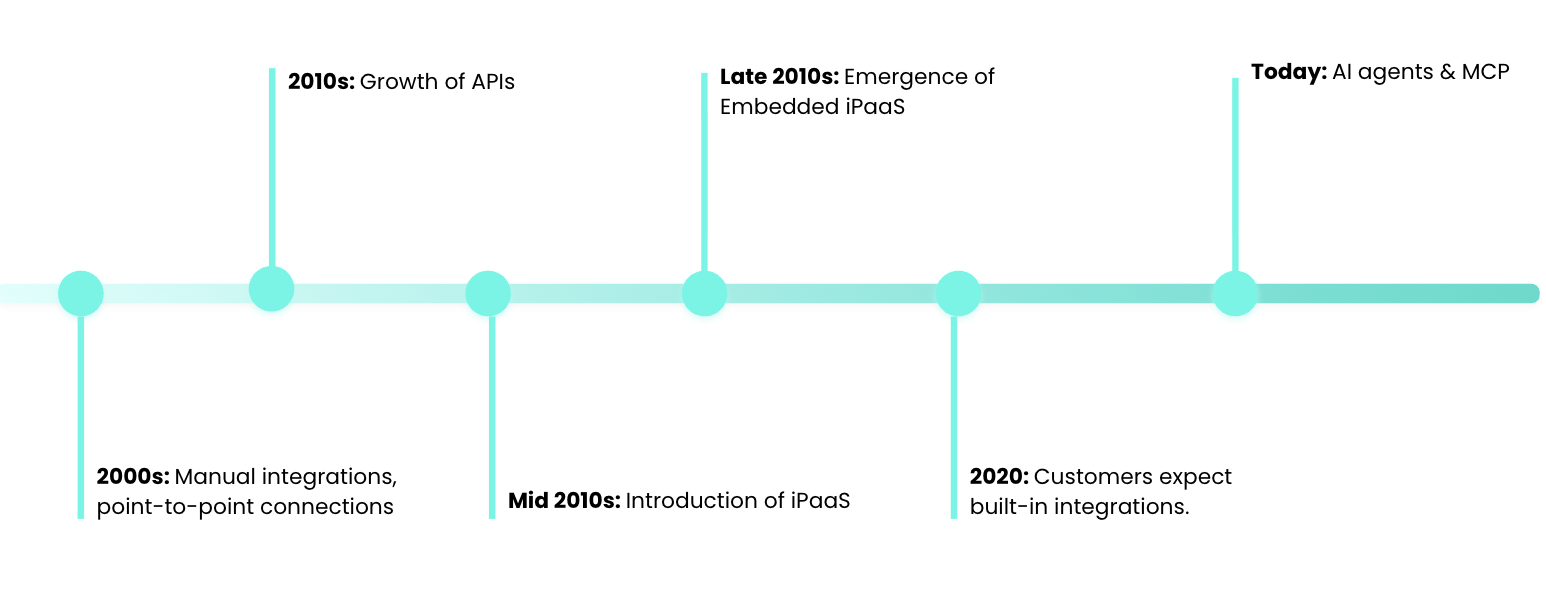
We’re now at the next, uncharted point on that timeline. AI agents are changing how work gets done, and more specifically, how your customers expect your product to participate in that work. Model Context Protocol (MCP) is the new standard making that possible. Think of it as the API layer for the agentic era that lets AI agents connect to and take action inside external platforms and systems.
Standing up an MCP server takes minutes. But just like with APIs, speed of adoption isn’t the deciding factor for long term success. Strategy is. And the approach you take now is what separates companies that just participate in this moment from the ones that own it.
“It’s the exact same process they took with APIs. They are creating MCP servers, which are their APIs, giving that to their customers and saying, ‘There you go.'”
— Ben Buhrow, Director of Sales Excellence, Workato Embedded
What a brittle MCP strategy actually costs you
The problem is that most companies are approaching today’s MCP the same way they approached yesterday’s APIs: Spin up a server, wrap your existing endpoints, ship it. It’s fast, it’s familiar, and it checks the box.
But here’s what that approach actually delivers: When a customer’s agent calls your MCP server looking for data, it has to figure out which endpoints to hit, in what order, and hope it gets back something useful. It’s a probabilistic process. Seven times out of ten it might return the right thing. Three times out of ten it might not. And when it doesn’t, when the agent surfaces the wrong data or takes the wrong action, your customer isn’t thinking about the model that powered it. They’re looking at your logo.
That’s the reality of a brittle MCP strategy: the risk lives with you, not the LLM.
“They’re not thinking the AI is broken. They’re thinking your solution isn’t good enough to work with their agentic offering. That’s just the reality.”
Your platform has something AI can’t replicate
But what’s more true than ever in this new integration era is that your platform isn’t just a product. It’s the infrastructure your customers have wired their workflows into. Your data is a proprietary signal no foundation model can access and no competitor can train on. Your customer relationships, the trust, institutional knowledge, and outcomes they’ve already attributed to you cannot be manufactured by a new entrant overnight.
That’s your moat, and it’s worth protecting.
“If you don’t defend what you’ve built up to this point, you’re probably going to be obsolete in the next 3 to 5 years.”
The challenge with a raw API approach to MCP is that it can’t account for any of that. Take Salesforce, for example. Every company runs their instance differently – different objects, fields, and workflows built around how that specific business operates. An agent calling a vaguely MCP-wrapped API has no way of knowing any of that, so it guesses. And at enterprise scale, across thousands of customers with their own configurations, that guess compounds into an experience nobody trusts.
Every time a new integration standard emerged, the companies that won didn’t just bolt it on. When APIs came out, the winners didn’t just expose endpoints and call it done. They built orchestration, transformation logic, security, and connectivity – the infrastructure that made APIs actually work reliably at scale. That’s what iPaaS was. That’s what embedded integration was. They took the hard parts off their customers’ plates and handled it themselves.
MCP is no different.
“The ability for these companies to live and thrive in this next era depends on their ability to work within the agentic space. Whether or not they’re thinking about that now, they need to be.”
The companies that win won’t be the ones that stood up an MCP server fastest. They’ll be the ones that build governed, deterministic workflows underneath it – the infrastructure that makes MCP actually reliable at enterprise scale. When an agent calls your platform, it isn’t guessing. It’s executing a defined, reliable action that works the same way every time, across every customer’s unique environment.
Agents are probabilistic by nature but workflows underneath them don’t have to be.
Why Workato is primed to solve this
I’ve watched this pattern play out firsthand. Since 2013, Workato has been the infrastructure layer underneath some of the world’s most sophisticated SaaS platforms, powering the embedded integration era for 500+ software companies and automating over 12 billion tasks a month across 30,000 end customer environments.
We didn’t build for MCP. We built the foundation that makes MCP actually work. All of the connectors, recipes, orchestration, and enterprise-grade security was built to handle the complexity that brittle point solutions can’t. Enterprise MCP for SaaS Platforms is the natural next expression of that. The same infrastructure that made embedded integration reliable, repeatable, and safe to stake a business on is what makes our MCP offering different.
That’s not a marketing claim, it’s 13 years of proof.
Build a defensible agentic strategy with Workato Enterprise MCP for SaaS Platforms.