What Do Solar Panels, Salesforce, and AI Agents Have in Common?
If you’ve spent time working in enterprise technology, you’ve seen hype cycles come and go. But the latest wave, AI agents, has captured imaginations and budgets like none before it.
Yet, as with solar panels and Salesforce, there’s a fundamental truth: regardless of how amazing and revolutionary the tech is under the hood, if it’s not deeply “wired” into the core infrastructure they are trying to support, it is pretty much useless.
Let’s break it down.
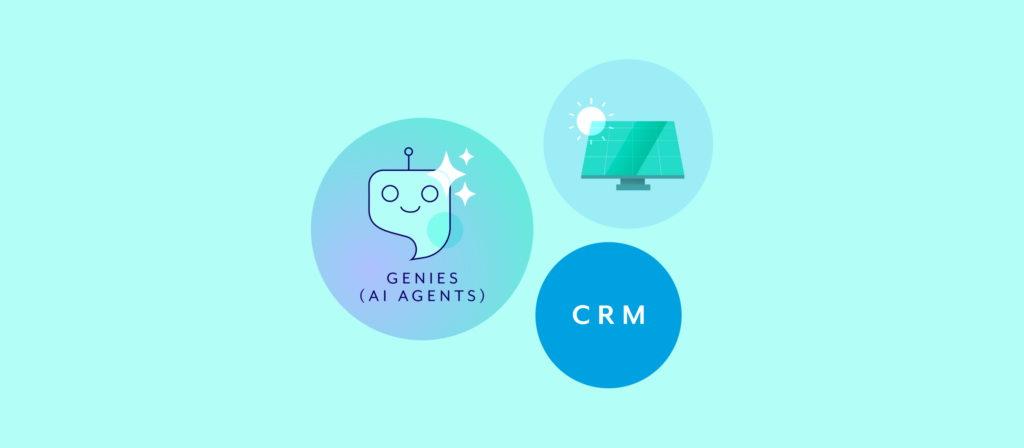
Solar panels are a marvel of engineering, but unless they’re wired into your home’s electric grid, they’re just shiny panels on the roof.
Salesforce is a powerhouse CRM, but without deep integrations with your business data and processes, it’s just another database (fun fact… Salesforce’s first version was a DB with a web form on top!).
And AI agents? They’re all the rage, but unless they’re connected to your application ecosystem, and more importantly, able to take action against those systems, their impact is limited to flashy demos and isolated chat interactions.

The AI Reality Check
Despite billions spent on AI in the last two years, most organizations have little to show for it. No meaningful impact on KPIs. No revenue transformation. Just expensive pilots and unfulfilled promises.
The numbers tell the full story of this harsh reality:
- 95% of organizations are getting zero return on their GenAI investments (MIT, 2025)
- 88% of enterprises are weighed down by substantial integration debt that prevents them from adopting AI in any meaningful way. (Savanta, 2025)
- Among those who manage to experiment, 70% can’t get their AI proof-of-concept out of the lab and into production. (IDC, 2025)
- 12% of organizations have actually managed to deploy AI agents for use. (KPMG, 2025)
These misfires aren’t a failure of vision or effort. They result from the cold, hard truth that most AI implementations are built on quicksand. They work great in isolation but break down the moment you try to connect them to real business systems, real data, and real governance requirements.
The outcome? You’re left with expensive automations with AI bolted on for vanity rather than intelligent transformation. Despite the bold promises and beautiful demos, the majority of AI Agents never deliver the business impact your board expects.
Why “Wiring” Matters
The lesson is clear: to make AI actionable, connectivity is everything. Whether it’s solar panels, Salesforce, or AI agents, the real value emerges only when these technologies are “wired” into the core infrastructure: your data, your workflows, your governance.
Everyone wants to implement agents quickly, but once you go beyond the “easy to build” chat interactions and try to do something meaningful with them, like taking action against your core applications and data, you realize that on their own, the typical approach to agents is not very valuable. Without orchestration, these agents exist on isolated islands of intelligence.
Orchestration: The Foundation for Agentic Strategy
An Agentic Strategy can only reach its full potential with a strong foundation in Enterprise Orchestration, where deterministic business building blocks (e.g., APIs, pre-defined workflows, business rules, data models) can power up the full dynamic (non-deterministic) nature of AI in a governed and secure way (e.g., access control, auditing, human-in-the-loop validation).
Orchestration is the connective tissue that binds your technology ecosystem together, integrating applications, structured and unstructured data, and AI models into a seamless fabric.
With this foundation, AI agents can operate within a governed, secure, and context-aware environment. They don’t just respond; they act intelligently and compliantly, driving real business transformation.

Workato Genie: AI Agent
This is where Workato Genies comes in. Unlike typical AI agents, Genies are deeply integrated with the connectivity fabric and orchestration layer. This unique architecture enables Genies to take truly meaningful, secure, and governed actions across your enterprise ecosystem.
How are Genies different?
- Rooted in connectivity fabric: Genies can access and act on data across all your applications.
- Powered by orchestration: Genies leverage deterministic business logic, workflows, and APIs to deliver Deep Action™.
- Enterprise-grade governance and security: Genies operate within robust controls, ensuring compliance and auditability.
A Workato Genie isn’t just another chat agent. It’s the only AI agent designed to deliver on the promise of an agentic strategy by being wired into the very heart of your business infrastructure.
To get a sense of how this works, take a look at the orchestration architecture diagram below. It illustrates how your application ecosystem, data, and AI/LLMs form the foundation.
Above it, the orchestration layer powers actionable, deterministic business building blocks and composable services. At the top, the agentic layer, where Genies operate, enables uniquely actionable, governed, secure, and context-aware AI agents.

Don’t bolt on AI. Build it into the foundation.
The takeaway is simple: revolutionary technology alone isn’t enough. The real magic happens when AI is wired into your enterprise’s core systems, enabling secure, governed, and context-aware actions that deliver measurable business impact.
If you’re ready to move beyond expensive pilots and start realizing the promise of AI, it’s time to focus on connectivity and orchestration. Workato Genie is leading the way, empowering enterprises to turn AI from a buzzword into a business driver.