
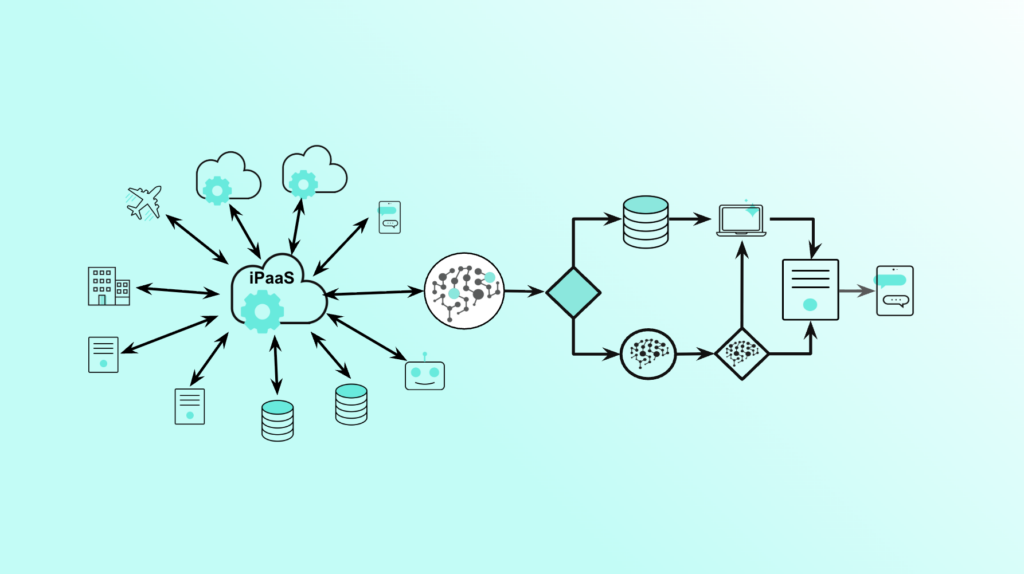
Massimo spent nearly 45+ years as an executive, industry analyst and research fellow, covering integration middleware, APIs, event-driven architecture, and cloud computing for financial services, telecom, manufacturing, retail, and government organizations worldwide. If you’re unfamiliar with iPaaS, it stands for Integration Platform as a Service and is among the fastest growing segments in enterprise infrastructure and is projected to dwarf other leading automation and integration technology segments like Robotic Process Automation by 2030.
Following his time as an industry analyst, Massimo has continued that work as an independent IT advisor while bringing his research practice to Workato as Head of Research. That background makes his recent webinar on the 2026 Gartner Magic Quadrant for iPaaS especially interesting. What he laid out wasn’t a product pitch. It was an architectural argument, grounded in forecast data, about where enterprise IT is heading and what organizations need to do before they get there.
Here is what stood out to me from his talk.
AI Initiatives and Modernization Drive the Decision to Replace Legacy Middleware and Patchwork Integrations
Massimo opened with an industry forecast of enterprise infrastructure software spending, and the numbers were striking. According to Gartner, iPaaS is the fastest-growing segment in the entire enterprise automation market, on track to roughly double in size by 2030. Meanwhile, classic ESB and B2B gateway categories are in active decline.

Chart created by Workato based on source: Gartner, Forecast: Enterprise Infrastructure Software, Worldwide, 2024–2030, 1Q26 Update, Published 25 March 2026.
Massimo observed that organizations are no longer evaluating integration platforms on technical capability alone. The question has shifted to whether a platform can carry the full weight of enterprise AI ambitions, not just connect systems, but orchestrate agents, govern AI interactions, and expose business capabilities in ways that AI can actually consume and trust.
That’s a different bar than most incumbents were built to meet. For companies still running legacy middleware, this isn’t just a maintenance decision. It’s an architectural one that is critical to their future.
The conversations Massimo hears most often aren’t about features. They’re about dependency. Teams carrying fragile platforms into a greenfield architecture, or inheriting a black-box EDI managed service they can’t see inside, or running integrations that only two people on the team can fix when they break. These aren’t technical failures. They’re organizational ones. The platform became a bottleneck, and the bottleneck became a liability.
The Three Problems Every Enterprise AI Project Hits
We think Massimo’s analysis of the 2026 Gartner Magic Quadrant for iPaaS is notable not just for who was placed where, but for what it reflects about where the market is going. iPaaS is no longer evaluated purely on connectors and transformation capability. The new axis is: can this platform carry enterprise AI?
He walked through orchestration challenges that any serious AI initiative will hit.
Agent-to-agent orchestration.
Monolithic agents don’t scale. Multi-agent architectures require reliable integration between agents, shared context, coordinated workflows, and governance across the handoffs.
AI mediation.
An agent that can’t take action in your actual systems is just a chatbot. Getting AI to interact with your ERP, CRM, supply chain, or core banking applications, reliably, securely, with transaction integrity, requires the same orchestration infrastructure integration teams have been building for years.
Skills composition.
The emerging best practice is to package enterprise capabilities as reusable “enterprise skills,” medium-granularity components discoverable and accessible by AI agents. This is conceptually similar to the service-oriented architecture principles However reconsidered and significantly reshaped to apply to the agentic layer. Building “enterprise skills” by composing multiple APIs requires exactly the kind of orchestration iPaaS was built to provide.
MCP (Model Context Protocol)
MCP is the protocol that enables agents to invoke these enterprise skills. But the protocol itself doesn’t handle governance, observability, cost management, or dynamic routing. That’s the gap Workato Enterprise MCP fills, sitting between the agent layer and your enterprise systems, providing the governance, security, reliability and observability guardrails that make AI projects safe to scale.
2026 iPaaS Leadership
Being close to the iPaaS for years, Massimo is in a rare position to contextualize what the rankings actually reflect, not just where vendors landed, but what the evaluation criteria are designed to surface.
Workato’s 2026 positioning as a Leader for the eighth consecutive time, furthest in Completeness of Vision for the third year running, ranked first in the Multistep Process (Internal) use case in the Critical Capabilities report, and ranked third in both the AI Enablement and Data Consistency (Applications) use cases, we feel, reflects a consistent architectural thesis: the platform you trust for integration today needs to be the platform that carries your AI ambitions tomorrow.
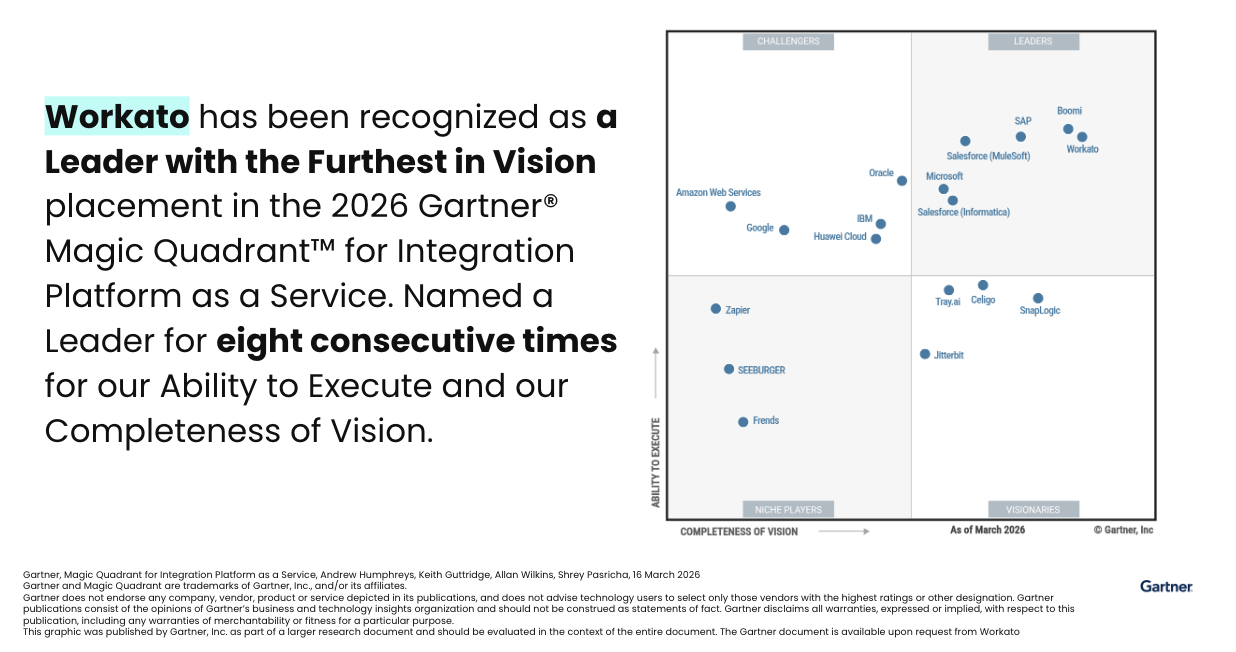
The 743+ displacements of legacy middleware vendors over the past 24 months aren’t primarily a pricing story, in Massimo’s framing. They’re evidence that the evaluation criteria have shifted, and that organizations reassessing incumbent platforms are arriving at similar conclusions about what the next five years require.
Massimo closed with a set of recommendations that felt less like a vendor webinar and more like advice from an analyst who has watched hundreds of platform decisions play out over time. The organizations moving fastest right now aren’t chasing the newest agent framework. They’re building on an integration foundation they already trust and layering AI deliberately, with governance and reusability built in from the start. The consolidation investment pays back not just in operational efficiency, but in the architectural readiness to scale AI without starting over at the foundation.
For anyone navigating a legacy migration, a contract renewal, or an AI initiative that keeps running into integration debt, Massimo’s framework is one of the clearer maps available for thinking through what the decision actually requires.
Download the 2026 Gartner Magic Quadrant for Integration Platform as a Service
*Gartner and Magic Quadrant are trademarks of Gartner, Inc., and/or its affiliates. Gartner, Magic Quadrant for Integration Platform as a Service, Worldwide, March 16, 2026 by analysts: Andrew Humphreys, Keith Guttridge, Allan Wilkins, and Shrey Pasricha. Gartner does not endorse any vendor, product or service depicted in its research publications, and does not advise technology users to select only those vendors with the highest ratings or other designation. Gartner research publications consist of the opinions of Gartner’s research organization and should not be construed as statements of fact. Gartner disclaims all warranties, expressed or implied, with respect to this research, including any warranties of merchantability or fitness for a particular purpose. This graphic was published by Gartner, Inc. as part of a larger research document and should be evaluated in the context of the entire document. The Gartner document is available upon request from Workato.