

In today’s enterprise environment, integration and automation are no longer a competitive advantage. They are foundational for success in the age of Agentic AI. As organizations adopt more SaaS tools, cloud platforms, and data sources, the ability to connect systems, orchestrate workflows, and operate securely at scale has become critical to day-to-day operations and long-term growth.
An Integration Platform as a Service (iPaaS) plays a central role in managing this complexity. At its core, an iPaaS connects applications, data, and systems so they can work together reliably to power end-to-end enterprise processes, insights, and AI agents. But as businesses scale, integration quickly becomes less about simple connectivity and more about orchestration, governance, and adaptability.
That’s where the challenge begins and why we created 2026 iPaaS Buying Kit, completed with the Guide and accompanying Request For Proposal (RFP) Template for evaluating modern middleware and intelligent automation platforms.
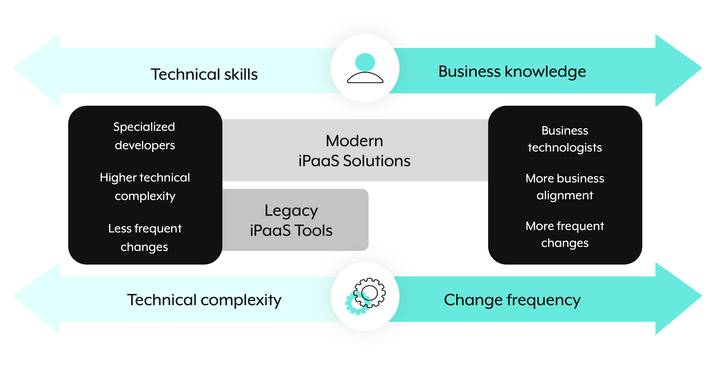
With more than 150 vendors in the market, many claiming to offer “modern” integration, choosing the right iPaaS has become increasingly difficult. Legacy middleware and custom-built integrations once promised a connected enterprise, but over time they often led to brittle architectures, rising maintenance costs, slow delivery, and heavy dependence on specialized developers. What worked in the past no longer supports the pace or complexity of today’s enterprise.
Modern iPaaS platforms have evolved to address these gaps. Built on cloud-native architectures, they enable real-time integration, event-driven workflows, and scalable automation across the enterprise. Teams can move faster by reducing infrastructure overhead, eliminating data silos, and standardizing how systems interact.
But iPaaS is evolving again.
As generative AI, large language models, and intelligent agents move into the enterprise, integration platforms are being asked to do more than orchestrate workflows. They are now expected to provide a secure, governed way for AI systems to interact with enterprise data and applications. This includes standardizing AI and LLM integrations, supporting agentic workflows, and introducing frameworks like the Model Context Protocol (MCP) to ensure visibility, control, and trust.
At the same time, security and governance expectations have increased. Identity lifecycle management, encryption and key management, auditability, and infrastructure assurances are no longer optional. Buyers need confidence that an iPaaS can support both human- and agent-driven automation without compromising security or compliance.
The 2026 iPaaS Buying Kit was created to help teams navigate this shift.
Rather than focusing only on connectors or workflow builders, the guide reframes how organizations should evaluate iPaaS platforms today. It covers operating models and Centers of Excellence, modern core capabilities like cloud-native architecture and built-in DevOps, and emerging requirements around AI, agentic orchestration, MCP, and enterprise-grade security. The kit also includes an updated RFP template with practical questions to help teams compare vendors and avoid costly replatforming in the future.
Why Download the 2026 iPaaS Buying Kit?
Inside the guide, you’ll find:
- Operating models explained
Understand different approaches to running integration and automation programs, and how to choose a model that scales with your organization. - Modern core capabilities
Learn which features are non-negotiable in 2026, including cloud-native architecture, API and event management, agentic orchestration, standardized AI integrations, and strong governance. - Stakeholder value across teams
See how IT, data, and business teams benefit from a unified iPaaS strategy. - Updated evaluation criteria
Access a downloadable RFP template with technical, security, and operating model questions designed for today’s buying decisions.
Get Started
Choosing an iPaaS is no longer just about connecting systems. It’s about selecting a platform that can support automation today and adapt as AI and agentic workflows become standard across the enterprise.
If your organization is ready to scale integration, strengthen governance, and prepare for what’s next, download the 2026 iPaaS Buying Kit and take the guesswork out of your evaluation process.