

As enterprises advance toward agentic AI, accuracy becomes the final and most unforgiving test. Context allows agents to see the full picture. Trust ensures they act within defined boundaries. But accuracy determines whether agents can reliably complete real work inside the business.
This is where many AI initiatives fail. McKinsey’s State of AI research shows that while AI adoption is widespread, most organizations remain stuck in experimentation or limited deployments, with only a small fraction achieving enterprise-level impact. The reason is not model capability. It is execution. AI outputs struggle to translate into correct, repeatable business actions when they are not embedded into operational workflows.
MIT research reinforces this conclusion, finding that only a small percentage of organizations report meaningful ROI from AI because systems, processes, and execution logic are too fragmented for reliable automation. Accuracy breaks down not because agents lack intelligence, but because enterprises lack an execution foundation that agents can rely on.
Why Accuracy Breaks Down in Agentic AI
Accuracy failures in agentic AI rarely come from intent. They come from execution.
When agents rely on raw APIs or loosely defined tools, every run becomes a new interpretation of how work should be done. The same prompt can produce different outcomes depending on timing, system responses, partial failures, or how edge cases are handled. There is no guarantee that a business action will execute the same way twice.

The graphic above illustrates this problem clearly. A single prompt to process a refund produces six different outcomes. One run succeeds. Another refunds the wrong amount. Others fail due to missing accounts or API errors. Even when the correct amount is issued again, it may be applied to the wrong account. From the agent’s perspective, each run is reasonable.
From the enterprise’s perspective, this variability is unacceptable. Deloitte’s research on generative AI adoption echoes this point, identifying governance, reliability, and execution risk as top barriers to scaling AI beyond pilots
This is the core issue with tool-based execution. Agents are forced to assemble multi-step workflows dynamically, interpret system responses, and manage failures on their own. Small differences in context or system state lead to large differences in results. Over time, these inconsistencies erode confidence and make it impossible to rely on agents for core operations.
In enterprise environments, accuracy is not about getting the right answer most of the time. It is about producing the correct outcome every time. Refunds must be issued for the right amount, to the right account, with proper approvals and audit trails. Without a deterministic execution layer, agents simply cannot meet this standard.
The Difference Between Tools and Skills
Accuracy improves when agents stop working with tools and start working with enterprise skills.
Tools expose individual functions. They leave agents responsible for sequencing steps, handling errors, retrying failures, and enforcing rules. Each execution depends on how the agent interprets system responses in that moment. Even when the intent is correct, outcomes vary.

Enterprise skills operate at a different level. They encapsulate complete business actions, including validations, calculations, approvals, retries, rollbacks, system updates, and compliance requirements. Agents no longer improvise execution. They invoke a proven capability.
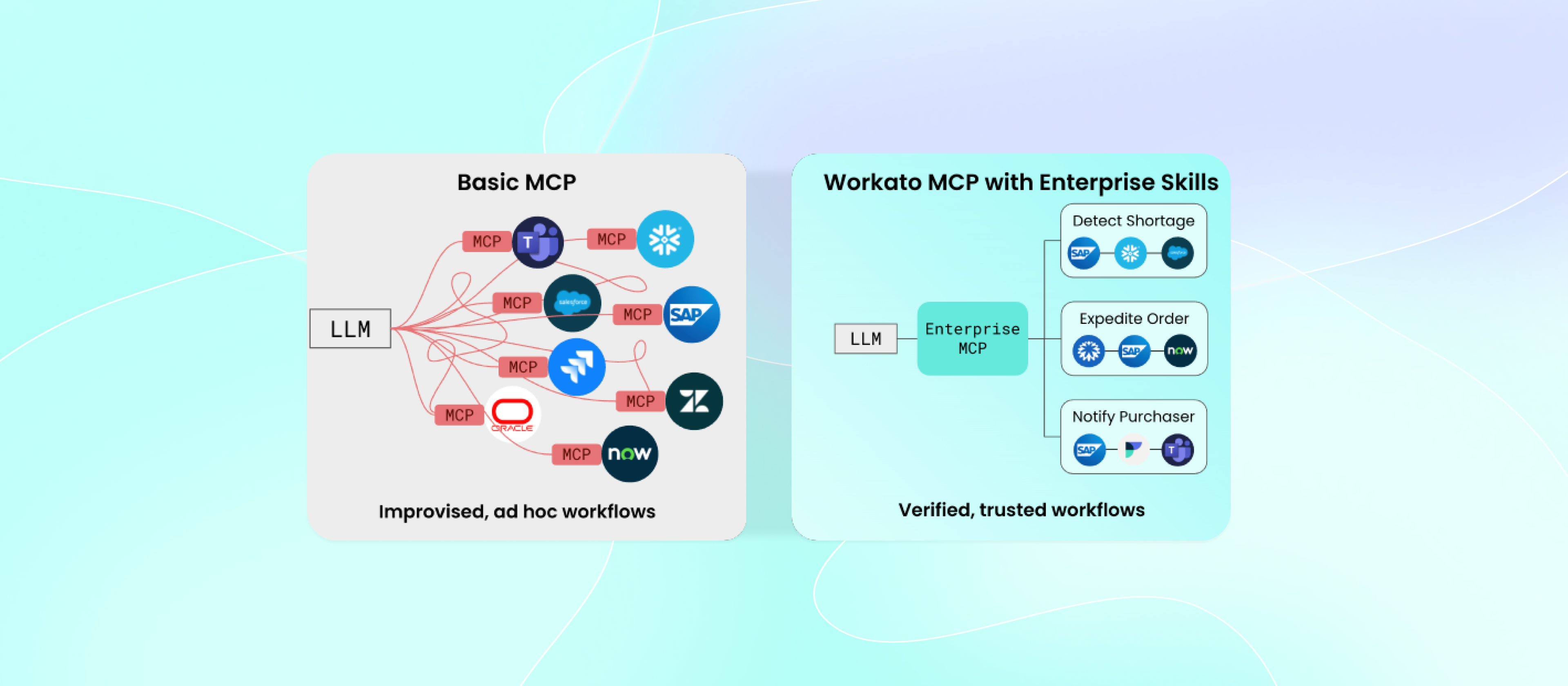
This shift is critical. It removes ambiguity from execution and replaces it with predictability.
Why Enterprise Skills Are Required for Accuracy
Enterprise environments demand deterministic outcomes. Finance teams expect ledger entries to post correctly. HR teams expect access provisioning to follow policy. Customer operations expect refunds and credits to be accurate and auditable.
Enterprise skills enforce this determinism. They ensure that every execution follows the same path, applies the same rules, and produces the same outcome regardless of which agent initiates the action or which model is used.
This is how enterprises move from probabilistic AI behavior to reliable automation. Accuracy is no longer dependent on prompts, reasoning chains, or model variability. It is enforced at the execution layer.
How Enterprise Skills Work in Practice
Consider an agent responsible for processing customer refunds.
Without enterprise skills, the agent must retrieve transaction data, calculate amounts, invoke payment APIs, update records, and handle failures step by step. Each stage introduces risk. Small variations in execution can lead to incorrect amounts, partial failures, or inconsistent system state.
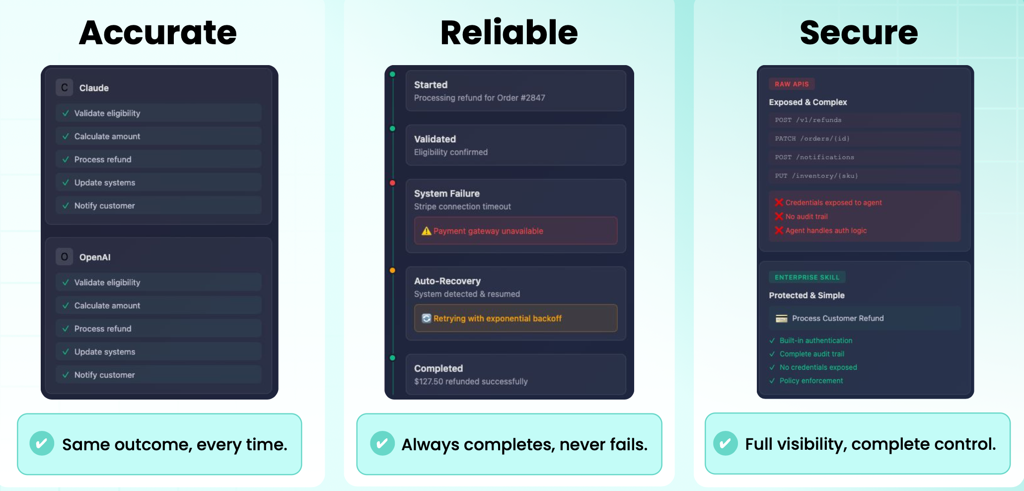
The graphic above shows how enterprise skills change this outcome. The refund workflow executes as a single, governed action. Eligibility is validated consistently. The refund amount is calculated using approved business logic. Temporary system failures are detected and retried automatically. If a downstream system is unavailable, execution resumes safely without human intervention. Credentials remain protected, audit trails are complete, and policy enforcement happens at runtime.
From the agent’s perspective, this is one action. From the enterprise’s perspective, it is a fully controlled, reliable business operation. The agent does not need to reason about execution details. It simply invokes a trusted capability and moves on.
Accuracy at Scale Requires Reuse
Accuracy also breaks down when logic is duplicated. When each agent implements its own version of a workflow, inconsistencies emerge. Over time, small differences create large discrepancies in outcomes.
Enterprise skills solve this by creating a shared library of reusable actions. Skills can be used across agents, teams, and use cases. Updates are made once and applied everywhere. This not only improves accuracy, but also accelerates development and reduces operational risk.
As agents scale across the enterprise, reuse becomes the only sustainable way to maintain correctness.
The Role of Enterprise MCP
Enterprise MCP enables this execution model by turning raw connectivity into governed, reusable enterprise skills. It provides the orchestration layer required to package logic, enforce rules, manage state, and guarantee outcomes across systems.
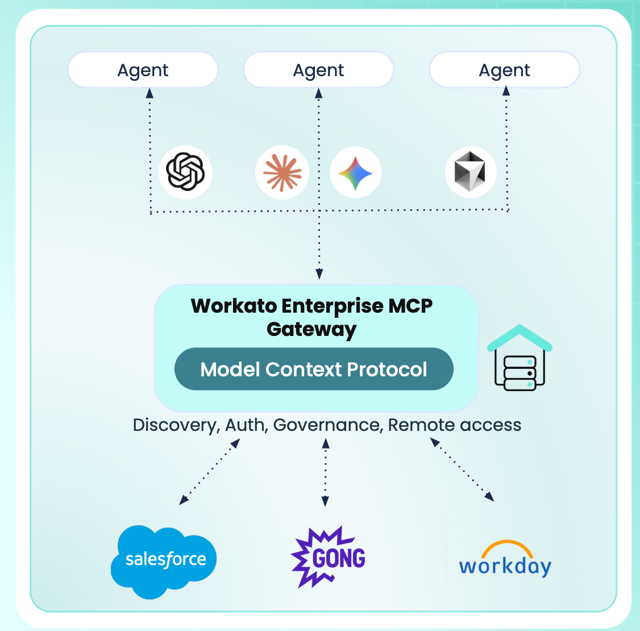
Agents do not call APIs directly. They invoke skills that represent complete business actions. These skills are observable, auditable, and resilient by design. This ensures that accuracy is not left to chance or model behavior.
By separating reasoning from execution, Enterprise MCP allows organizations to adopt new models, frameworks, or agent architectures without sacrificing correctness.
The Takeaway
Accuracy is the line between experimentation and execution.
Enterprises do not fail with agentic AI because models are incapable. They fail because execution is inconsistent, fragile, and difficult to govern. When agents rely on tools and raw APIs, outcomes vary. When they rely on enterprise skills, outcomes become predictable.
Orchestrated context gives agents the information they need to act. Enterprise trust ensures they act within defined boundaries. Enterprise skills ensure they act correctly, every time.
This combination is what makes agentic AI viable in production. It transforms agents from probabilistic assistants into dependable operators. Accuracy stops being something teams hope for and becomes something the architecture guarantees.
For enterprises looking to scale agentic AI beyond pilots, accuracy is not a feature. It is a requirement.

Explore how Workato Enterprise MCP brings context, trust, and accuracy together for production-ready agents.