Every enterprise I talk to has already said yes to AI. That was the easy part. The harder question, the one which we believe Gartner® just put a name to, is what actually sits between your models, your agents, and the systems that run your business. Gartner calls it AI middleware, and its May 2026 Innovation Insight on the category is worth reading closely, because we feel it says something most vendor pitches won’t: this isn’t one product. It’s an architectural layer you have to assemble.
AI Middleware Definition
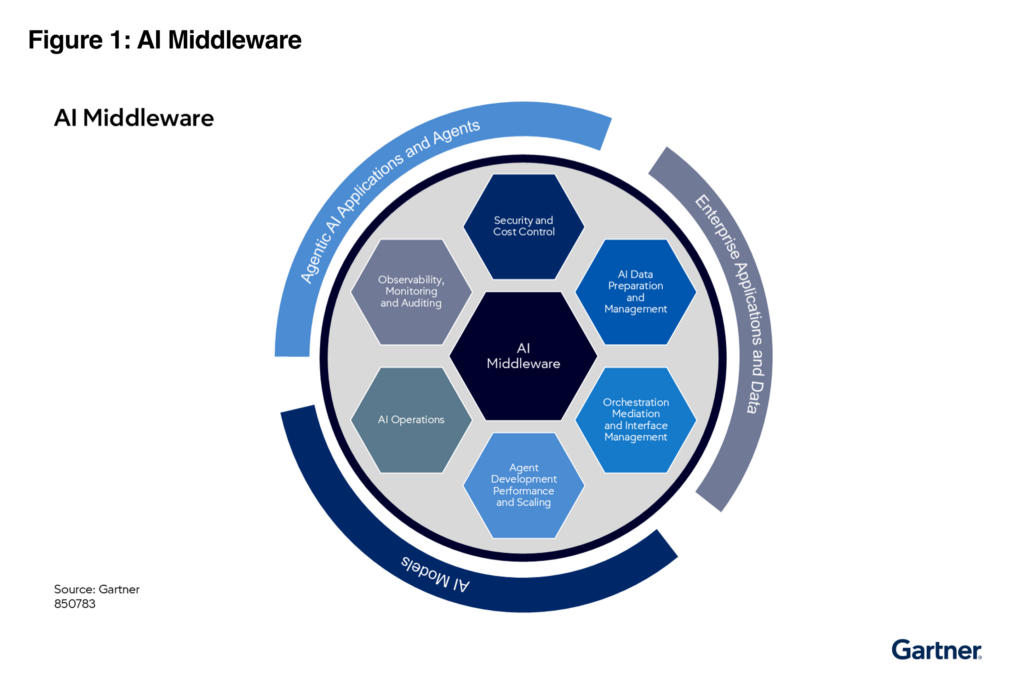
Gartner defines AI middleware as the collection of software that sits between applications and AI models and between AI agents and enterprise data, managing security, communication, data flow, and orchestration. The report breaks it down into six capability areas: Observability, Monitoring and Auditing, Security and Cost Control, Agent Development, Performance and Scaling, AI Data Preparation and Management, AI Operations, and Orchestration, Mediation and Interface Management. That last one is where I spend most of my time, because it’s where AI-specific protocols like MCP and A2A meet existing APIs and event-based interfaces, and where a lot of architectures either hold together or fall apart.
The stats behind this are why I don’t treat it as an abstract concern. The Innovation Insight report draws on a 2025 Gartner survey which found security and governance cited as the top barrier to GenAI adoption by 38% of respondents, with 68% saying IT can’t keep pace with rollout and 83% reporting a need for stronger technical controls over AI agents. A separate Gartner 2026 Survey for AI Maturity and Organizational Mandates found integration is among the top three barriers to implementing AI initiatives for 20% of the respondents, reinforcing the need for scalable orchestration layers over custom integrations.
Report says that AI middleware is not a single product because it is not a single problem. It represents a set of tools and an operational discipline that connect AI systems to real-world business environments. Attempting to buy AI middleware “off the shelf” creates the risk of oversimplification, as it must address many substantial concerns simultaneously. While there are strong point solutions, no single product can cover them all effectively without becoming either overly rigid or overly generic, leading to gaps, compromises, or fragile architectures. That matches exactly how I think about this internally: the goal isn’t to be the only platform in your stack, it’s to be the governed layer that makes every other piece of the stack trustworthy. Switzerland, not end-all-be-all. Some teams will want to centralize on one platform. Others will want to govern the sprawl without consolidating vendors. Both are legitimate, and the report doesn’t pretend otherwise.
That sprawl risk is real, and it’s not just the Gartner middleware report saying so. The 2026 April Gartner Press Release on agent sprawl projects that the average Fortune 500 enterprise will run over 150,000 agents by 2028, up from fewer than 15 in 2025, and it recommends that organizations can use AI trust, risk, and security management (AI TRiSM) tools to help discover and categorize agents across applications, both from sanctioned tools, and from shadow AI solutions. Once organizations have an agent inventory, they can start to build adaptive controls to enforce the right policies based on the level of risk the agent presents. And we believe the June 2025 Gartner prediction that over 40% of agentic AI projects will be canceled by 2027 points to the same root cause: escalating costs, unclear business value, and inadequate risk controls, the exact gaps AI middleware exists to close.
Where I’d push past the report is this: orchestration without governance is a gate with no fence, and governance without orchestration is a fence with nothing inside it. For MCP specifically, those two have to live on the same platform. That’s the layer we’re building at Workato, one execution architecture and one audit trail underneath every model and agent you run, with tool-level RBAC and an external MCP proxy still on our roadmap, not shipped today. In my opinion, the report’s conclusion stands regardless of vendor: AI middleware isn’t optional infrastructure anymore. It’s the thing that decides whether your AI investment scales or stalls.
Gartner is a trademark of Gartner, Inc. and/or its affiliates.