Workato’s keynote this year articulated a shift in how enterprises should think about the foundation of their AI strategies
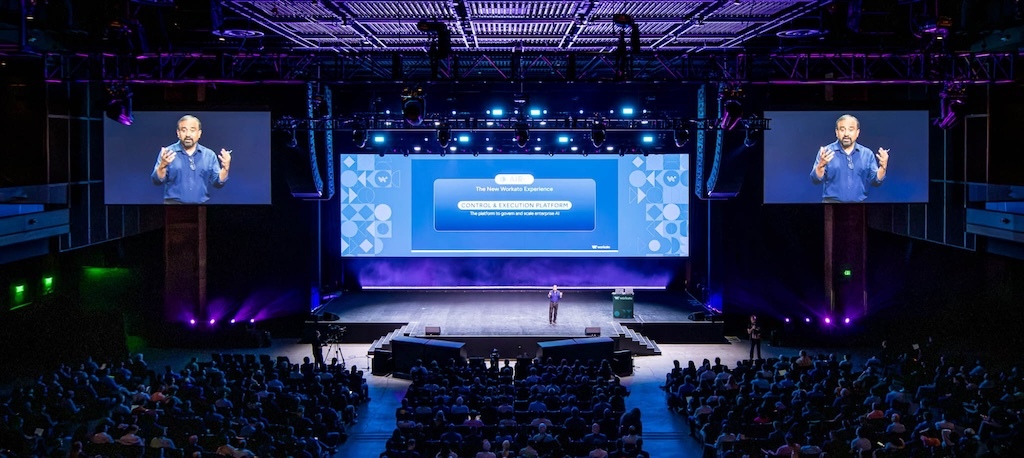
Our annual conference, WOW: World of Workato, has officially wrapped in Las Vegas, bringing together the Workato community for three days of over 50 sessions, 100 speakers, hands-on training, and product deep dives.
Chief of AI, Bhaskar Roy, kicked off the opening keynote with a clear message: we have always been about helping our customers close the “intent-to-outcome gap” between idea and business outcomes, at speed and at scale. Joined on stage by our Chief Product Officer, Bhagat Nainani, alongside leaders from Lenovo, Vodafone VOIS, and Anthropic, we laid out how companies are closing the gap from intent to outcome.
Reasoning is abundant, results are not
Bhaskar began by describing familiar challenges in enterprise AI. Spend on AI and token consumption is growing. But outcomes are not keeping pace. In most cases, AI is stuck at the edges of the enterprise and is failing to transform the core. Worse, new AI models and agents keep being added, and every team working on AI sets up its own connections to enterprise apps, databases, and legacy systems. This creates a new layer of fragmentation and chaos. As Bhaskar put it so plainly, “organizations can’t scale AI on chaos.”
To solve this, Bhaskar unveiled two core announcements that together form Workato’s new foundation for enterprise AI:
The Control and Execution Platform
A unified, neutral platform that brings together complete relevant enterprise context, enforces security and governance at design time and runtime, and enables trusted, governed execution across any AI model, any agent, and any MCP server.
AIRO
The new face of Workato, which takes your intent and translates it into business outcomes for every builder, across every stage of the lifecycle, from analyzing and architecting to deploying, monitoring, and improving.
In this post, we’ll dive deeper into the market shifts driving these announcements and why bridging the intent-to-outcome gap requires a fundamentally new approach to enterprise architecture.
Control plane sprawl will not solve agent sprawl
As enterprise AI initiatives multiply, so does the need for an AI control plane. For example, BCG argues that “AI agents are scaling faster than enterprise governance, making centralized control critical for organizations seeking to accelerate AI adoption without increasing risk,” while Deloitte recently described the enterprise control plane as “the strategic nervous system” across the tech stack. But as every major tech vendor rushes to answer this demand with their own control plane, a new architecture problem has emerged.
As Raj Pillai, CIO of a Fortune 500 company, shared, “We have a lot of control planes now, but less control.” As hyperscalers, security vendors, data platforms, and even SIs launch their own isolated control planes, enterprise CIOs are facing a new form of operational chaos: control plane sprawl. Each insular control plane only sees well within its own apps and ecosystem of apps, but not outside them. Workato Chief of AI Bhaskar Roy put it bluntly, cautioning leaders that “control plane sprawl is not going to help you with your chaos; it’s going to add to it.”
Enterprise AI requires a new foundation of work
Companies that close the intent-to-outcome gap control the chaos, they enable AI to execute at scale, and they architect in such a way that delivers enterprise ROI. That requires a new foundation of work that rests on three layers:
Complete enterprise context
Effective AI needs complete, relevant enterprise context. And context is more than just company knowledge and data from systems of record and documents. As Bhagat Nainani shared, without process context, “AI may know how the process could work. It doesn’t know how your process actually works.”
A neutral control and execution plane
Governance cannot be trapped within a single vendor’s application stack. Enterprises need a platform that can bring all business context and sit between all systems and execute across multiple models, apps, MCP servers, agents, and data sources simultaneously.
Foundation of intent
AI systems should be designed around the business goal workers are trying to achieve, be it “Onboard this new employee” or “Process an invoice.” That goal is the intent. Knowledge workers need to direct AI through natural conversation, collaborate with domain-specific AI experts, and maintain full visibility over the process. Everything below this layer functions invisibly in the background. Its sole job is to make human intent trustworthy (strictly enforced by security and compliance guardrails) and actionable (reliably executed across all underlying systems).
Control planes and execution planes belong together
A control plane cannot operate in isolation from the execution plane, where actual work happens. Bhaskar likened this to an airport. The control tower sets the rules of the airspace, but the airport is far bigger than the tower: runways, gates, fuel, and ground crews all have to work for a single flight to leave on time. “Without the control tower, the airport won’t function. And if they’re not in lockstep, things will fall apart.” The same holds for AI: governance without execution moves nothing, and execution without governance is just faster chaos.
This gap between reasoning and action is where most projects stall. During his fireside chat, Anthropic’s Head of US Mid-Market GTM, Travis Bryant, noted that simply “sprinkling AI on stuff” won’t work. Models like Claude serve as intelligent brains, but they need governed enterprise “hands” to act safely. “The models are only as good as the context that you give it,” Travis explained. “If you don’t teach Claude to talk to those systems, then you’re not gonna get automation and workflow improvements.”
While the control plane sets the guardrails, the execution plane is where agents reason and act in real time. If they drift apart, you cannot guarantee the agent will do what you intended. But when governance and execution operate together, as demonstrated on stage by Lenovo, Vodafone VOIS, and others, AI stops being a pilot and starts driving true enterprise scale.
Because knowledge workers operate at the level of intent rather than underlying infrastructure, the ultimate test of this architecture is how seamlessly it translates human intent into real business outcomes. That brings us directly to the new face of Workato: AIRO.
With AIRO, builders don’t have to be rocket scientists
The biggest moment of the keynote was a look at AIRO, which Bhaskar described as “the new face” of Workato and a single primary interface for all builders in Workato across the entire business lifecycle.
“AIRO is one of the biggest unlocks that we have had since we started Workato.” – Bhaskar Roy, Chief of AI, Workato
The traditional approach requires builders to make complex decisions up front. As Diginomica’s Ian Thomas put it, with AIRO, “users are not expected to decide whether they need to build a recipe, workflow, agent or skill, using different tools to assemble and deploy the resulting solution, but to simply describe what they are trying to achieve and allow AIRO to determine how that intent should be implemented on their behalf.”
The future is built by telling AIRO your ideas
You could say, “when a new customer signs up, verify that they’re real, check our systems, provision their account,” and AIRO figures out the architecture for you and builds you a production-grade solution. No components for you to assemble.
This is already happening in production. At Lyft, a no-code builder with zero integration experience, shipping agents in under a day, shared:
Why this matters comes down to empowerment
AIRO is a big change in how users across the business will interact with their work. The people who understand their processes and know what is really needed are now empowered to improve them directly. When people can take control of their processes, it benefits the business in countless ways: it grows, improves, expands, and enables new operating models that wouldn’t have been possible when change required specialized technical expertise.
At Cohesity, they’re demonstrating this at scale. Rather than creating a bottleneck where a central team must approve every change, they democratized access across departments:
When enterprise AI adoption scales, this is what it looks like. Gatekeeping change is replaced with empowerment across the enterprise.
Proof in production: Lenovo, Vodafone, and Red Hat
We were thrilled to share the stage with enterprise leaders who are already executing on this new foundation:
Lenovo’s Qira
Lenovo shared how they are using Workato to power Qira, an ambient personal AI operating across PCs, smartphones, and wearables. Using our enterprise-grade MCP connectors, Lenovo rolled out dozens of secure app connections in weeks to deliver unified user experiences at scale.
“We had this problem. We needed to connect Qira to the data that people already had. We wanted to do it at scale and build MCP-type connectors. Workato was the solution…Workato, within one week, gave us 10 applications.” – Pooja Sathe, Head of AI Ecosystems & Partnerships, Lenovo
Vodafone / Vodafone Intelligent Solutions (VOIS)
Alena Keck, Head of Strategic Initiatives at VOIS, detailed how Vodafone completely re-engineered core operations. By running 5-day hackathons, they built 30 agents and 60 reusable skills while introducing an AgentOps framework to continuously monitor performance, costs, and quality.
Red Hat’s AI Factory Execution
Red Hat’s deployment of Workato illustrates the potential of enterprise-scale AI automation. By focusing on speed and empowerment, they’ve scaled their platform dramatically:
From Lenovo and Vodafone to Red Hat, the proof in production is clear: the experimental phase of enterprise AI is over, and the era of production-grade execution has begun. Bridging the intent-to-outcome gap at speed and scale requires an architecture built with complete enterprise context, unified control and execution, and an AI-first experience that empowers every builder.
All of these new capabilities are available today in your Workato ONE subscription, and we can’t wait to see what you build next.