

A growing number of companies are choosing Workato over MuleSoft in recent years. Why are so many enterprises making this move? The answer lies in three critical factors: operational cost reduction, dramatically faster development cycles, and the need to modernize their integration stack for the AI era.
If you’re comparing vendors for middleware, orchestration, and AI-powered orchestration or evaluating whether to stick with MuleSoft or explore alternatives, this analysis of real customer migrations will help you understand what’s driving this significant shift in the enterprise integration landscape.
The Migration Trend: What’s Driving the Move from MuleSoft to Workato?
When comparing Workato vs MuleSoft, enterprises consistently cite three primary drivers for migration: ROI & TCO, speed of development, and modernization for AI-readiness. Let’s dive into each point.
1. Higher ROI & Lower Operational Costs: Up to 65% TCO Reduction
Workato customers report substantial reductions in TCO (total cost of ownership) compared to MuleSoft. The difference stems from Workato’s cloud-native, serverless architecture that eliminates infrastructure management costs and enables business technologists—not just expensive specialist developers—to build automations.
Proven Cost Consolidation Success at a Leading Game Development Platform
The Director of Enterprise Technology at a 5,000 person company and leader in games and interactive content development shared their experience with app rationalization and cost cutting since migrating from MuleSoft to Workato.
- 236 applications consolidated
- $19M in rationalization savings
- $441K in iPaaS TCO savings
- 70+ integrations built in just 8 months
“We were able to save with an iPaaS strategy, specifically, using Workato played a key role…it reduces a lot of bolt-on applications, a lot of redundant software… So that…led to 20% cost savings where we are.”
“We implemented and came up with a single iPaaS strategy using Workato to automate, and we started curbing down systems like Zapier and MuleSoft.”
“The majority of these integrations were built on Workato. So seventy-plus integrations involving eight-plus systems is what we built over the period of eight months…you can build very clean, meaningful, scalable, low-cost integrations on Workato.”
Global insurance software provider saves $2M+ by replacing MuleSoft
Workato helps companies migrate away from MuleSoft and dramatically reduce infrastructure costs, specialized resources, and technical complexity. A leading provider of cloud-based software for the insurance industry—operating in over 40 countries with more than 5,000 employees—reduced Total Cost of Ownership (TCO) by more than 50%. This approach helps companies unlock budget and capacity for faster, lower-risk migrations and long-term operational savings.
2. Faster Speed of Development: Up to 10x Acceleration
Development velocity is a critical factor when comparing middleware vendors. Workato customers consistently report development cycles that are 4-10x faster than MuleSoft, thanks to Workato’s intuitive graphical user interface (GUI), pre-built connectors, and auto-scaling platform with zero DevOps overhead.
Development Speed Breakthrough
“Workato helps us really move fast, automating really complex workflows…our legacy solution was almost like a large science experiment to manage these integrations.” –Head of Technology at a Global Entertainment Company
The numbers are striking:
“Our longest [integration with Workato] took one to two weeks… [With MuleSoft], the same initial build took somewhere around 8–10 weeks. That is a tremendous amount of time for the MuleSoft build compared to how quickly we implemented the same solution with the Workato recipes… The biggest selling point for me, for Workato, was the ease of use and the speed of development from an engineering perspective.” –Head of Technology at a Global Entertainment Company
Breaking Down the iPaaS Delivery Lifecycle Comparison
When comparing Workato vs MuleSoft delivery timelines:
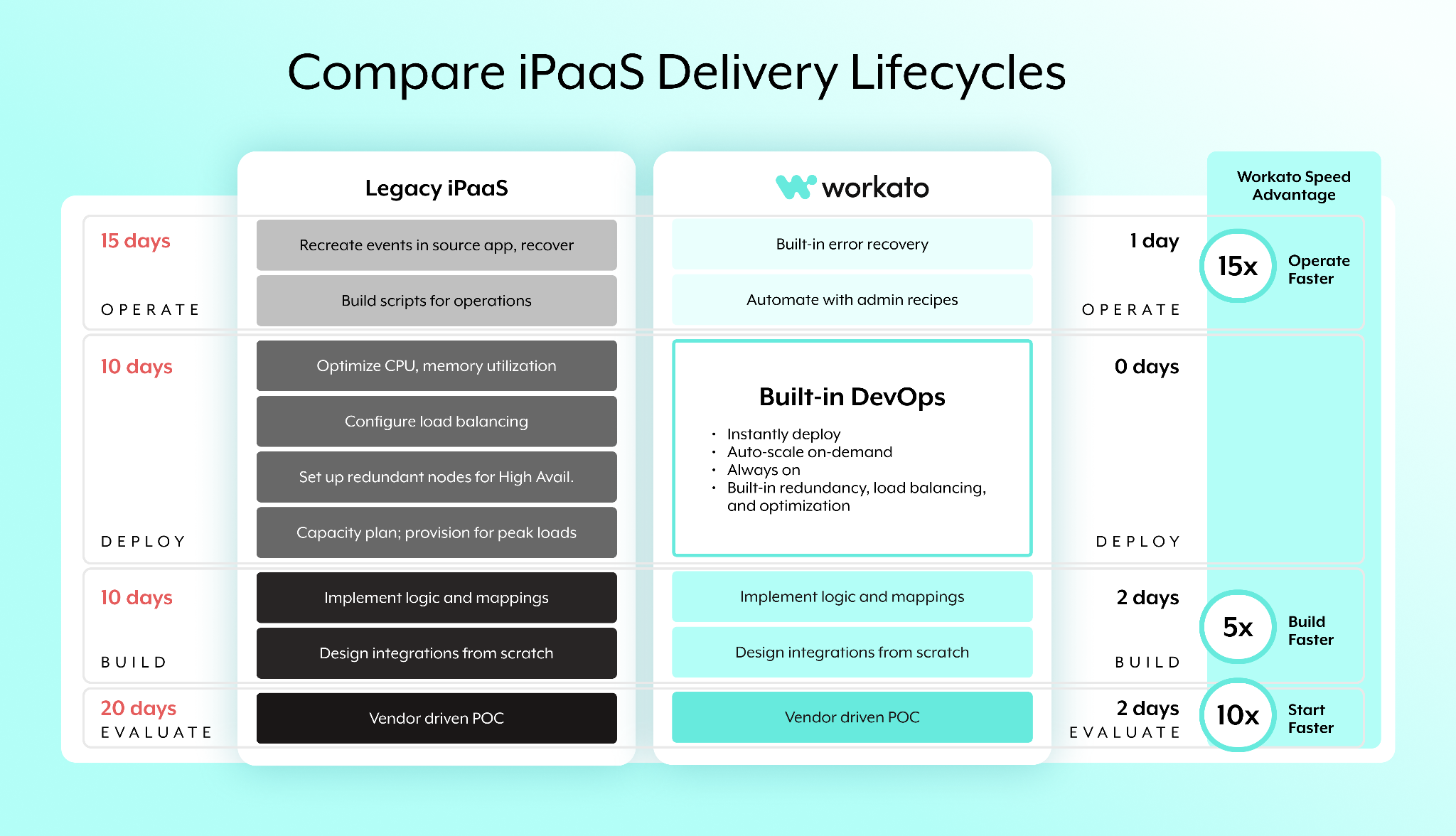
MuleSoft Timeline (55+ days total):
- 15 days to operate (recreate events, build scripts, optimize performance)
- 10 days to deploy (configure load balancing, setup redundancy, plan capacity)
- 10 days to build (implement logic, design integrations)
- 20 days to evaluate (vendor-driven POC process)
Workato Timeline (5 days total):
- 1 day to operate (built-in error recovery, admin recipes, 15x faster)
- 0 days to deploy (instant deploy, auto-scale, built-in redundancy and optimization)
- 2 days to build (ML-guided logic, start with community recipes, 5x faster)
- 2 days to evaluate (hands-on proof of value, 10x faster)
3. Stack Modernization: Future-Proofing with AI Capabilities
MuleSoft’s ESB architecture requires expensive specialist developers, CloudHub infrastructure management, and constant DevOps overhead. Companies choose Workato for serverless, cloud-native simplicity that empowers business technologists to build, and native support for enterprise MCP and agentic AI to future-proof their orchestration stack for integration and automation.
As enterprises move toward AI-driven operations, the integration platform becomes the orchestration layer for not just applications, but intelligent agents working autonomously.
Choosing a Platform that Enables AI Today and Tomorrow
“As we look to the future, we’re not only managing employees… we’re managing fleets of agents. It’s incredibly important for us to orchestrate them with Workato so that they’re working together to meet business goals.” —CIO at a Leading Technology Company Specializing in Logistics and IOT
Real Migration Stories: Companies Who Made the Switch
Reducing Sprawling Complexity
When comparing middleware vendors, complexity reduction is often overlooked—but it’s critical for long-term success.
One CIO at a professional services company with 60,000 employees across 120 countries shared about their experience while using MuleSoft:
“With that sprawling complexity [of MuleSoft], we could never connect our processes, workflows, and data to our systems, applications, and services.”
“We had multiple API management systems, ETL systems, enterprise service bus messaging, you name it… So what we did is we brought Workato in to be our integration platform as a glass layer, and we were able to displace and replace all these other systems that we had, all vendors that we had.”
Since making the switch to Workato the same CIO described the following results:
“Now we have an enterprise-level capability that all of our product lines and solutions lines are using to automate processes. And we’ve already started on the journey and we’ve automated many processes across our entire value chain. Some examples are like client onboarding or invoicing or certificate of interest generation. Just a few samples, but Workato has been a huge component of our tech stack modernization journey.”
Choosing Workato for Stack Modernization
One company’s common migration story illustrates the operational reliability and partnership difference between Workato vs MuleSoft:
“Before Workato… [MuleSoft] was like an old film reel, slow and prone to breaking… we were faced with high costs, slow market responses, and system outages.” —Head of Technology at a Global Entertainment Company
The reduction in tech debt, and architectural improvements were dramatic:
“In many instances we slashed 4,000 lines of code down to under 100—that’s a whopping 98% reduction. Our integration dashboards used to be a roller coaster of spikes and outages; now they’re steady and boring, and that’s exactly what we want.” —CIO at a Global Entertainment Company
But perhaps most impressive was Workato’s partnership approach during a critical moment:
“Our partners predicted that they would need to scale their infrastructure 5 times to cater to [new program]. We got the news 48 hours before the launch. So we made a call to Workato and the next day, they bumped our concurrency from 50 to 200. No questions asked. No commercial negotiations whatsoever. That’s what I mean by partnership.” —CIO at a Global Entertainment Company
Delivering More Projects with Less Overhead
“Since migrating from MuleSoft to Workato our development cycle is halved, even with half of our previous manpower and resources.” —CIO at a Global Entertainment Company
What MuleSoft Specialists Are Saying
When comparing middleware vendors, hearing from users with direct experience on both platforms is invaluable:
“As someone who spent 10+ years using MuleSoft…what did it for me was the speed of development, the scalable costs, and the pace of the Workato Product Team’s innovation. [Workato] is a modern platform and a vendor that delivers.” — Integration Engineer at a Leading Technology Company Specializing in Logistics and IOT
Workato vs MuleSoft: Key Differentiators
When comparing Workato vs MuleSoft, these are the critical differences driving migration decisions:
Architecture
- MuleSoft: ESB-based, requires CloudHub infrastructure management, constant DevOps
- Workato: Serverless, cloud-native, auto-scaling with zero infrastructure overhead
Developer Requirements
- MuleSoft: Requires expensive MuleSoft specialists and dedicated DevOps teams
- Workato: Empowers engineers, business technologists, and citizen integrators with a high level of baked-in security, governance and observability
Development Speed
- MuleSoft: 8-10 weeks for typical integrations
- Workato: 1-2 weeks for the same integrations (4-10x faster)
Code Complexity
- MuleSoft: Thousands of lines of custom code to maintain
- Workato: Robust support for pro-code, low-code, and no-code led to 98% code reduction reported by one company
Total Cost of Ownership
- MuleSoft: High infrastructure costs, expensive specialists, lengthy projects
- Workato: 20-65% TCO reduction, predictable pricing, rapid ROI
AI Capabilities
- MuleSoft: AI capabilities center on the Salesforce platform with external connectivity limitations
- Workato: Native agentic AI orchestration, future-ready, vendor-agnostic platform
Partnership & Support
- MuleSoft: Traditional vendor relationship
- Workato: True partnership, elastic scale, fair pricing
Is It Time to Reconsider Your Integration Platform?
If you’re currently using MuleSoft and facing challenges with high costs, slow development cycles, or complex infrastructure management, you’re not alone. The hundreds of companies that have decided to go with Workato in the past two years were dealing with the same issues.
Signs it might be time to evaluate Workato vs MuleSoft for your organization:
- Your MuleSoft implementations take weeks or months instead of days
- You’re struggling to find or afford MuleSoft specialists
- Infrastructure and DevOps overhead is consuming significant resources
- You need to democratize integration to business technologists
- You’re preparing for an AI-driven future and need agentic orchestration
- Your integration costs are growing faster than your business value
The Bottom Line: Comparing Middleware Vendors in 2026
When comparing middleware vendors, the data from actual migrations tells a clear story. Companies are choosing Workato over MuleSoft for:
- Dramatic cost reduction (20-65% lower TCO)
- Substantially faster development (4-10x speed improvement)
- Modern, cloud-native architecture (serverless, zero DevOps)
- Business technologist enablement (democratized integration)
- AI-ready platform (native agentic orchestration)
- True partnership (responsive, customer-focused support)
The migration trend is clear: enterprises are moving from complex, expensive, specialist-dependent platforms to modern, efficient, business-accessible solutions. In the past 24 months, organizations made the choice to go with Workato over legacy iPaaS vendors, like MuleSoft, 743+ times. The Workato vs MuleSoft comparison increasingly favors the modern, cloud-native approach.
Ready to Explore Your Options?
If you’re evaluating integration platforms or reconsidering your current MuleSoft implementation, Workato offers:
- Migration assessments to understand your current state and potential savings
- Proof of value programs to demonstrate speed and capability differences
- Migration support to ensure smooth transitions with minimal disruption
- Flexible pricing that scales with your business, not your infrastructure
Contact Workato for a demo to see why hundreds of companies are choosing the modern enterprise platform over legacy iPaaS.
About This Analysis
This comparison is based on customer testimonials, case studies, and verified migration data from companies that selected Workato over MuleSoft and other legacy iPaaS vendors between 2023-2025. All quotes and statistics are from Workato customer sources.