

Enterprise AI agents are finally moving from experiments to production. The difference between pilots that stall and programs that ship is enterprise orchestration. Models alone do not drive outcomes. Agents must coordinate data, tools, policies, and people.
Keep reading to learn how to design enterprise-grade agents, what we call Genies, with Workato’s Agent Studio in the Workato One platform — and how our partner, Saravana Kumar, CTO at Twenty20 Systems, implemented a multi-agent order management flow that showcases what agentic automation can really do in production.
Order management is one of the most complex and high-value processes inside any enterprise. It touches quoting, inventory, fulfillment, billing, and customer communications, making it the perfect example of where multiple agents must coordinate across teams and systems to deliver measurable business outcomes.
Why Chatbots Aren’t Enterprise-Ready
A chat wrapper with an LLM and a few API calls can answer questions. An enterprise agent must do more:
- Listen to secure business events across systems
- Retrieve and use governed knowledge sources
- Decide when to invoke the right skill deterministically
- Take actions in apps with correct credentials and audit trails
- Engage humans only for real exceptions
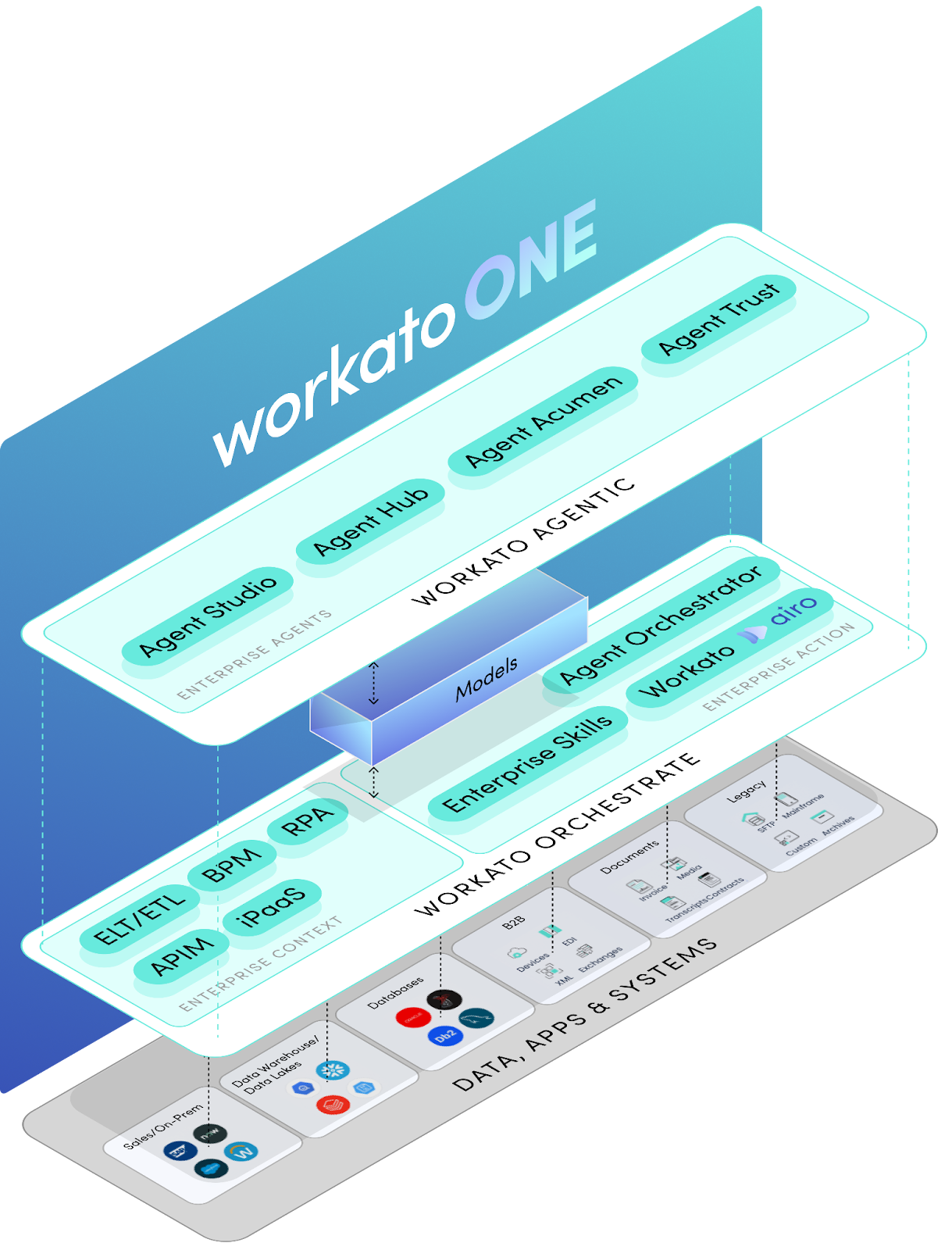
This is where Agent Studio fits in. It adds an agentic layer on top of Workato’s proven orchestration capabilities. You can connect to models, define Genies, attach skills, scope access, and ship governed, multi-agent flows to Slack, Teams, or Workato Go, our enterprise search platform.
Want to see this end-to-end? Watch the webinar recording.
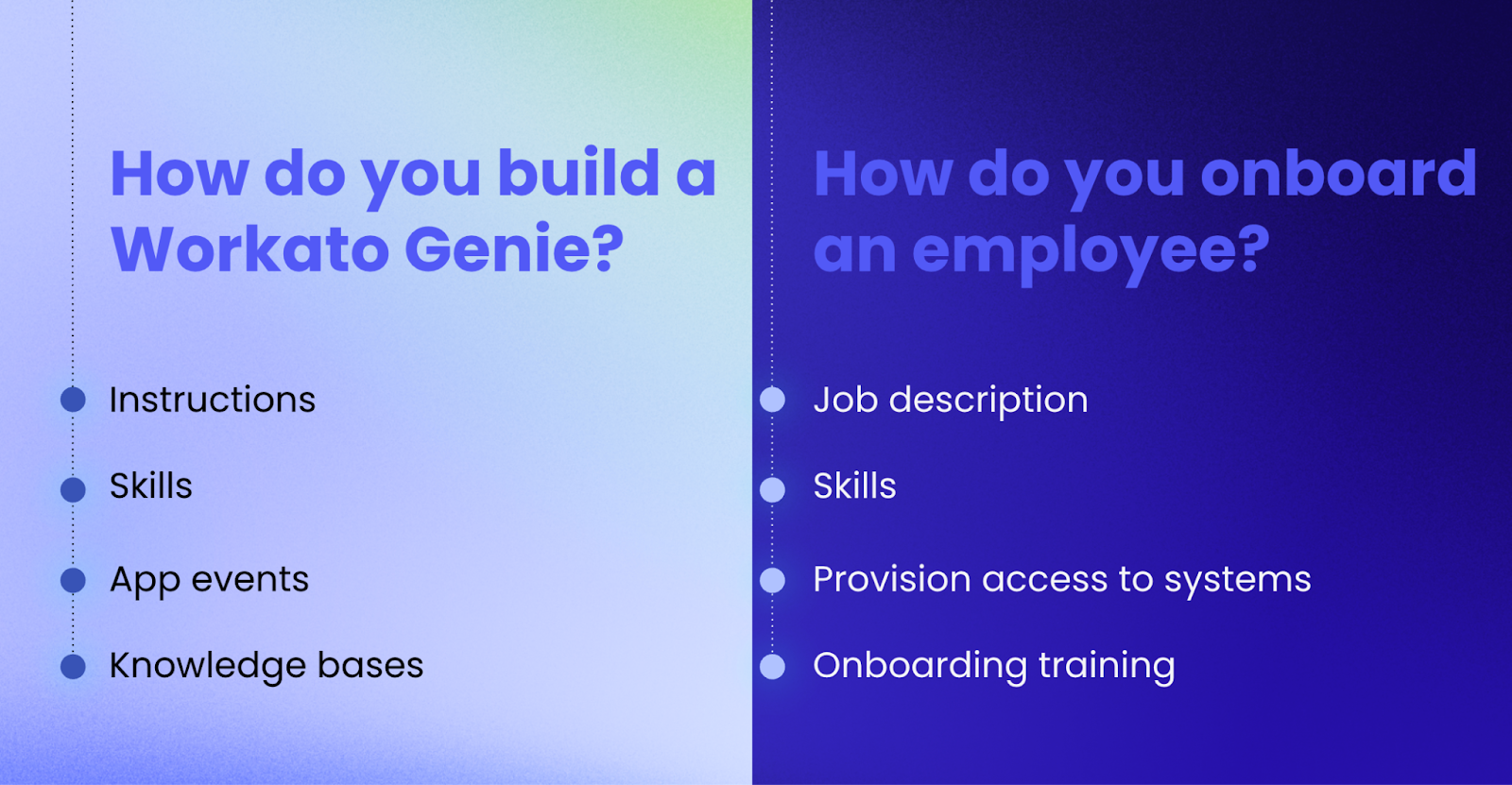
A reliable mental model: onboard your Genie like a new employee
Designing a Genie maps neatly to onboarding a teammate.
Job Description
Define purpose, responsibilities, and KPIs. These instructions set guardrails for how the Genie should behave and what “good” looks like.
Skills
Give the Genie the deterministic abilities it needs. In Agent Studio, skills are built much like Workato recipes. They encapsulate concrete actions such as “create order,” “reserve inventory,” “validate address,” or “run SQL to fetch open opportunities.”
Access
Attach the right connections to apps and data. Scope by business unit. Least privilege by default. Credentials live in Workato with auditability.
Events
Subscribe to the business signals that matter. Webhooks and API triggers from your ERP, CRM, OMS, WMS, and more. Agents should react in near real time rather than wait on batch windows.
Knowledge base
Load the context that makes outputs trustworthy. Policies, naming conventions, field maps, and process docs. The model does the reasoning. The knowledge base keeps it grounded in how your company actually works.
Reference architecture: super agent plus specialists
A proven pattern for complex workflows is a super agent that orchestrates specialist agents:
Order agent
Validates and enriches orders, handles exceptions
Inventory agent
Checks availability, makes reservations, triggers replenishment
Notification agent
Routes approvals and status updates to the right people and channels
Future specialists
Shipment, fraud, pricing, and compliance agents
This mirrors how teams scale in the real world. The super agent coordinates. Specialists do one thing well with clear contracts.
Why start with order management?
Before diving into the demo, it’s worth explaining why order management was chosen.
Across industries—from manufacturing and retail to distribution and logistics—order management sits at the intersection of revenue, inventory, and customer experience. It’s one of the most universal, complex, and manual processes every company runs.
Because it touches so many systems (ERP, CRM, eCommerce, warehouse, tax, and credit), it’s also one of the clearest illustrations of what agentic orchestration can do. If Genies can make order management faster, cleaner, and more reliable, the same pattern can transform nearly every other mission-critical process in the enterprise.
Real demo: multi-agent order management with Twenty20 Systems
Twenty20 Systems built a Genie-powered order management flow for a physical goods scenario. It highlights three paths: auto-approval, manual approval, and rejection with replenishment.
Flow overview
- Orders land from a portal or CSV.
- MCP tools expose uniform actions, such as creating an order or getting product details, so agents can reuse existing APIs cleanly.
- The super agent triggers a sequence: inventory check, credit check, enrichment, and activation in Salesforce.
- Notification Genie sends outcomes to email or Slack.
- Humans only step in for real exceptions.
Three core interactions
Auto-approval
Inventory passes. Credit passes. Enrichment finds no gaps. The order is activated and notifications go out.
Manual approval
Inventory passes. Credit fails. Slack notifies the account manager of the context needed. The manager approves in Slack. Enrichment runs. The order activates.
Rejection with guided replenishment
Inventory fails due to a shortfall. The order is rejected with a clear reason. A field rep opens Workato Go, asks the Inventory Genie for on-hand units in natural language, then asks it to raise a restock request. The Replenishment Genie kicks off procurement steps and reports status.
Why this matters
- Cycle time drops because events and skills run in near real time
- Errors shrink because validation and enrichment are deterministic
- Humans focus on exceptions instead of rote checks
- Auditability looks like recipe jobs: every request and action is traceable
Governance, security, and compliance by design
Genies inherit Workato’s enterprise controls:
- Scoped access per Genie and per business unit
- Credential management with rotation and audit logging
- Policy-driven knowledge to keep responses compliant
- Human-in-the-loop at defined checkpoints
- Model flexibility
- Use platform-supported models for chat and reasoning. Call out to other LLMs from skills via APIs if needed. For sensitive data, hash or tokenize before model calls and store identifiers safely in your systems of record.
- Use platform-supported models for chat and reasoning. Call out to other LLMs from skills via APIs if needed. For sensitive data, hash or tokenize before model calls and store identifiers safely in your systems of record.
Builder notes: practical tips to go from pilot to production
Write the job description as tests
Phrase responsibilities and KPIs so they can be verified. Example: “Approve orders under $10K when inventory is available and credit score is above threshold.”
Keep skills small and composable
One skill per outcome, predictable inputs and outputs. Easier to test and to reuse across Genies.
Name your fields consistently
Knowledge bases should document field names, units, and validation rules. This reduces brittle prompts.
Start with the happy path, then layer exceptions
Ship value early. Add credit edge cases, partial fills, and back orders iteratively.
Put humans where decisions are subjective
Use Slack or Teams approvals for credit overrides and margin checks. Keep the audit trail.
Expose Genies where users already work
Slack, Teams, or Workato Go action boards. Minimize context switching.
Where to apply Genies next
Customers are finding quick wins with packaged Genies in HR and recruiting, IT and security, sales and support, and CPQ. Anywhere that rules, lookups, approvals, and updates cross multiple systems, agents can compress cycle times and make quality measurable.
See the full walkthrough and Q&A. Watch the webinar recording.
How to get started this week
- Pick a workflow with clear rules and a business owner. Order intake, new hire onboarding, or SDR follow-up are great first candidates.
- Define the Genie job description and two or three measurable KPIs.
- Implement the happy path with small skills.
- Load only the knowledge the Genie truly needs.
- Pilot with a real team. Add exceptions and approvals based on live feedback.
- Expand into a super-agent pattern when you have two or more specialists.
Ready to orchestrate real outcomes with Genies?
If you want hands-on help designing and governing your first production use case, or you want to see Agent Studio and Workato Go in action, we can show you exactly how it works in your stack.