
Everyone’s got a take on AI agents. Execs think they’re digital genies where you make a wish and it shall be automated. CIOs think they’re a ticking compliance time bomb. Tech bros are busy diagramming 17 layers of “autonomous intelligence” on a whiteboard. Employees think they’re about to be replaced by a glowing hologram named ChadGPT. And AI startups? They’re rebranding last month’s chatbot with the word “agentic.”
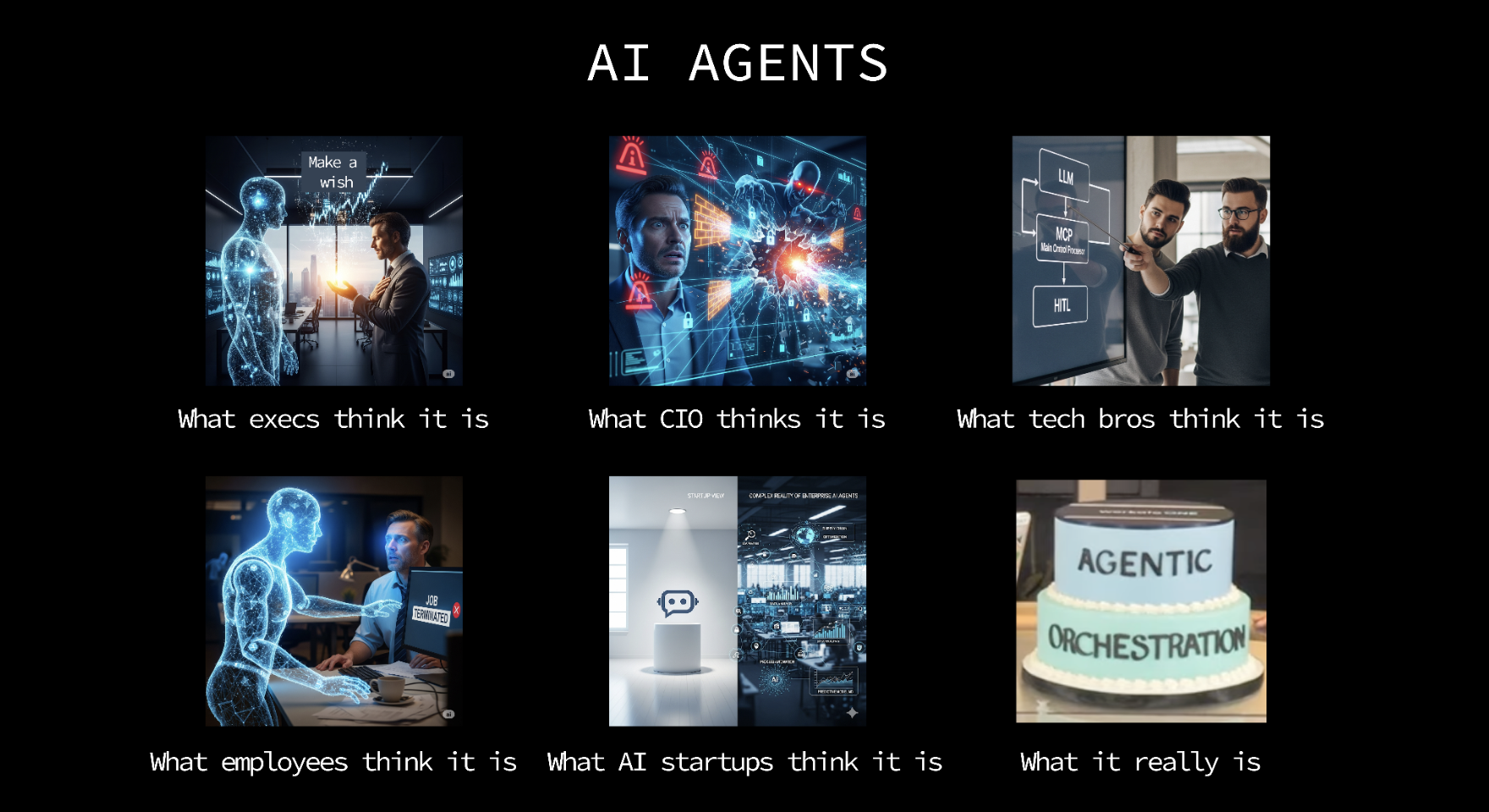
But here’s what AI agents actually are: they’re not magic, or Skynet, or even just another chatbot. They’re really about agentic orchestration, layering intelligence on top of APIs and workflows so we can finally get things done smarter and faster.
The Action Gap: Why AI Agents Stop at the Starting Line
Typical AI agents are more likely to assist than take action. They excel at front-end tasks like writing emails, creating content, finding information, answering questions, and suggesting next steps. But that’s where it stops. They can reason, but they can’t act reliably. There’s no easy or secure way for them to work with real enterprise systems, creating critical AI agent coordination problems that prevent teams from scaling their AI initiatives.
Most organizations end up building fragile, one-off solutions that don’t scale. This is the fundamental AI agent reliability challenge: agents are powerful at understanding intent and reasoning through problems, but they hit a wall when it comes to taking action.
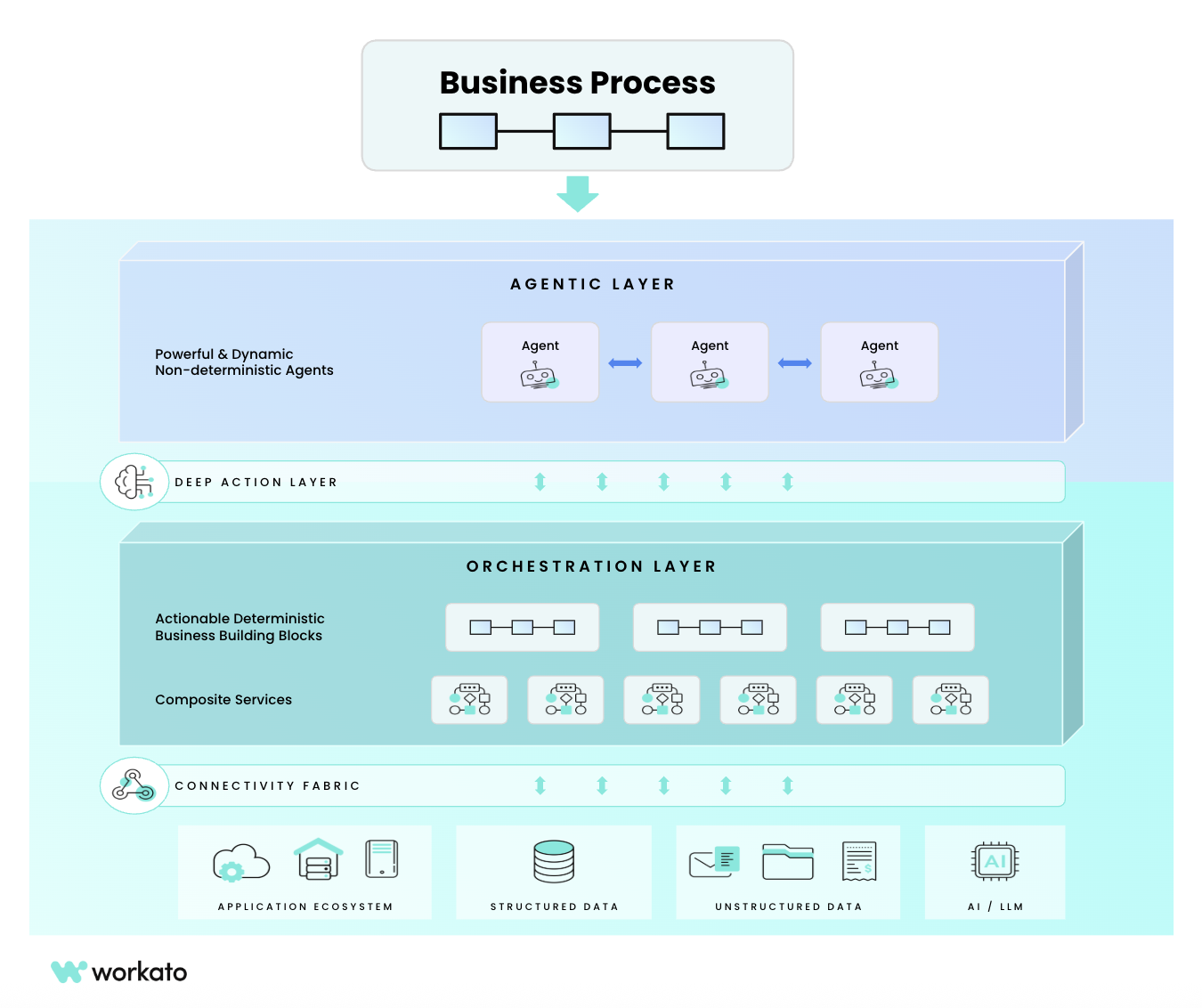
What’s missing is the ability to orchestrate—the bridge that connects intelligence with enterprise systems like CRMs, ERPs, databases, and APIs. Without that orchestration layer, AI can’t access governed, real-time data, run end-to-end processes, or follow clear roles and escalation paths. It also can’t continuously improve or manage its own lifecycle.
AI needs a way to work through your systems, not just on top of them. That’s the key to turning intelligence into real operational impact and solving AI agent coordination problems at scale.
Building Trust in Enterprise Agents Through AI Governance
For any enterprise to truly get value from AI agents, these agents must interact with enterprise systems in a secure, governed, and trustworthy way. AI governance means putting guardrails in place—controlling what actions agents can take, what data they can access, and under what conditions.
Effective AI governance also means enabling collaboration between humans and AI, where users can review, approve, or override actions when needed. Finally, there must be end-to-end visibility, clear monitoring, audit trails, and performance insights so teams can trust, refine, and continuously improve how AI operates within business processes.
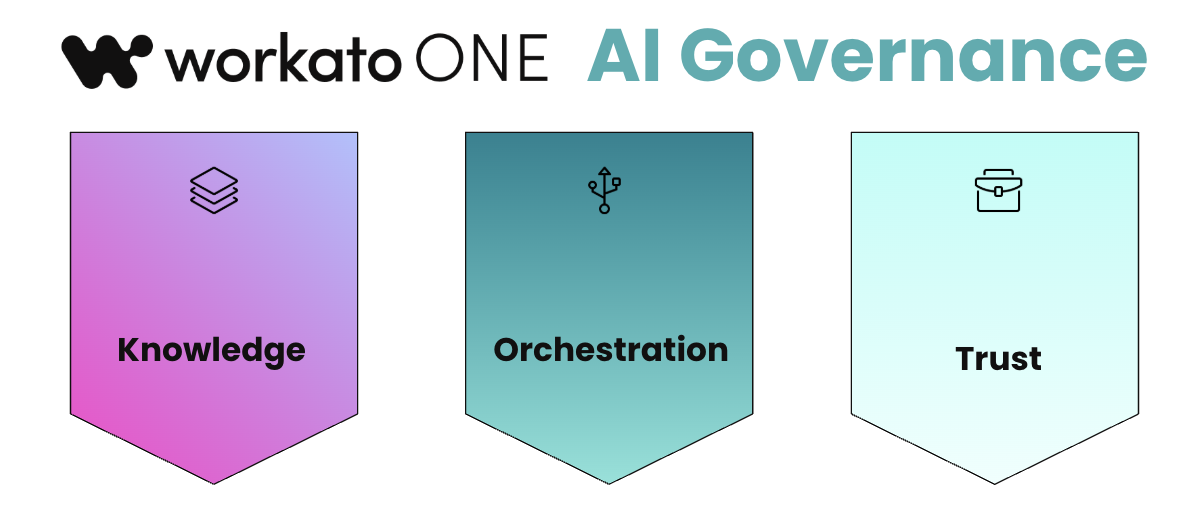
Orchestration provides the foundation that connects AI intelligence to real-world execution. It ensures that actions are secure, governed, and coordinated across systems, turning smart insights into reliable outcomes while maintaining robust AI governance standards.
The Evolution of Orchestration for AI Agents
Orchestration has evolved significantly and remains essential in the age of enterprise AI agents. In the past, it focused on basic connectivity and workflow automation between isolated applications. Today, it serves as the central nervous system for digital and AI-augmented operations, connecting people, processes, and systems to ensure governance, consistency, and adaptability.
In the future, orchestration will become the foundational layer that securely connects enterprise AI agents to systems, people, and processes at scale, enabling trust, collaboration, and compliance across the enterprise. The key takeaway? Orchestration isn’t replaced by AI. It’s amplified by it with a synbiotic relationship where orchestration powers the data, context, and actions for AI agents and in turn, true enterprise AI agents can trigger end-to-end orchestration.
Put Your Existing Investments to Work for Enterprise AI Agents with MCP
Here’s the good news: onboarding AI applications and unlocking deeper enterprise capabilities doesn’t mean starting from scratch. You’ve already invested significant time, effort, and resources into building secure, governed systems and orchestrations. Those shouldn’t go to waste. You should be able to leverage the same trusted foundation to power your AI agents.
Your organization has likely spent years perfecting integrations, establishing data governance policies, defining approval workflows, and building automations that connect your CRM, ERP, ticketing systems, and dozens of other critical applications. These aren’t just technical assets, they represent institutional knowledge, compliance requirements, and battle-tested business logic that keeps your operations running smoothly.
The challenge most enterprises face is that traditional AI implementations ignore this foundation entirely. Teams end up rebuilding connections, redefining permissions, and recreating workflows specifically for AI use cases. This creates duplicated effort, introduces new security risks, and fragments governance to manage across disconnected systems.
That’s where the Model Context Protocol (MCP) comes in. MCP is an open standard that enables AI agents to tap into your existing orchestrations, allowing them to execute business processes intelligently, securely, and at scale. Instead of building parallel infrastructure, MCP transforms your proven workflows into reusable “skills” that agents can call upon when needed.
This approach brings together non-deterministic reasoning i.e.the AI’s ability to understand context and make intelligent decisions with deterministic action i.e., the reliable, governed execution of your existing business processes. The AI handles the intelligence layer, while your trusted orchestrations handle the execution, ensuring consistency, compliance, and control.
In practice, this means your enterprise AI agents inherit the same security controls, approval mechanisms, and audit trails that already govern your operations, dramatically improving AI agent reliability.
From Vision to Action: The MCP Foundation
We’ve already seen what an enterprise’s technology landscape looks like: complex, interconnected, and full of potential. But to truly unlock the power of AI agents, organizations need more than intelligence at the surface; they need a foundation that connects thought to action. That’s where the Model Context Protocol (MCP) comes in.
MCP provides a unified connectivity and orchestration fabric that makes secure, enterprise-scale agent-to-system interaction possible. It bridges the gap between intelligent agents and enterprise orchestrations, allowing agents to act safely, consistently, and effectively across systems. In doing so, MCP transforms disconnected automation efforts into a cohesive Agentic Enterprise, one where intelligence and execution work hand in hand to overcome AI agent coordination problems that previously stalled AI initiatives.
Building Your Agentic Enterprise
Becoming an agentic enterprise doesn’t require months of implementation or specialized expertise. With Workato’s Enterprise MCP, you can enable all your apps and systems with trusted MCP servers, allowing AI agents to safely take real action across your entire technology stack.
Turn any Workato recipe into a secure MCP server in just a few clicks, or connect instantly using over 100 pre-built, composable servers across 12,000+ apps. MCP delivers enterprise-grade skills that replace fragile, one-off API integrations with governed, reliable actions. It’s fully managed and serverless, with enterprise-level AI governance and security including user-based controls, rate limits, MFA, and complete audit trails for compliance.
No code. No dependencies. No token juggling. Just scalable, trusted orchestration that powers real, intelligent automation that can ensure AI agent reliability.
MCP in Action
Imagine asking ChatGPT or Claude to summarize your open sales pipeline. Instead of manually managing tokens or writing custom API calls, the agent connects instantly through Workato’s managed MCP servers. Within seconds, you have governed, secure access to Salesforce and Gong with no complex integration work required.
This is the promise of MCP: AI that goes beyond chat to deliver tangible business value, built on the orchestrations you already trust.
The Unified MCP Advantage
Unlike vendor-specific MCPs, which result in fragmented control, siloed security, and inconsistent governance across hundreds of apps, the Workato Enterprise MCP provides a unified, governed orchestration layer that centralizes control across all apps, data, and AI agents.
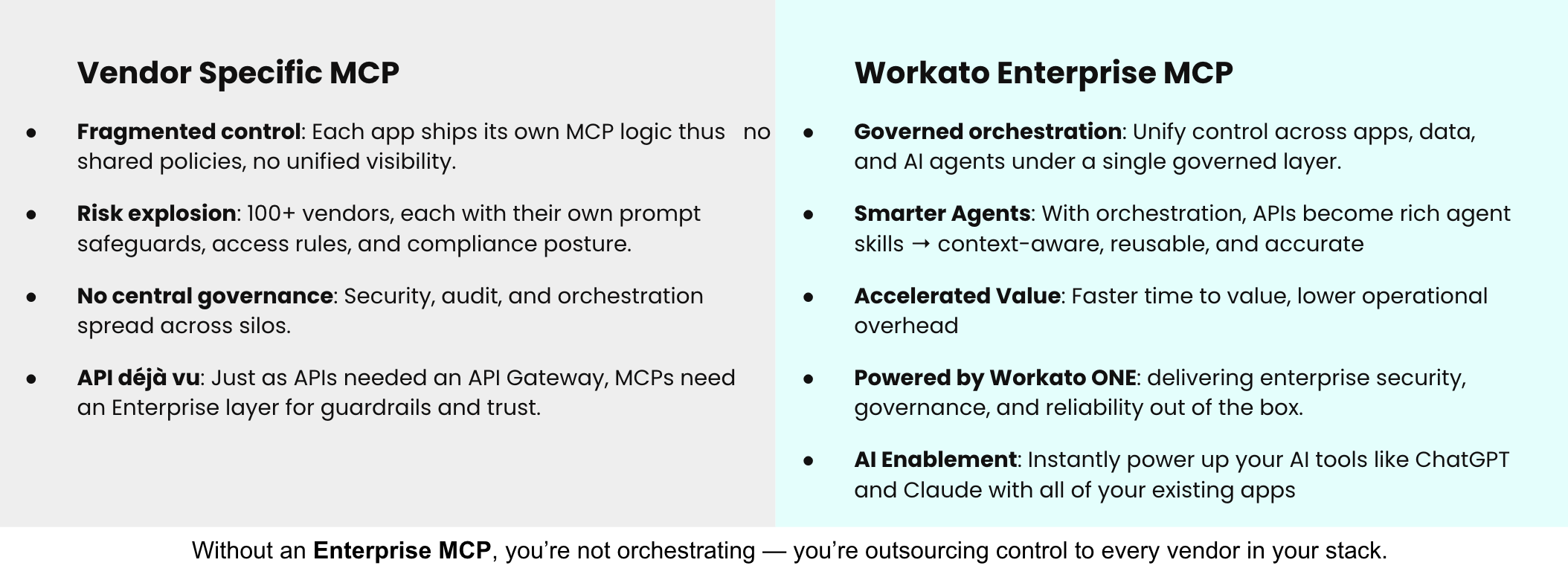
This approach transforms APIs into context-aware, reusable agent skills, enabling smarter automation and dramatically reducing operational overhead. It solves AI agent coordination problems by providing a single source of truth for AI governance, while ensuring AI agent reliability through consistent, battle-tested orchestrations.
The future of AI isn’t just about making it smarter. It’s about making it actionable, trustworthy, and ready for the enterprise. Without orchestration, AI is just talk. With it, AI becomes transformation.
Ready to Move from AI Talk to AI Action?
The future of enterprise AI isn’t about smarter chatbots. It’s about orchestration that turns intelligence into reliable business outcomes. Workato’s Enterprise MCP gives you the foundation to build an Agentic Enterprise where AI agents work securely across your entire technology stack.
See it in action: Schedule a demo to watch how Workato transforms your existing orchestrations into governed, enterprise-ready AI agent skills.
Start building today: Get hands on with our MCP server library and turn your first recipe into an AI-powered skill in minutes.
Why Workato is Leading the Way with Enterprise MCP
Workato is a unified enterprise orchestration platform that seamlessly brings together integration, automation, and AI agent capabilities in a secure, scalable environment. With its intuitive low-code / no-code recipe builder and serverless architecture, Workato enables organizations to solve AI agent coordination problems, enforce robust AI governance, and deploy reliable enterprise AI agents through the Model Context Protocol—all while maintaining the security and control that enterprises demand.
The platform empowers users to build and deploy AI agents with full business context, leveraging pre-built accelerators and frameworks to speed up automation projects. By providing universal connectivity to over 10,000 apps and data sources, Workato accelerates digital transformation, reduces total cost of ownership, and allows enterprises to scale automation and AI initiatives confidently and efficiently.