
AI agents are designed to feel magical.
You give them a prompt, and they get to work. They triage support tickets, update CRMs, spin up reports, or even write emails. It feels simple, seamless, and smart.
But behind that clean interface is a web of interconnected systems, actions, automations, and data flows. And the moment you empower an agent to act, not just suggest, you introduce real enterprise risk.
That is why agentic automation needs more than intelligence. It needs structure, oversight, and control. In short, it needs trust that is built into the foundation.
This blog explores how enterprises can harness the power of AI agents without letting them operate unchecked. It is about creating the guardrails that let agents move quickly while staying safe.
|
Not Quite Citizen Dev (And That’s a Good Thing) You might be wondering if this is just a new version of citizen development – Not exactly. While both approaches aim to decentralize automation, AI agents do not wait for a business user to press “run.” They initiate workflows. They act across systems, data, and sometimes even on behalf of customers. If you want to dive into how governance supports citizen development, here’s our deep dive on the topic: Scale Smarter, Not Harder: Unlocking Developer Capacity with Federated Governance |
Agent’s aren’t Chatbots, They Take Action
Many still associate AI agents with copilots or chat assistants. But true enterprise agents go far beyond suggestion. They execute.
They update records, sync systems, route requests, and send communications, often without human review. And that is the shift. When AI moves from answering questions to taking action, trust becomes the most important feature.
Think of agents like digital interns. Some you trust to fetch coffee. Others might handle invoicing. The difference comes down to structure, training, and oversight.
Trust on the Surface, Granularity Underneath
To the user, agents should feel fast and intuitive. But behind the scenes, trust is built through layers of control:
- Role-based access and fine-grained permissions
- Scoped execution environments for development, testing, and production
- Full audit trails and real-time observability
- Pre-approved workflows and escalation paths
Predictability is not a nice-to-have. It is a requirement for enterprise AI.
Deterministic vs. Stochastic Agents, and how to govern both
One of the core challenges with AI is that it is probabilistic. Unlike traditional deterministic systems, where the same input gives the same output, AI may give slightly different results each time, depending on context and data.
That variability can be powerful. But it also introduces risk.
Workato allows enterprises to define how much autonomy an agent has. You can let agents use flexible reasoning in some areas and apply strict logic in others.
Deterministic vs. Stochastic Behavior
|
Enterprises need both:
- Use deterministic agents where precision is critical, such as in financial processes, audit logging, or compliance scenarios.
- Use stochastic agents for tasks like triage, summarization, data classification, or opportunity discovery.
This flexibility enables a new model of control, one where you define the conditions for when AI can act independently and when it must escalate or request validation.
- Control the leash: With Workato, you can decide where AI runs freely and where it escalates or defers to a human.
|
Why Modular Architecture Matters for Agentic AI AI can interpret, classify, and operate more effectively in low-code and no-code environments because workflows are modular, explicit, and structured. This modularity makes agents safer, more explainable, and more governable than agents embedded in opaque, pro-code environments—where logic, intent, and side effects are harder to reason about and control. |
Bridging the Gap: From “AI Agents” to Agentic AI

According to Gartner, “AI agents” and “agentic AI” are often conflated, but agentic AI is a broader architectural strategy
- AI agents = single-purpose, execution-focused tools
- Agentic AI = multi-agent systems designed to pursue goals autonomously
But here’s the opportunity:
With the right security, orchestration, and control, enterprises can achieve agentic systems that approximate human-level agency.
That means:
- Orchestrating multiple agents to collaborate toward shared outcomes
- Retaining memory across interactions
- Adapting plans in real time, based on new data or context, safely and observably
In this model, governance becomes the difference between chaos and coordinated autonomy. It enables agents to act with independence while staying aligned with enterprise policies, priorities, and compliance frameworks.
- Orchestration provides the body.
- AI provides the brain.
- Governance provides the nervous system.
Workato brings all three together in a single, unified platform. Agents operate within structured, auditable processes, access enterprise data responsibly, learn over time, and act with precision. The result is not just smarter automation, but scalable, safe autonomy.
Agent Governance Framework: What It Should Include
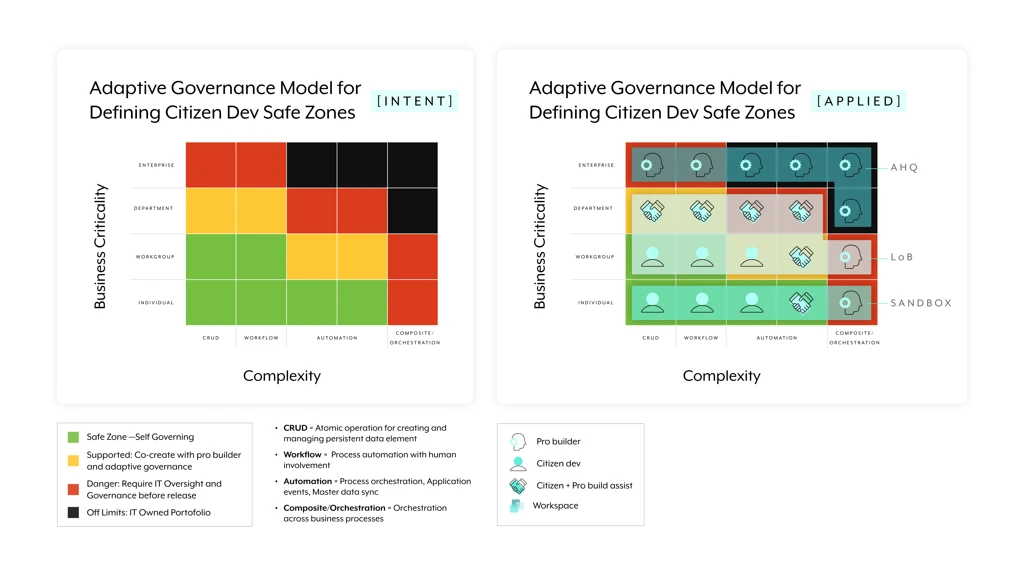
Workato extends the Adaptive Governance Model framework to agents by defining zones of autonomy and control:
- Green zone: Agents limited to sandbox/test environments
- Yellow zone: Supervised agents with limited prod access
- Red zone: Mission-critical flows requiring pre-approval
- Black zone: No agents allowed
Behind each zone are Recipes. These Recipes define what agents can do and expose that capability through Skills and Skillsets, a structured, reusable, and governable model.
This model ensures agents only do what they are authorized to do and nothing more.
Scaling Agentic Automation with Confidence
Going from pilot to production takes more than clever prompts. It requires:
- Scoped permissions
- Full lifecycle management for provisioning, monitoring, and revoking
- Orchestration that serves as a mediation layer
Workato provides a clear path for this. Instead of allowing agents to connect directly to backend systems, Workato uses orchestration to mediate those connections. That ensures agents follow approved, vetted processes, no matter how they were triggered.
This is critical to scale agentic automation without introducing new risk.
Agent Skills, Guardrails, and Governance by Design
Enterprise-ready agents need more than intelligence. They need structure, training, and oversight.
The goal is not to lock agents down, but to give them the clarity and control needed to act responsibly. That means defining three essential layers:
- Skills: What an agent is allowed to do. These are specific actions like updating a record, triggering a workflow, or retrieving data.
- Guardrails: What the agent is not allowed to do. These include sensitive systems, high-risk operations, or actions that require approval.
- Supervision: When the agent must escalate, pause, or alert a human before continuing.
This framework allows you to design agents that are adaptable and autonomous without being unpredictable or opaque.
Real-World Examples:
- An agent attempts to send a payment but hits a threshold limit. It immediately escalates the request for approval.
- A general-purpose agent receives a request and calls a specialized skill-based agent to perform a domain-specific task.
- Agent actions are logged, monitored, and reviewed continuously to refine performance and spot potential issues before they escalate.
With this model in place, agents become trusted extensions of your enterprise, not isolated tools operating in a vacuum.
Designing for Control, Without Bottlenecks
Governance should not slow you down. When implemented correctly, it improves speed, scale, and safety.
Workato’s platform supports:
- Low-code development for fast iteration
- Unified observability with audit logs and monitoring
- Role-based permissions with granular control
- Modular workflows that AI can understand and adapt to
Because everything happens inside a single platform, there is no need to stitch together disconnected tools or deal with unpredictable agent behavior.
You Don’t Need a Copilot. You Need a Crew and a Control Tower
AI systems are powerful because they are flexible, context-aware, and adaptive. But that also means they are inherently unpredictable. Enterprise systems, on the other hand, demand consistency, compliance, and control.
This is the core challenge of agentic automation: enabling intelligent agents to act autonomously without introducing chaos or risk.
To solve this, enterprises need a new foundation, one that combines:
- Orchestration, to structure and coordinate actions across apps, data, and systems
- Governance, to define what agents can and cannot do, when they must escalate, and how their actions are monitored
- Modularity, to ensure agents operate within clear, explainable logic
- Adaptability, to allow agents to learn, collaborate, and improve safely over time
That is how you move from one-off AI experiments to scalable, trustworthy automation. Not by locking agents down, but by training them with the right skills, enforcing the right guardrails, and designing the right supervision models.
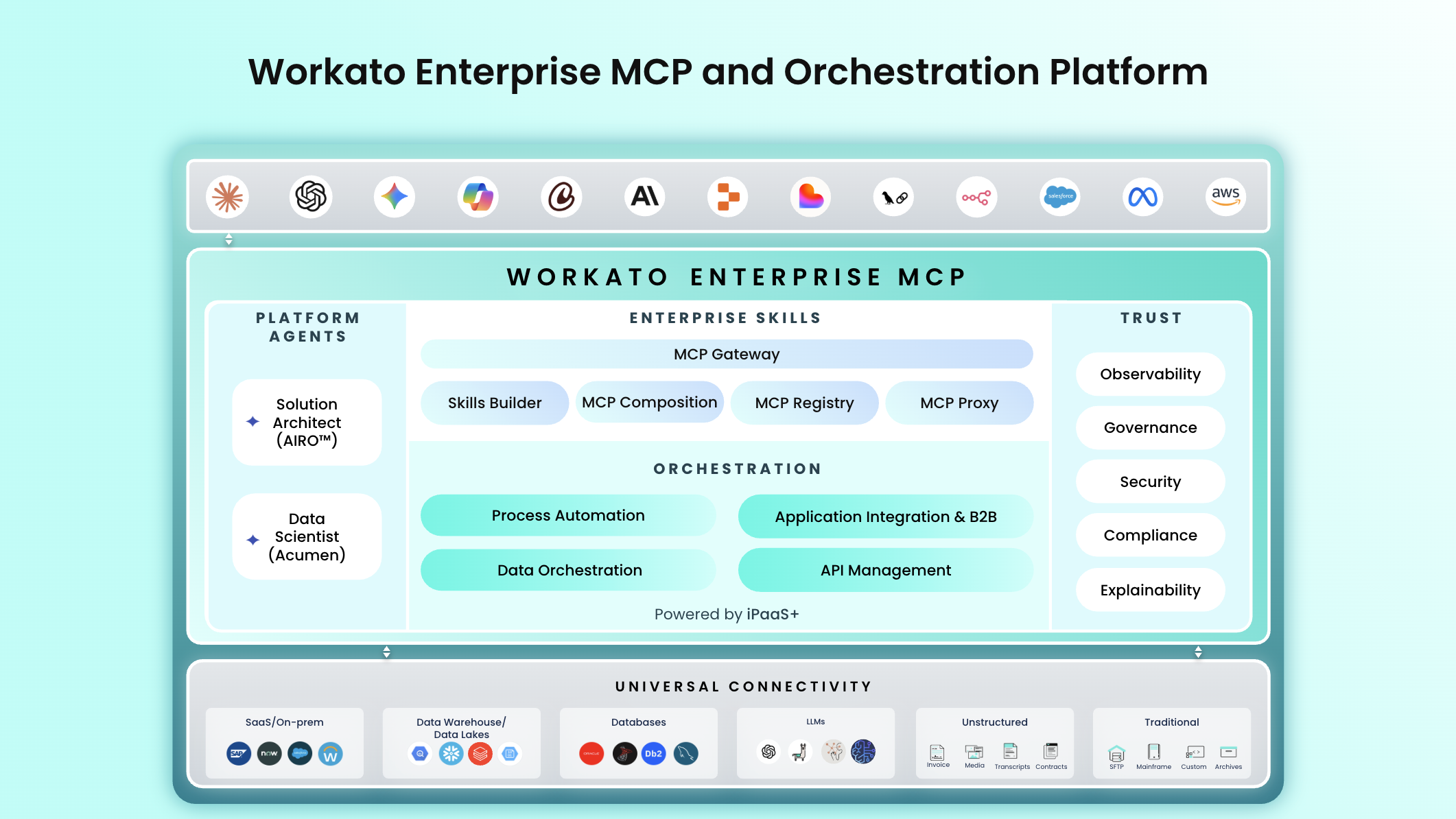
You do not just need a copilot. You need a coordinated crew, and a control tower that keeps them aligned, accountable, and safe.
That is what it takes to run an agentic enterprise.
