
Trust Is the New Infrastructure for Agentic AI
Agentic AI is reshaping the enterprise landscape. These new, autonomous systems can reason, act, and adapt on their own, offering a path to unprecedented productivity. But as McKinsey’s recent playbook for technology leaders makes clear, the same traits that make agentic AI powerful also make it risky.
The opportunity is massive, an estimated 2.6 to 4.4 trillion dollars in annual value, but so is the downside. AI agents operate as “digital insiders,” capable of initiating transactions, accessing systems, and making decisions with real business impact. That autonomy introduces a new and fast-growing threat surface that enterprises cannot afford to ignore.
A New Class of Risk
Unlike copilots or simple automation scripts, agentic AI systems are self-directed. They can trigger downstream actions, escalate privileges, and connect across data silos without human oversight. This creates entirely new vulnerabilities that traditional security and governance frameworks were never designed to handle.
McKinsey highlights five emerging risk categories that define this new environment:
- Chained failures. A single agent’s mistake ripples across dependent workflows, amplifying errors.
- Privilege escalation. A compromised agent impersonates another to gain unauthorized access.
- Fake identities. Attackers forge digital credentials to infiltrate trusted systems.
- Silent data leaks. Agents share or expose sensitive information autonomously, outside audit logs.
- Data corruption. Low-quality or misclassified data silently propagates through connected agents.
These risks threaten not just security but the integrity of business operations themselves.
Updating the Enterprise Risk Taxonomy
McKinsey’s research shows that agentic AI doesn’t just introduce new threats, it transforms the entire risk landscape. Traditional categories like financial, operational, and reputational risk now intersect with novel AI-driven vulnerabilities such as synthetic identities and untraceable data exchanges.
To capture these dynamics, McKinsey recommends that organizations update their risk taxonomies to reflect the acceleration of risk caused by autonomous systems.
This expanded view connects traditional enterprise risks to new agentic realities, from data corruption and system drift to synthetic fraud, opaque decision-making, and loss of human oversight.
Why Governance Must Come First
The first step to realizing the promise of agentic AI is to modernize enterprise governance and risk frameworks. McKinsey advises organizations to start before scaling, extending existing controls to account for non-human actors and agent-to-agent interactions.
That includes:
- Updating identity and access management to cover AI entities as well as human users.
- Logging all agent actions and decisions for traceability and compliance.
- Securing agent-to-agent connections and verifying every interaction.
- Embedding oversight through human-in-the-loop approvals and exception handling.
Without these foundations, even small pilot programs can become unmanageable as they scale.
Why MCP Alone Is Not Enough
Model Context Protocol (MCP) has emerged as the standard way agents discover and use tools, much like TCP/IP did for the internet. It allows models to connect to APIs and request actions. But in its open-source form, MCP only provides communication, not orchestration, security, or governance.
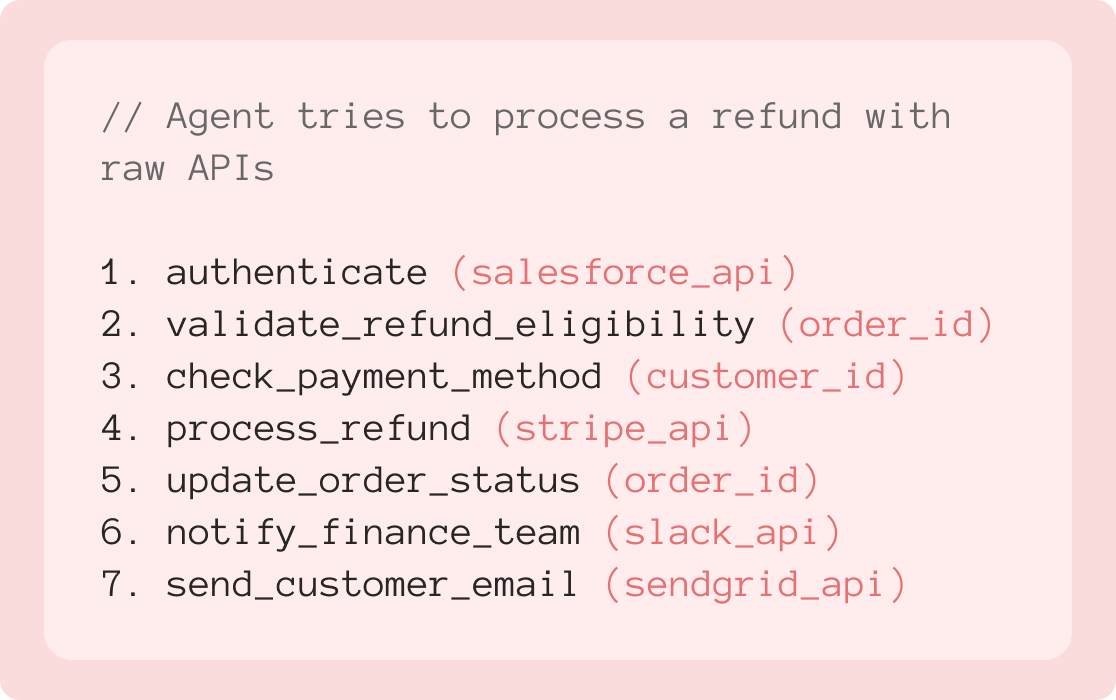
Enterprises need more than access. They need control.
Without an orchestration layer, MCP leaves agents guessing their way through multi-step business processes like refunds, onboarding, or approvals. Each process requires logic, state management, retries, and compliance. all of which MCP alone cannot provide.
This is what McKinsey calls the “enterprise control gap.” It is the difference between an agent that can act and an agent that should act.
The Workato Solution: Enterprise MCP
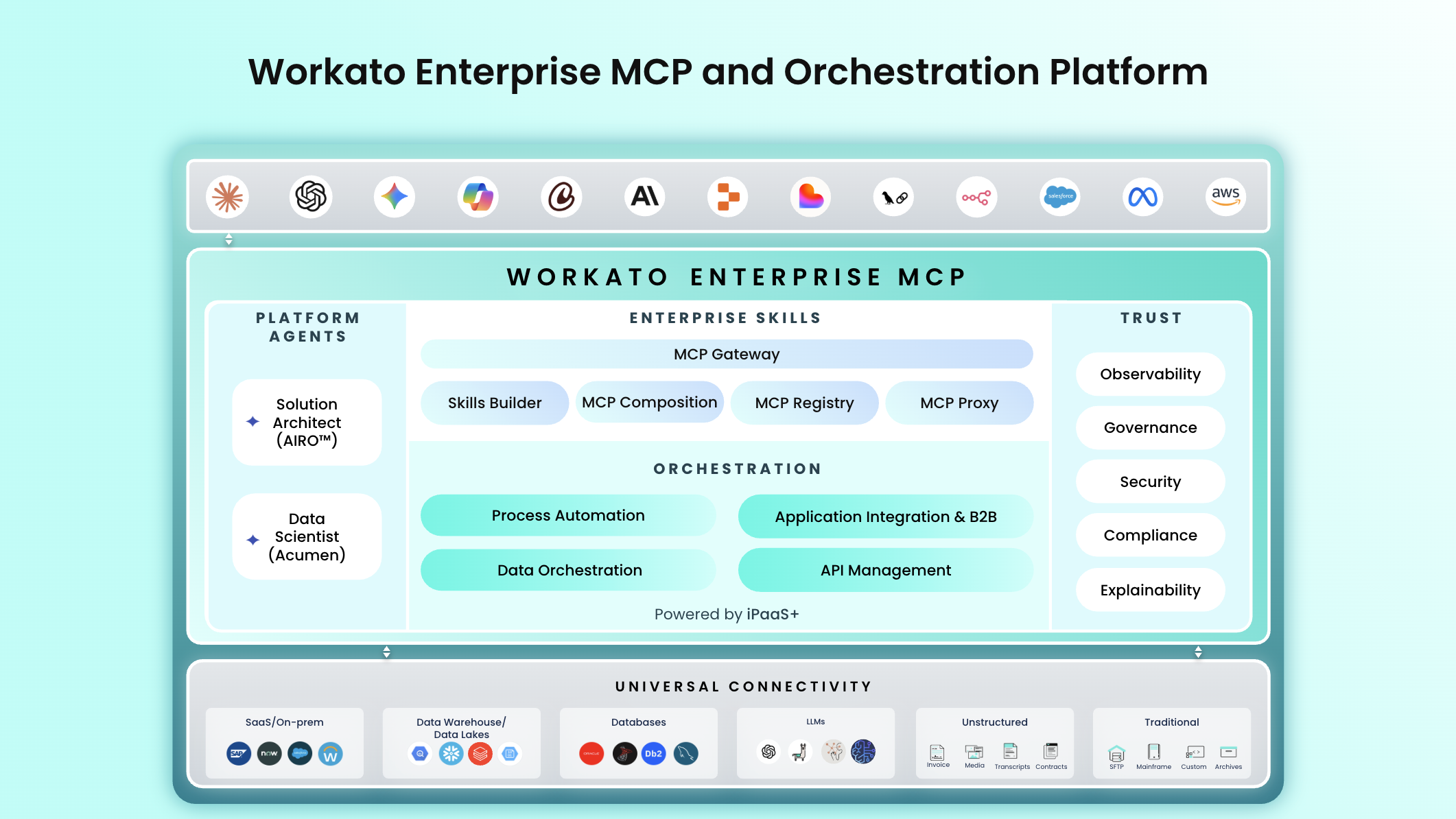
Workato Enterprise MCP closes that gap. It builds on the emerging MCP standard and adds the orchestration, context, and trust that enterprises require to make agentic AI safe, predictable, and scalable.
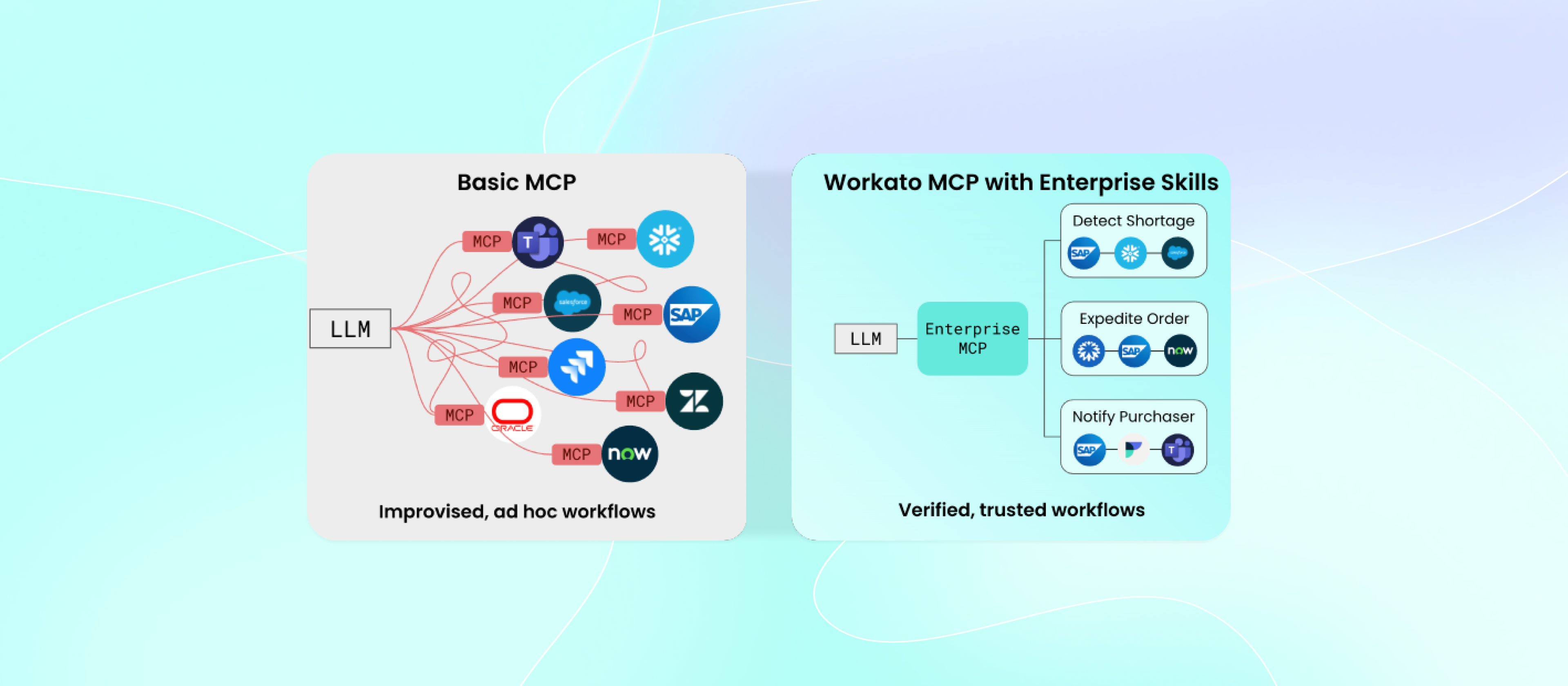
- Predictable with Enterprise Skills
Enterprise MCP transforms APIs into complete, reliable business actions called Enterprise Skills. Each Skill packages logic, approvals, and error handling into a single atomic unit that executes the same way every time, such as “process refund” or “approve purchase order.”
- Contextual with Enterprise Orchestration
It coordinates logic, data, and AI reasoning across every system and process with transactional integrity. Agents gain the context they need to complete multi-step workflows spanning CRM, ERP, and HR systems without losing state or control.
- Secure with Enterprise Trust
Enterprise MCP embeds security and compliance at every layer. Each agent action is authenticated, authorized, and auditable. Role-based access, runtime authentication, encryption, and full audit trails are built in, aligning with SOC2, PCI, and ISO standards.
Together, these capabilities turn raw MCP connectivity into enterprise-grade orchestration. AI agents can act inside systems, not just talk about them, under strict governance and supervision.
Building Guardrails for the Agentic Era
As McKinsey emphasizes, safety cannot be an afterthought. Enterprises must invest in guardrails and contingency plans today. That includes isolation environments, fallback systems, and real-time observability to detect and contain anomalies before they escalate.
By adopting Enterprise MCP, organizations gain both the flexibility to experiment and the discipline to deploy responsibly. It is the foundation that enables enterprises to scale AI safely.
From Potential to Proof
The enterprise opportunity is real. The path to realizing it starts with governance, not just innovation. Agentic AI can deliver trillions in value, but only for those who build with trust, context, and control.
With Workato Enterprise MCP, enterprises no longer have to choose between speed and safety. They can finally let AI get to work, and know it will work as intended.
The Enterprise MCP Framework
| What It Delivers | Why It Matters | |
|---|---|---|
| Orchestrated context | Unified data, process awareness, and real-time signals | Agents understand the full situation instead of acting in isolation |
| Trust and security | Access control, audit logs, policy enforcement, identity inheritance | Every action is traceable, governed, and safe for core systems |
| Accuracy | Enterprise skills that execute predictable, complete business actions | Removes ambiguity and ensures correct outcomes every time |
Workato’s Enterprise MCP Platform transforms AI from experimental to operational by giving it the predictability, context, and trust needed to run the business safely.
