
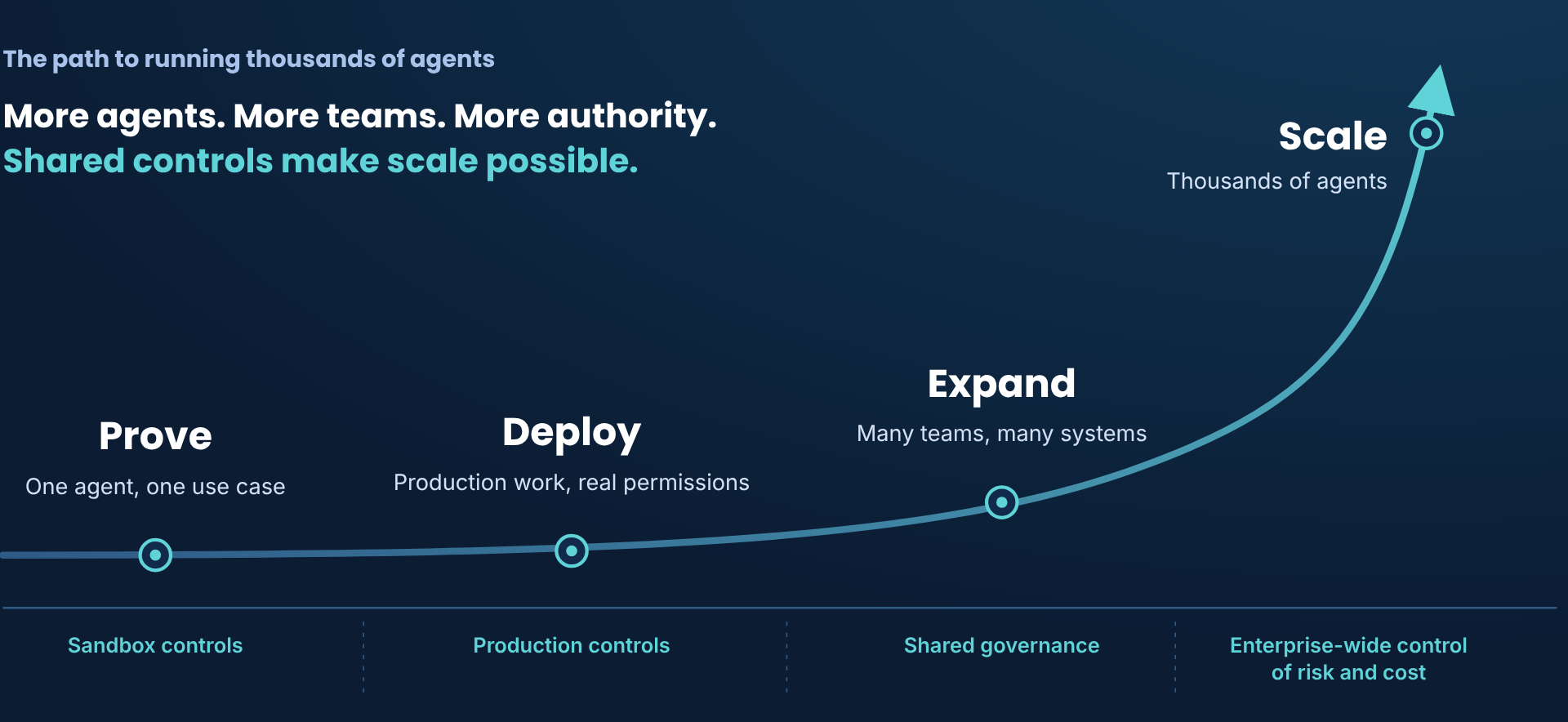
Know every agent. Govern every action. Control the cost of scale.
A successful pilot proves an agent can do useful work. The harder test comes next: one successful agent becomes fifty, built by ten teams, on different platforms, touching systems none of them own.
Picture the operating review where that happens. Finance asks what is driving AI spend. Security asks which agents can change business records. The business sponsor asks who can shut one down if it misbehaves. Each answer lives in a different platform, so each question becomes an investigation. The immediate response is often to slow down, and the next deployment waits for another review.
The deeper risk isn’t one misbehaving agent. It’s that every new team invents its own identity scheme, negotiates its own credentials, and stitches together its own audit trail. Each deployment is controlled by hand, so the AI program never becomes a platform.
The question isn’t how to control agent number one. It’s how to control agent number fifty, built by team number ten, without rebuilding the foundation each time.
In this guide
Start with the requirements: Know Your Agents
Know Your Agents, or KYA, defines what every agent on the platform must carry, regardless of team, framework, or runtime. Make these the minimum operating requirements for every production agent: five answers grouped into three jobs.
Know it: its identity and owner, and its role and scope.
Bound it: its authority, and the budgets and quotas that constrain its consumption.
Verify it: traceability for what it actually did, and under whose authority.
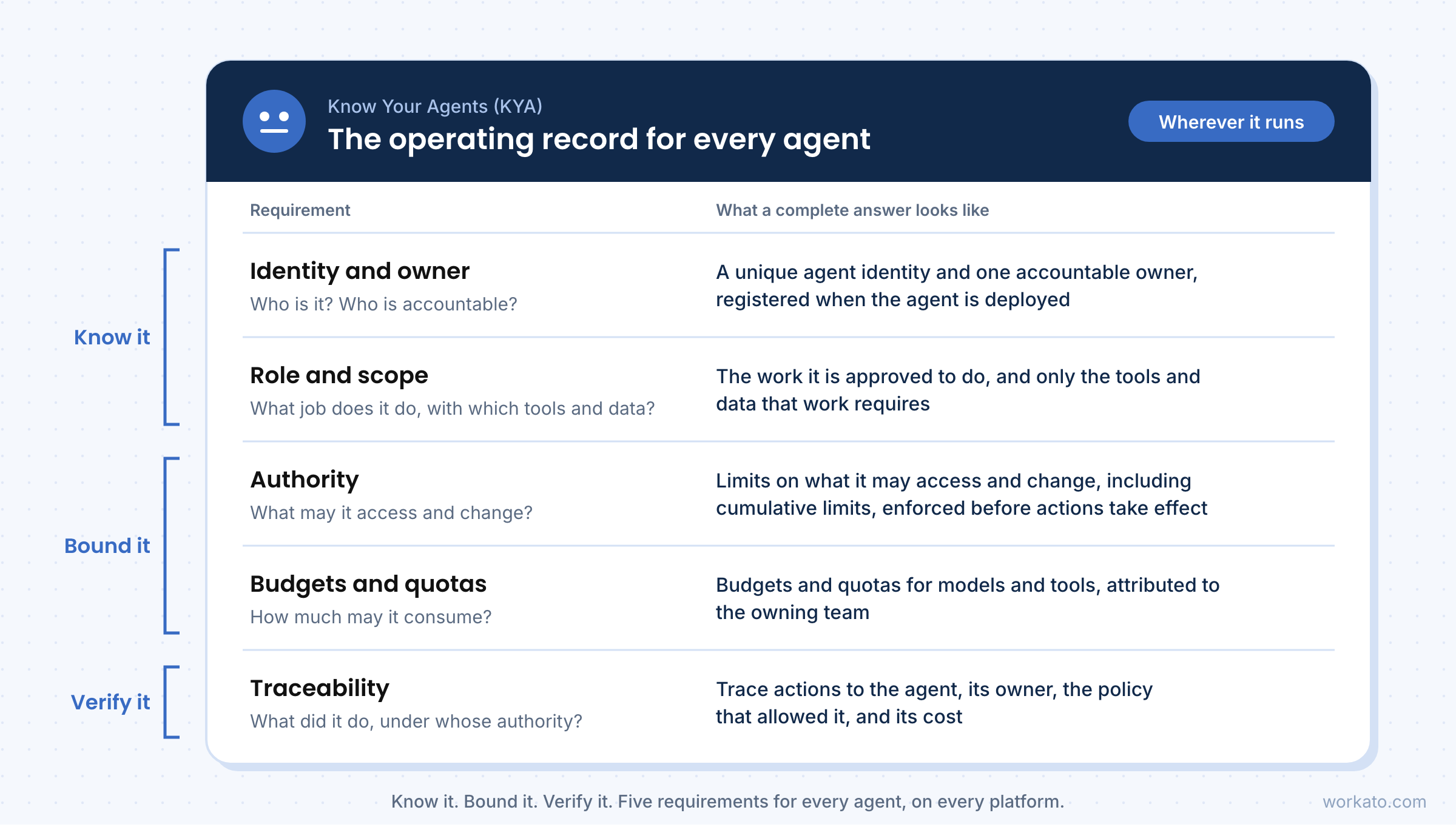
Five answers every agent should carry, wherever it runs.
None of these requirements is new on its own. Identity teams manage credentials, Finance manages budgets, and application owners manage permissions. What’s new is that every agent needs all five, consistently, at the speed agents are copied and deployed. A platform provides reusable controls that each workload inherits and validates.
KYA can support broader AI governance programs by making agent ownership, authority, consumption, and activity explicit. It complements frameworks such as NIST AI RMF and management systems such as ISO/IEC 42001; it does not replace their broader requirements.
Why the requirements are harder than they look
Follow one customer-support agent through its first year.
Month one. A support team builds an agent to summarize customer tickets. A regional team builds nearly the same one. Neither knows the other exists, and each connects to customer data with its own credentials and owner. Know it has slipped before anything has gone wrong.
By month four, the agent can update customer records. By month eight, it can issue refunds.
The agent’s identity has not changed. Its authority has—and so has the potential impact of a mistake.
The business lets the agent auto-approve eligible refunds under $500. Finance policy is just as clear: any day’s refunds above $250,000 need Finance approval, to preserve oversight of large cash outflows. The implementation checks each refund but never checks the daily total. Then a pricing error makes 30,000 orders eligible. In one day, the agent issues 30,000 refunds of $400 each. Every individual check passes. The agent releases $12 million, $11.75 million beyond its delegated authority.
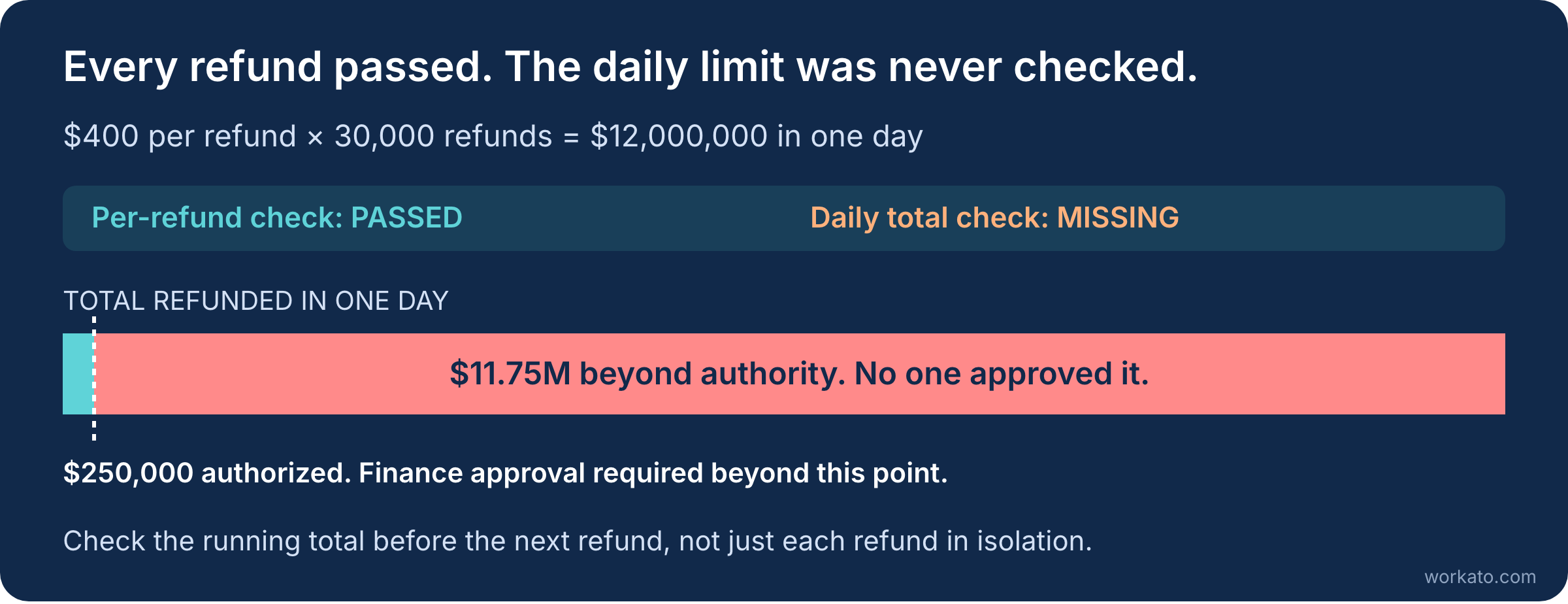
Every check was correct. The missing check was the total.
The issue is not whether customers deserve the refunds. It is whether the agent can release that amount without Finance approval.
The daily limit must be enforced before the next refund, including under retries and concurrent requests. Model consumption needs its own controls.
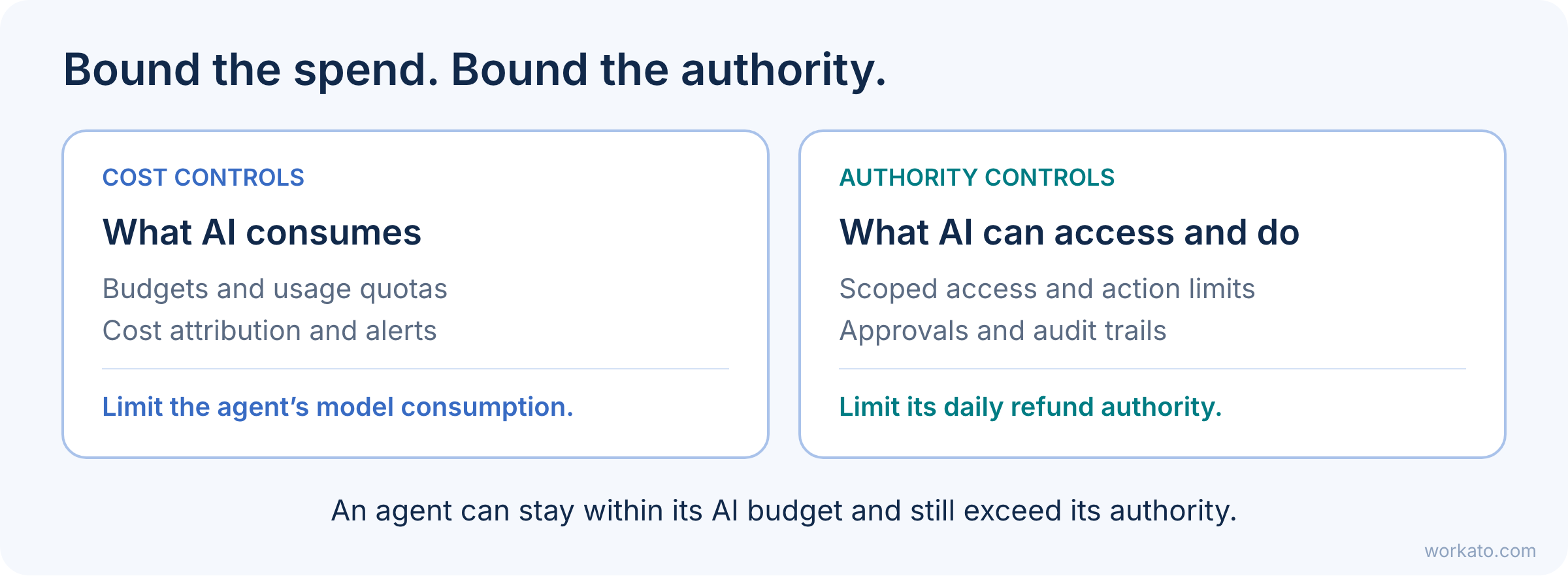
Cost controls and authority controls answer different questions. You need both.
The same agent can also make repeated model calls while retrying failed work. Finance needs to see which team owns that consumption, while the platform team needs limits on retries and usage—and separate enforcement of any monetary budget.
Month eleven. A customer disputes a refund. Who owned the agent? Whose authority did it use? Which policy allowed the refund, and what did it cost? Verify it is where fragmented answers show.
Where the answers live today
Try answering those questions in most enterprises today. Identity sits in the identity provider, model spend with the model provider, refund rules in the order system, and activity in a logging tool. Each system answers for its own piece.
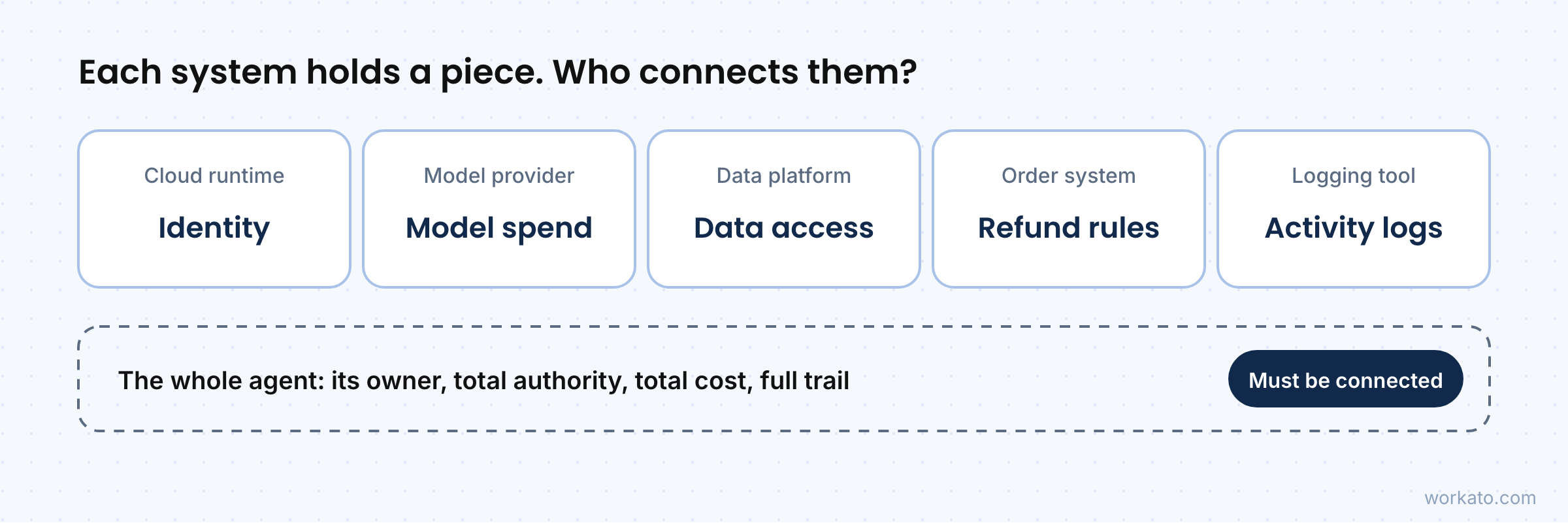
The enterprise needs a connected view of identity, authority, cost, and activity.
Each platform can answer for its managed scope. The enterprise still needs a connected answer for the whole agent.
These approaches overlap, and several already extend beyond their original platforms. The question is which controls cover your actual workloads—and where your team still has to connect identity, authority, cost, and evidence.
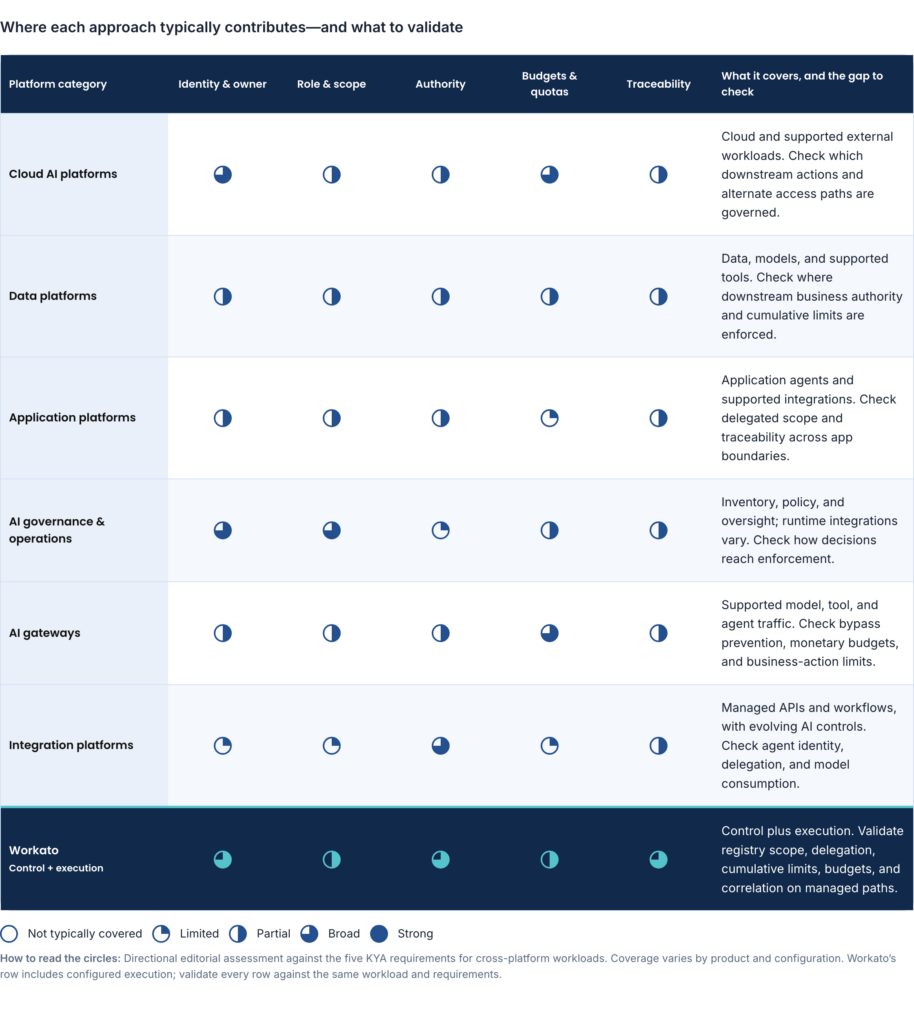
How to read the circles: Directional editorial assessment against the five KYA requirements for cross-platform workloads. Coverage varies by product and configuration. Workato’s row includes configured execution; validate every row against the same workload and requirements.
For many enterprises, a multi-vendor AI environment is already the starting point. Functions choose different systems, and those systems increasingly include agents. Shared governance needs to work with those choices and their native controls.
Connecting them requires agreement on identities, policy ownership, consumption measures, and trace correlation. Without that, the answers may not line up. A neutral layer can reduce this integration work where its coverage fits. A custom layer is another option, with ongoing maintenance owned by your team.
Six patterns for an enterprise agent platform
These are the six patterns we would look for in an enterprise agent platform. None is specific to one vendor. Together they turn the five requirements into reusable controls that teams can apply and validate.
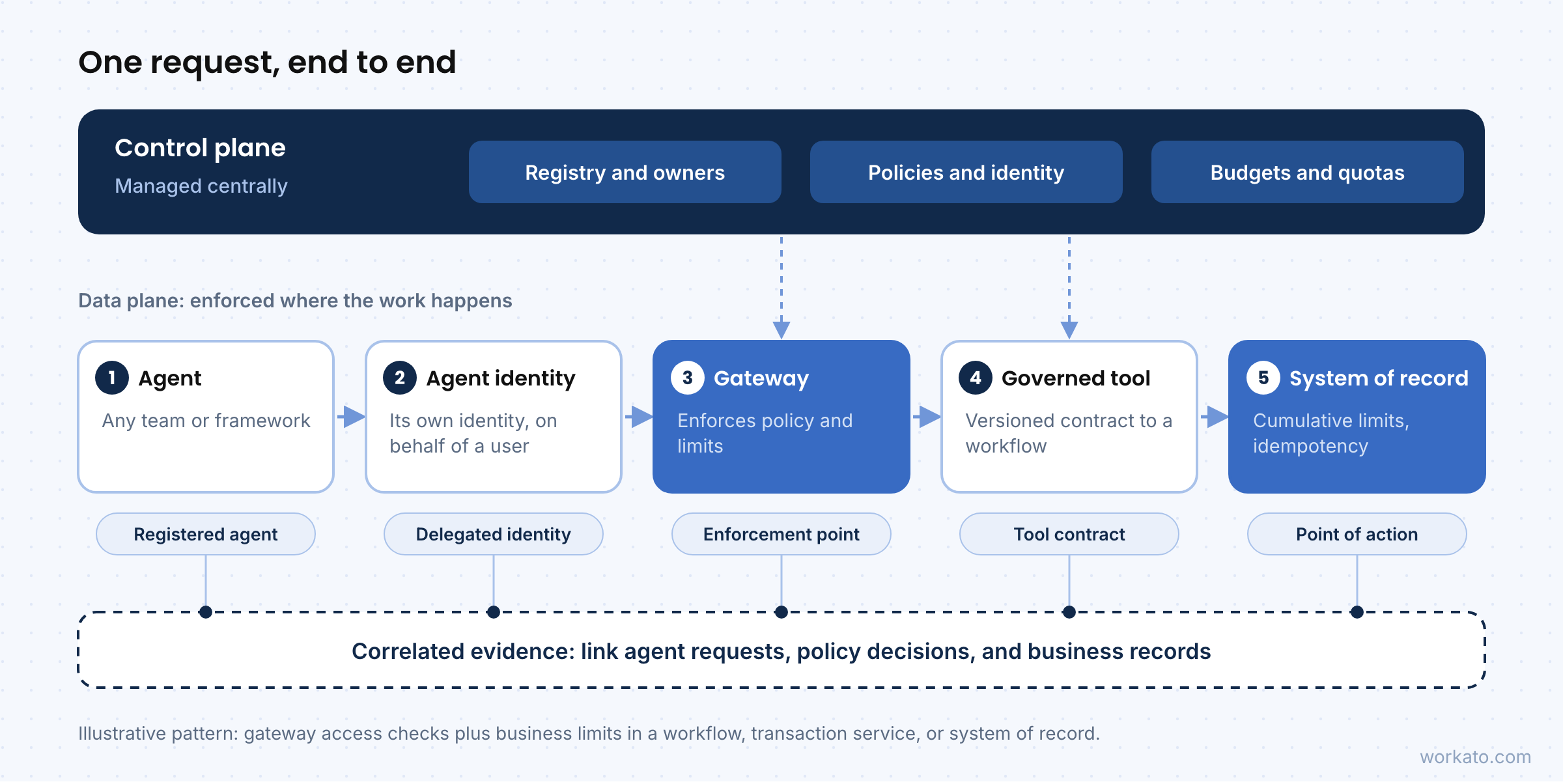
Control plane and data plane separation
Manage common requirements centrally, with workload-specific policies and enforcement at supported points close to the work. Central ownership doesn’t require a central runtime.
Supports: all five requirements
Gateways as policy enforcement points
Route model, MCP, agent, and API traffic through enforcement points that apply the relevant access, usage, and security policies to each type of traffic. Block prohibited bypasses and monitor exceptions; monitoring alone does not prevent an action. Review tool descriptions, inputs, and outputs for injection risks. Combine detection with least-privilege access, isolation, and restrictions on where data can be sent.
Supports: Bound it
Agent identity with delegation
Give every agent its own identity. Where downstream systems still use shared credentials, keep each action attributable to the agent and its owner. When it acts for a user, carry that context and explicitly enforce delegated scope at every hop; identity propagation alone does not constrain permissions.
Supports: Know it, Bound it
Governed tools as contracts
Expose business actions as approved, versioned tools backed by workflows, not as raw system credentials. Teams reuse the contract; owners change the implementation safely.
Supports: Bound it
Authority at the point of action
Enforce cumulative limits before an action takes effect, using an authoritative transaction service, workflow, or system of record. Coordinate concurrent requests and make retries idempotent; gateway access alone does not enforce the business limit.
Supports: Bound it
Correlated evidence
Correlate agent requests, policy decisions, tool calls, and business records using trace IDs or mapped identifiers. Validate that the evidence supports an end-to-end investigation.
Supports: Verify it
Five ways to test any agent platform
Ask any vendor, including us, to show these working on one of your workloads:
- Block an unapproved action, including a direct bypass, before anything changes.
- Follow a request from user to agent to tool, and verify that each hop enforces the delegated scope.
- Test consumption limits and cumulative action limits under retries and concurrency. Test monetary budget enforcement separately.
- Revoke the agent’s access and test propagation delays, active jobs, and alternate credentials on each relevant path.
- Rebuild one outcome end to end without guessing which records belong together.
Where Workato’s Enterprise AI Control Plane fits
Workato’s Enterprise AI Control Plane provides a shared foundation for KYA across supported assets and managed paths. Teams retain their chosen clouds, models, applications, and native controls. The AI Registry catalogs Agent Studio agents, MCP servers, and model routes from linked workspaces; gateways govern supported traffic.
Connect governance to the work agents perform. Workato combines gateway controls with reusable workflows exposed to agents as Enterprise Skills through MCP servers. For the refund agent, the gateway controls access to the tool. A configured skill checks eligibility, invokes an authoritative cumulative-limit check, routes exceptions for approval, and handles retries.
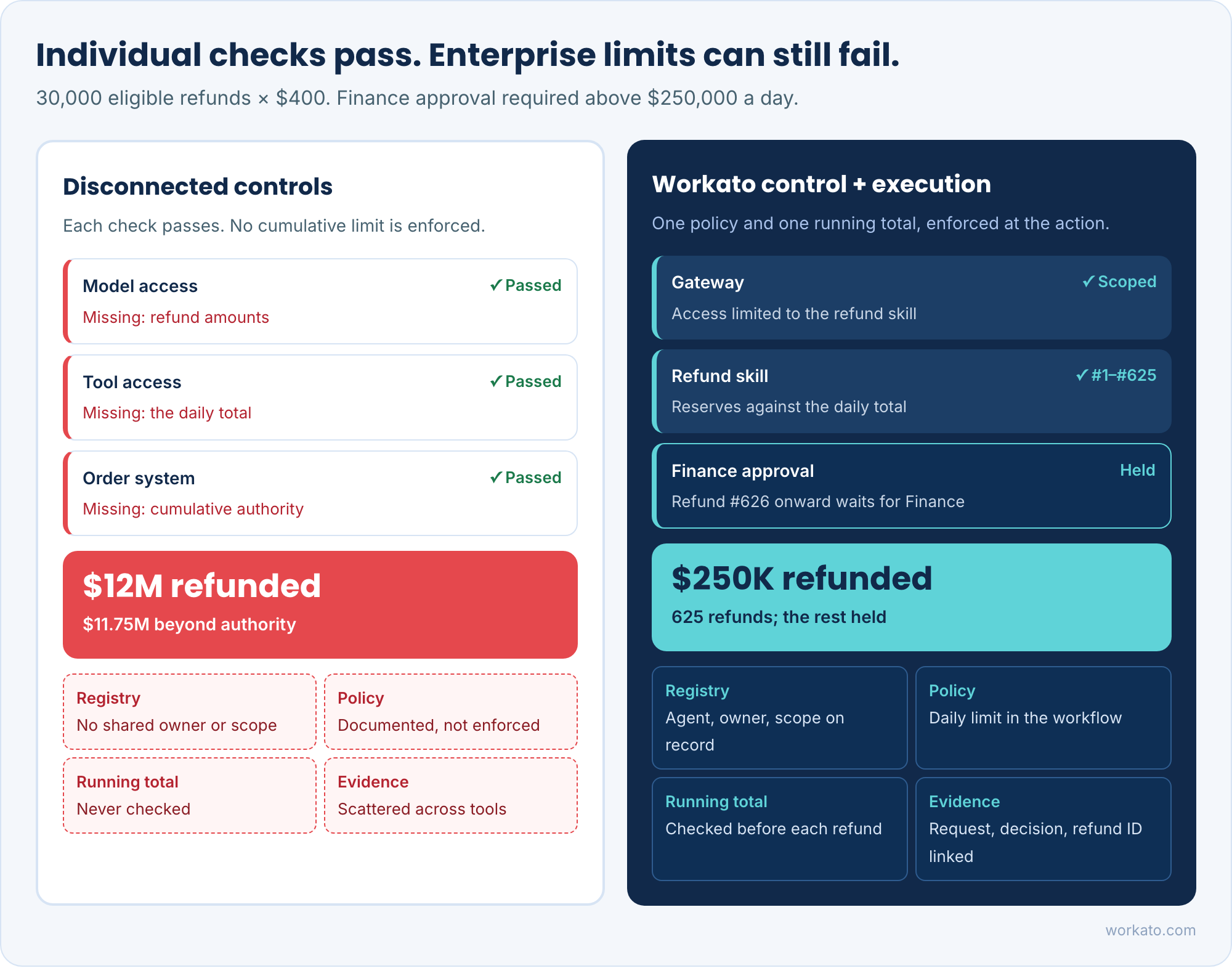
Other stacks can implement these controls. Workato combines governance and reusable execution on one platform. Illustrative configured workflow.
Other teams can reuse that business action with their own scoped access. They still validate permissions, limits, and failure handling for their workload. Where request identifiers and business-system results are captured and correlated, teams can trace the request through to its recorded outcome.
Customers can retain their existing execution systems and use Workato where business actions need coordinated execution across applications.
Customers remain responsible for assigning owners, defining workload authority and budgets, configuring business checks, and validating audit coverage. Token and rate limits constrain consumption; monetary budget enforcement is a separate requirement. Confirm supported cost reporting, attribution, and feature availability for the deployment.
Before putting any enforcement layer in the request path, Workato included, establish how it behaves under load and failure: the added latency for your workloads, whether each policy fails open or closed, how availability is delivered, and who operates it. Measure those on your own traffic as part of the architecture review.
Make the next team faster, with controls it can reuse
A regional support team using a different agent framework requests scoped access to the approved refund skill. It reuses the connections, eligibility checks, daily-limit enforcement, and approval process instead of rebuilding them.
The new agent gets its own identity and workload-specific limits, built on a shared control baseline. Its review focuses on changes in role, scope, and authority, and validates that the inherited controls remain appropriate. Reassess its risk tier when those change.
Choose the smallest combination that controls your material AI risks and costs. Give each component a clear responsibility, an owner, and a test that proves it works.
The test of an enterprise AI platform is what happens when the next team arrives. Can it reuse approved tools, inherit appropriate controls, and reach production without rebuilding the foundation?
That is how governance becomes an enabler of scale.
Put the five tests to work
Get the evaluation worksheet: the five KYA requirements, the questions to ask, and the five tests, ready to use with any vendor.
Want to see it live?
Bring one agent workflow, and we’ll map it against the five requirements with you.
Sources and scope notes
Capabilities vary by product, deployment, and configuration. The refund example is illustrative, not a customer result or a prebuilt Workato feature.
Workato controls apply to managed paths; assets outside the registry’s supported scope and traffic that bypasses the gateways need their own controls. Delegated scope must be enforced explicitly at each hop. Token and rate limits constrain consumption; confirm which cost-reporting, budget, and chargeback capabilities apply to your deployment.